Introduction
The internet has transformed how we create, share, buy, and consume digital content. But for most of its history, digital ownership has been surprisingly limited. When you purchase a digital game, subscribe to a platform, buy an in-game item, or create an online profile, you often receive permission to use something rather than true ownership of it.
Web3 proposes a different model.
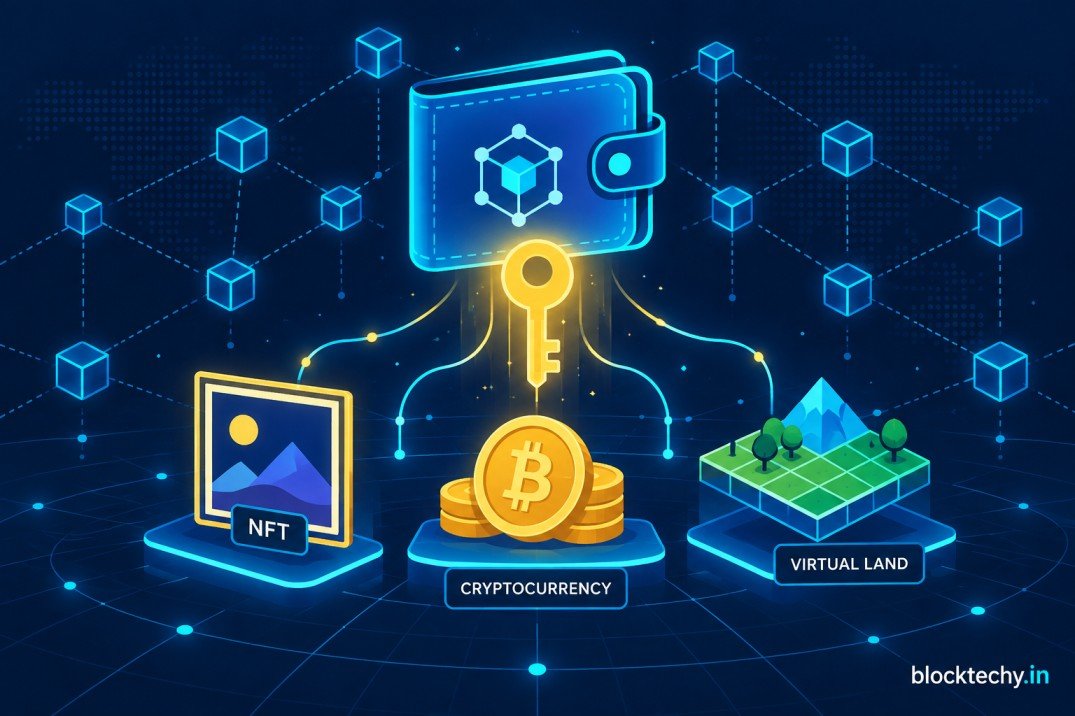
Powered by blockchain technology, cryptocurrencies, smart contracts, NFTs, and decentralized applications, Web3 introduces the concept of digital ownership—the ability to hold digital assets in a blockchain wallet and independently verify who controls them.
But what does “owning” something digitally actually mean? Can you really own an NFT, digital artwork, virtual land, cryptocurrency, or an online identity? And does blockchain ownership give you the same rights as owning a physical object?
The answers are more complicated than the marketing around Web3 sometimes suggests.
In this article, we will explore what digital ownership means, how blockchain enables it, what you can actually own in Web3, what you cannot own, and why digital ownership could become an important part of the future internet.
What Is Digital Ownership?
Digital ownership refers to having recognized control or rights over a digital asset.
In the traditional internet, ownership is usually controlled by centralized companies.
For example, consider a digital game. You might pay ₹2,000 for a game, but the publisher may still control the servers, your account, and the license that allows you to access the game.
Similarly, when you upload a photo to a social media platform, the platform controls the infrastructure where the content is hosted. Your account can potentially be suspended, restricted, or deleted.
Web3 attempts to change this relationship by separating ownership from platform access.
Instead of a company maintaining the only database that says you own an asset, a blockchain can maintain a public record of asset ownership.
Your wallet contains cryptographic keys that allow you to control blockchain assets.
This creates a new model:
Traditional Web → Platform controls digital assets
Web3 → User can directly control blockchain-based assets
However, there is an important distinction:
Owning a blockchain token does not automatically mean owning every piece of content or intellectual property associated with that token.
That distinction is critical when understanding Web3 ownership.
How Blockchain Makes Digital Ownership Possible
Blockchain networks are decentralized databases maintained by many computers.
When an asset is represented by a blockchain token, transactions involving that token can be recorded permanently on the network.
For example, suppose Alice owns an NFT.
The blockchain may contain information showing:
Token #123 → Wallet Address A
If Alice transfers the NFT to Bob:
Token #123 → Wallet Address B
Anyone can independently inspect the blockchain and verify the current token holder.
This is fundamentally different from a traditional centralized database.
In a centralized system, a company maintains the database.
In a blockchain system, ownership records can be verified by participants across the network.
This provides several important properties:
- Transparency
- Verifiability
- Programmability
- Transferability
- User-controlled wallets
- Reduced dependence on a single platform
Smart contracts make these assets even more powerful because they can automatically execute predefined rules.
What Can You Actually Own in Web3?
Web3 supports several different forms of digital assets.
Let’s examine them individually.
1. Cryptocurrencies
Cryptocurrency is one of the clearest examples of blockchain-based digital ownership.
Assets such as Bitcoin and other cryptocurrencies can be controlled through a blockchain wallet.
If you control the private keys associated with an address, you can generally authorize transactions involving the assets held at that address.
This creates the popular Web3 concept:
“Not your keys, not your coins.”
The idea is that keeping cryptocurrency in your own wallet can give you direct control instead of relying on an exchange.
However, self-custody also introduces responsibility.
If you lose your private key or seed phrase, recovering the assets may be extremely difficult or impossible.
Therefore, blockchain ownership is often closer to cryptographic control than traditional legal ownership.
2. NFTs
Non-fungible tokens, or NFTs, became one of the most visible examples of digital ownership.
Unlike cryptocurrencies, NFTs are designed to represent unique tokens.
An NFT might represent:
- Digital artwork
- Collectibles
- Memberships
- Event tickets
- Gaming items
- Certificates
- Virtual assets
- Digital identities
- Access rights
For example, an NFT collection might contain 10,000 unique tokens.
Each token can have its own identifier and metadata.
The blockchain records who controls each token.
But there is an important misconception about NFTs.
Owning an NFT Does Not Always Mean Owning the Artwork
Suppose you purchase an NFT representing a digital illustration.
You may own the NFT token, but the artist may still own the copyright.
Unless the associated license explicitly transfers copyright or grants specific commercial rights, buying the NFT generally does not automatically transfer all intellectual-property rights.
This is one of the most important concepts in digital ownership.
Token ownership ≠ copyright ownership
You can own the blockchain token while someone else owns the underlying intellectual property.
3. Digital Art
Web3 has created new ways for artists to sell digital artwork.
Before NFTs became popular, digital artists often struggled with the problem of scarcity.
A digital image can theoretically be copied thousands of times.
NFT technology doesn’t prevent copying the image.
Instead, it creates a blockchain-based record identifying a particular token associated with the artwork.
Think of it somewhat like owning an authenticated collectible.
Millions of people may be able to view or download an image, but a particular blockchain address may hold the recognized token associated with it.
This can give digital artists new ways to monetize their work.
Artists can potentially sell directly to collectors without relying entirely on traditional marketplaces.
4. Virtual Land
Another major concept in Web3 is virtual property.
Blockchain-based virtual worlds can represent pieces of virtual environments as NFTs.
These assets are sometimes described as virtual land.
A virtual land NFT could represent a specific location inside a blockchain-based game or metaverse.
Owners might use virtual land to:
- Build digital environments
- Host events
- Create games
- Display artwork
- Build virtual stores
- Offer interactive experiences
However, virtual land comes with an important limitation.
You don’t own a physical piece of Earth.
You own a blockchain token representing rights or status within a particular digital ecosystem.
If the project disappears, changes its rules, or stops maintaining its virtual world, the practical value of that token may change dramatically.
So virtual land ownership is often dependent on both:
Blockchain ownership + platform functionality
5. In-Game Assets
Gaming is another area where digital ownership could have major implications.
Traditional games usually keep game items inside centralized databases.
You may spend hundreds of hours earning a rare sword, skin, character, or vehicle, but the publisher ultimately controls the database.
Blockchain games can represent certain game items as tokens.
For example:
Player Wallet → NFT Sword → Game Character
The player can potentially transfer the NFT independently of the game interface.
This could enable new models such as:
- Player-to-player trading
- Digital marketplaces
- Cross-platform asset experiments
- User-created items
- Collectible gaming economies
However, interoperability is still a major challenge.
An NFT from one game doesn’t automatically work inside another game.
The receiving game must understand and support that asset.
6. Web3 Domains
Blockchain-based naming systems provide another interesting form of digital ownership.
Traditional domains such as:
example.com
are generally managed through centralized domain-registration systems.
Web3 naming systems can represent names as blockchain assets.
A blockchain domain might be used as:
- A wallet identifier
- A decentralized website address
- A payment identifier
- A digital identity
- A username
Instead of sending cryptocurrency to a long hexadecimal wallet address, a user might interact with a human-readable blockchain name.
This can make blockchain applications easier to use.
However, blockchain domains and traditional DNS domains are fundamentally different systems and shouldn’t automatically be treated as equivalent.
7. Digital Identity
One of the most interesting possibilities of Web3 is user-controlled identity.
Today, you might have dozens of accounts:
- Discord
- Gaming accounts
- Banking accounts
- Shopping accounts
Each platform controls your account.
Web3 introduces the concept of wallet-based identity.
A blockchain wallet can potentially act as a persistent identifier across decentralized applications.
For example:
Wallet → NFTs + Credentials + Reputation + Assets
Instead of creating a completely separate account for every application, users could connect their wallet.
This could make identity more portable.
However, wallets should not automatically be considered complete identities. Privacy, recovery, regulation, security, and user experience remain major challenges.
8. Tokenized Real-World Assets
Web3 ownership doesn’t have to remain purely digital.
Blockchain technology can also be used to represent claims or interests connected to real-world assets.
This is commonly called tokenization.
Potential examples include:
- Real estate
- Government bonds
- Company shares
- Commodities
- Collectibles
- Investment funds
The basic idea is:
Real-world asset → Legal agreement → Blockchain token
But tokenization doesn’t magically transfer legal ownership.
The relationship between a blockchain token and the underlying physical asset depends on contracts, laws, custodians, and the legal structure of the system.
Therefore, tokenization combines technical ownership with legal rights.
Blockchain Ownership vs Legal Ownership
This is perhaps the most important distinction in the entire digital ownership discussion.
There are at least three different concepts:
1. Technical Ownership
Who controls the blockchain asset?
2. Contractual Rights
What rights does the associated agreement give the holder?
3. Legal Ownership
What rights are recognized and enforceable under applicable law?
These three things can be different.
For example, you could own an NFT technically while having limited rights to the associated artwork.
Similarly, you could hold a token representing a real-world asset, while your legal rights depend on the contract and jurisdiction behind that token.
Therefore:
Blockchain verification does not automatically equal legal ownership.
What You Cannot Automatically Own in Web3
Web3 does not give users unlimited ownership of everything on the internet.
There are several important limitations.
Copyright
Buying an NFT does not automatically transfer copyright.
The creator may continue to control:
- Reproduction rights
- Commercial rights
- Licensing
- Distribution rights
The exact rights depend on the license.
Digital Files
Owning an NFT doesn’t necessarily mean owning the actual image, video, or music file.
The NFT may contain a link or reference to external metadata.
If that content is stored using centralized infrastructure and the infrastructure disappears, the experience associated with the NFT could potentially change.
This is why decentralized storage and content-addressed systems are important parts of Web3 infrastructure.
Platform Infrastructure
Owning a token doesn’t mean you own the website, blockchain, game server, or application displaying it.
A wallet might own an NFT, but a particular website could stop displaying it.
This distinction is often overlooked.
Why Digital Ownership Matters
The concept of digital ownership could have major implications for the internet.
Users Could Have Greater Control
Instead of platforms controlling every digital asset, users could directly hold certain assets in their wallets.
Assets Could Become Transferable
Blockchain-based assets can potentially be transferred between users without requiring a platform to manually update ownership records.
Digital Scarcity Becomes Possible
Blockchain tokens can create verifiable scarcity for digital assets.
Creators Could Monetize Directly
Artists, developers, musicians, and creators can potentially interact directly with collectors.
New Digital Economies Could Emerge
Gaming, virtual worlds, creator economies, decentralized finance, and digital communities could all use programmable ownership.
The Problems With Web3 Ownership
Digital ownership also introduces serious challenges.
Private Key Management
Self-custody means users become responsible for their security.
Lose the private key, and access to assets can potentially be lost.
Scams and Fraud
The Web3 ecosystem has experienced scams, phishing attacks, fake NFT collections, malicious smart contracts, and fraudulent projects.
Users must verify contracts and platforms carefully.
Smart Contract Bugs
Blockchain applications rely heavily on smart contracts.
A coding vulnerability can potentially result in significant financial losses.
Regulatory Uncertainty
The legal treatment of digital assets varies across countries and continues to evolve.
Scalability
Some blockchain networks can face congestion and transaction-cost issues.
Environmental Concerns
The environmental impact of blockchain depends heavily on the network’s consensus mechanism and infrastructure. Proof-of-stake systems generally have substantially different energy requirements from proof-of-work systems.
Is Web3 Really Decentralized Ownership?
The answer depends on the project.
A project may use blockchain while still relying heavily on centralized infrastructure.
For example:
Blockchain ownership + centralized website + centralized storage + centralized development team
is not fully decentralized.
True decentralization can involve multiple layers:
- Blockchain network
- Smart contracts
- Storage
- Frontend
- Governance
- Identity
- Infrastructure
Therefore, users should examine the entire architecture rather than assuming that something is decentralized simply because it uses NFTs or blockchain.
The Future of Digital Ownership
The future of digital ownership is unlikely to be simply “everything becomes an NFT.”
Instead, blockchain technology may become one component of a broader digital ownership infrastructure.
We could see blockchain-based ownership used for:
- Digital credentials
- Event tickets
- Loyalty programs
- Gaming assets
- Creator memberships
- Financial assets
- Digital identity
- Intellectual-property licensing
- Real-world asset tokenization
- Decentralized communities
The most successful applications may be those where blockchain solves a genuine ownership or coordination problem rather than simply adding a token to an existing product.
Digital Ownership and the Next Generation of the Internet
The traditional internet made information extremely easy to copy.
Web3 attempts to introduce another layer:
verifiable digital ownership.
Instead of asking only:
“Can I access this?”
users may increasingly ask:
“What do I actually own?”
This is a major conceptual shift.
A blockchain can prove that a particular wallet controls a particular token. Smart contracts can define rules around that token. Decentralized infrastructure can potentially reduce dependence on centralized platforms.
But ownership is still more complicated than simply holding a token.
The real question is:
What rights does the token give you?
That could mean control over cryptocurrency, ownership of an NFT, access to a community, rights defined by a legal agreement, or simply recognition as the holder of a digital collectible.
Final Thoughts
Digital ownership is one of the most important ideas introduced by Web3.
Blockchain technology provides a way to create publicly verifiable records of who controls digital assets without requiring every transaction to be recorded in a company’s private database.
You can potentially own cryptocurrencies, NFTs, blockchain-based collectibles, virtual assets, digital names, and tokenized representations of other assets.
But Web3 ownership has limits.
Owning a token does not automatically mean owning the underlying file, copyright, company, physical object, or platform.
Understanding this distinction is essential.
The future of digital ownership will likely depend on the combination of blockchain technology, smart contracts, decentralized infrastructure, legal frameworks, digital identity, and user-controlled wallets.
Web3 may not completely replace the traditional internet. Instead, it could add an ownership layer to parts of the internet that previously relied almost entirely on centralized platforms.
The biggest question isn’t simply whether you can own something on the internet.
It is:
What rights, control, and permanence come with that ownership?
As Web3 infrastructure develops, answering that question will become increasingly important for users, creators, developers, businesses, and digital communities.
Frequently Asked Questions
What does digital ownership mean in Web3?
Digital ownership in Web3 generally means having verifiable control over a blockchain-based asset through a wallet and its cryptographic keys.
Does owning an NFT mean I own the artwork?
Not necessarily. You generally own the NFT token itself, while copyright and other intellectual-property rights may remain with the creator unless the applicable license says otherwise.
Can cryptocurrency be considered digital property?
Cryptocurrency is a blockchain-based digital asset that can be controlled through cryptographic keys. The legal treatment of cryptocurrency varies by jurisdiction.
Can I own virtual land?
You can own a blockchain token representing virtual land in a particular digital ecosystem. However, the practical rights associated with that token depend on the project’s rules and infrastructure.
Is Web3 ownership permanent?
Blockchain records can provide strong persistence, but the overall experience and utility of an asset can depend on smart contracts, websites, storage systems, projects, and legal arrangements.
Why is digital ownership important?
Digital ownership could give users greater control over certain digital assets and enable new models for creators, games, communities, identity, and financial applications.
Is blockchain ownership the same as legal ownership?
No. Blockchain ownership describes control recorded on a blockchain, while legal ownership depends on applicable laws, contracts, and rights recognized by courts or regulators.