Introduction
For decades, humanoid robots have existed mainly in science fiction. Movies, TV shows, and futuristic stories have imagined robots that walk like humans, understand conversations, perform complex tasks, and even work alongside people.
Today, that future is becoming increasingly realistic.
Rapid developments in artificial intelligence, computer vision, robotics, machine learning, sensors, batteries, and advanced computing are helping engineers build humanoid robots capable of operating in environments designed for humans.
Companies around the world are developing robots that can walk, pick up objects, move boxes, navigate spaces, use tools, and respond to voice instructions. Some are being developed for factories and warehouses, while others are being designed for research, healthcare, logistics, and eventually homes.
But an important question remains:
How close are we really to a robot-powered world?
The answer is complicated. Humanoid robots have made remarkable progress, but creating a robot that can reliably perform the wide range of tasks humans do every day remains an enormous engineering challenge.
Let’s explore how far humanoid robotics has come, what is driving its development, the challenges that remain, and what the future could look like.
What Is a Humanoid Robot?
A humanoid robot is a robot designed to have a body structure that resembles the human body.
Typically, this includes:
- A head or camera system
- Two arms
- Two hands
- A torso
- Two legs
- Sensors for understanding the environment
- Computers for processing information
- Motors and actuators for movement
The human-like shape is not simply about appearance.
Many workplaces and buildings are already designed around human bodies. Stairs, doors, shelves, tools, vehicles, machines, and workstations are built for people.
A robot with a human-like body could potentially use the same infrastructure without requiring an entirely new environment.
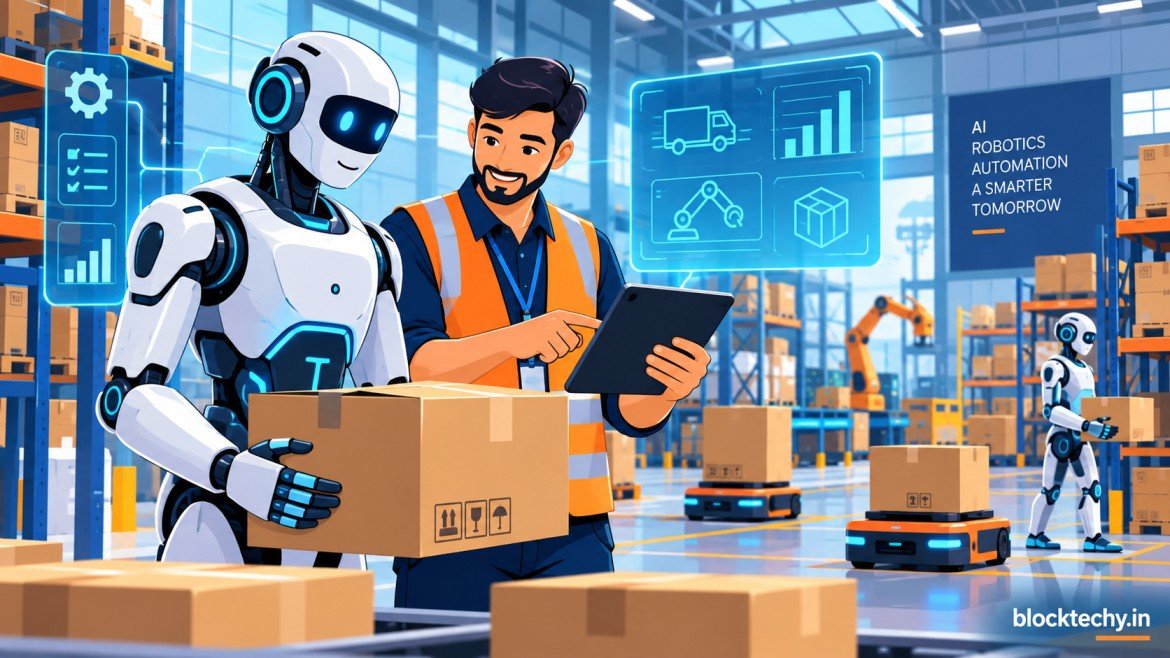
For example, instead of redesigning a warehouse for a specialized machine, a humanoid robot could potentially walk through existing spaces, pick up boxes, use equipment, and interact with objects designed for human workers.
Why Are Humanoid Robots Suddenly Becoming Popular?
Humanoid robots have been researched for many years, so why are they receiving so much attention now?
One major reason is the rapid improvement of artificial intelligence.
Traditional robots usually perform predefined actions. They can be extremely good at repetitive tasks, but they generally require carefully structured environments and programming.
Modern AI systems are changing this model.
Large AI models can process language, images, video, and other forms of information. When these capabilities are combined with robotics, machines can potentially understand instructions and adapt their actions to changing environments.
For example, instead of programming a robot with hundreds of individual instructions, a future system might receive a high-level instruction such as:
“Move these packages to the storage area.”
The AI system could then interpret the environment, identify the packages, plan a route, determine how to pick them up, and execute the task.
This combination of AI + robotics is one of the biggest reasons humanoid robots are attracting investment and research.
The Technologies Behind Humanoid Robots
Building a useful humanoid robot requires several technologies to work together.
1. Artificial Intelligence
AI acts as the robot’s decision-making layer.
Modern robotics research increasingly uses machine learning to help robots understand environments and learn movements.
AI can help robots with:
- Object recognition
- Voice commands
- Navigation
- Movement planning
- Decision-making
- Task execution
- Environmental understanding
The long-term goal is to create robots that can learn new tasks without requiring engineers to manually program every movement.
2. Computer Vision
Humans constantly use their eyes to understand the world.
Robots need a similar capability.
Cameras and other sensors allow robots to detect:
- People
- Objects
- Walls
- Floors
- Stairs
- Vehicles
- Tools
- Obstacles
Computer vision algorithms can then convert visual information into data that the robot can use for decision-making.
This is particularly important because the real world is unpredictable.
A box may not always be in exactly the same position. Lighting can change. People can move unexpectedly. Objects can fall.
A useful humanoid robot needs to handle these situations safely.
3. Sensors
Humanoid robots use many types of sensors.
These can include cameras, depth sensors, force sensors, position sensors, microphones, and other sensing technologies.
Sensors help robots understand their surroundings and their own physical condition.
For example, sensors can help a robot determine whether it is:
- Standing correctly
- Losing balance
- Touching an object
- Applying too much force
- Approaching an obstacle
This information is essential for safe movement.
4. Advanced Actuators and Motors
A human body has hundreds of muscles and joints that allow incredibly precise movement.
Robots need mechanical systems capable of producing similar movements.
Motors and actuators control the robot’s:
- Arms
- Hands
- Legs
- Hips
- Knees
- Feet
- Head
The challenge is creating systems that are simultaneously strong, precise, efficient, reliable, and lightweight.
5. Batteries and Energy Systems
Battery technology is another major limitation.
Humanoid robots need significant energy to move their bodies, process sensor data, run computers, and perform physical tasks.
A robot may be impressive in a laboratory but much less useful if it can only operate for a short period before needing to recharge.
Improved batteries and energy-efficient hardware will therefore be important for large-scale deployment.
Where Are Humanoid Robots Being Used?
Humanoid robots are still developing, but several industries are exploring their potential.
Manufacturing
Factories are one of the most promising environments for humanoid robots.
Manufacturing facilities often involve repetitive physical tasks such as:
- Moving components
- Sorting materials
- Carrying objects
- Inspecting products
- Supplying workstations
Because factories are relatively controlled environments, they may be easier for robots to operate in compared with homes.
Warehouses and Logistics
Warehouses contain thousands of repetitive physical tasks.
Robots could potentially move packages, organize inventory, transport materials, and perform other physical operations.
Humanoid designs could be useful where warehouses already contain infrastructure designed for humans.
However, specialized warehouse robots may remain more efficient for certain specific tasks.
Healthcare
Healthcare is another possible application.
Future robots could potentially assist with tasks such as:
- Moving supplies
- Transporting equipment
- Supporting hospital logistics
- Assisting elderly people
- Performing routine physical tasks
However, healthcare requires extremely high levels of safety and reliability.
A robot working near vulnerable people cannot simply be “mostly correct.”
It needs to behave predictably.
Construction
Construction sites are physically demanding and can contain dangerous environments.
Humanoid robots could eventually help with tasks such as carrying materials, inspection, and repetitive physical work.
The ability to operate tools and navigate environments designed for humans could make humanoid robots particularly interesting for this industry.
Retail and Hospitality
Robots could eventually assist with:
- Stocking shelves
- Moving products
- Cleaning
- Delivering items
- Basic customer assistance
However, interaction with people introduces additional challenges because public environments are unpredictable.
What Makes Humanoid Robots So Difficult to Build?
Despite impressive demonstrations, humanoid robotics remains extremely difficult.
One of the biggest challenges is general-purpose intelligence in the physical world.
A human can learn a new task quickly.
Suppose someone asks you to pick up an unfamiliar object.
You can look at it, estimate its size and weight, decide how to hold it, and adjust your grip if it starts slipping.
A robot needs to perform many of these steps computationally.
The Problem of Balance
Walking on two legs is surprisingly complicated.
Humans continuously adjust their balance while walking.
Robots need to do the same using sensors, algorithms, motors, and real-time control systems.
A small error can cause a robot to lose balance.
Walking on a flat laboratory floor is one challenge.
Walking over uneven ground, stairs, wet surfaces, clutter, or outdoor environments is significantly harder.
The Hands Are One of the Biggest Challenges
Human hands are incredibly sophisticated.
We can hold fragile objects, rotate tools, open containers, type on keyboards, tie shoelaces, and manipulate tiny components.
Creating robotic hands that can perform a similarly broad range of tasks is extremely difficult.
The challenge isn’t simply creating fingers.
Robotic hands need:
- Precise movement
- Force control
- Tactile sensing
- Mechanical durability
- Fast response
- AI-based control
Progress in robotic hands could become one of the most important developments for general-purpose humanoid robots.
Can Humanoid Robots Think Like Humans?
Not exactly.
Modern AI can perform impressive tasks, but an AI system is not simply a human brain inside a machine.
Robots need to combine multiple systems:
Perception → Reasoning → Planning → Movement → Feedback
For example:
- The robot sees a cup.
- It identifies the cup.
- It determines where the cup is located.
- It plans how to reach it.
- It moves its arm.
- It adjusts its hand position.
- It applies an appropriate amount of force.
- It checks whether it successfully picked up the cup.
All of this needs to happen quickly.
The closer robots get to performing these processes reliably, the more useful they become.
Humanoid Robots and Jobs
One of the biggest questions surrounding humanoid robots is their impact on employment.
If robots become capable of performing more physical tasks, some jobs could change significantly.
Industries involving repetitive physical work may experience greater automation.
However, this does not necessarily mean that every human job will disappear.
Technology often changes the nature of work rather than simply eliminating every task.
New roles could emerge around:
- Robot maintenance
- Robot programming
- AI training
- Robotics engineering
- Safety
- Robot fleet management
- AI supervision
- Robot system integration
At the same time, some workers may need new skills to work alongside increasingly capable machines.
The transition could therefore involve both opportunities and disruption.
Will Humanoid Robots Replace Humans?
A complete replacement of humans is unlikely in the near term.
Humans are extremely flexible.
We can learn new tasks quickly, communicate socially, improvise, understand context, and operate in unfamiliar environments.
Robots are becoming more capable, but they still have significant limitations.
A more realistic future may involve humans and robots working together.
For example:
A human could make decisions and supervise a process while robots perform repetitive or physically demanding tasks.
This could create a hybrid workforce in which machines handle certain physical operations while humans focus on tasks requiring creativity, judgment, communication, and complex decision-making.
The Role of AI in the Future of Robotics
AI may be the technology that transforms robots from machines that follow instructions into machines that can perform more general tasks.
A major direction in robotics is the development of systems that can learn from:
- Demonstrations
- Videos
- Simulations
- Human instructions
- Real-world interactions
Instead of manually programming every possible situation, researchers are working toward robots that can learn patterns and generalize them to new situations.
This is sometimes described as creating more general-purpose robots.
If successful, it could dramatically expand the number of tasks robots can perform.
How Close Are We to a Robot-Powered World?
The answer depends on what we mean by “robot-powered world.”
If we mean a world where robots perform some industrial and logistical tasks, that future is already beginning.
If we mean a world where humanoid robots are common in factories and warehouses, the technology is moving in that direction.
But if we mean a world where every home has a humanoid robot capable of doing almost everything a person can do, we are much further away.
Several breakthroughs are still needed.
These include:
- More reliable manipulation
- Better robotic hands
- Longer battery life
- Lower manufacturing costs
- Improved AI reasoning
- Safer human-robot interaction
- Better navigation
- More robust hardware
- Reliable operation over long periods
The biggest challenge is not making a robot perform one impressive demonstration.
The real challenge is making it perform thousands of different tasks reliably, safely, and economically.
The Economics of Humanoid Robots
Even if a robot technically works, companies need to determine whether it makes financial sense.
A humanoid robot must eventually justify its cost through productivity, safety, efficiency, or other benefits.
This creates an important equation:
Robot Cost + Maintenance + Energy < Economic Value Generated
If robots become cheaper while becoming more capable, adoption could accelerate.
Mass production could also reduce costs over time, similar to how many technologies become more affordable as manufacturing scales.
Humanoid Robots in Our Homes
The home may ultimately be one of the most challenging environments for humanoid robots.
Homes are unpredictable.
Every house has different furniture, layouts, objects, lighting conditions, and people.
A robot would potentially need to:
- Pick up objects
- Clean rooms
- Carry items
- Navigate stairs
- Recognize household objects
- Follow spoken instructions
- Avoid people and pets
- Handle fragile objects
A robot that works perfectly inside a controlled factory may struggle inside an ordinary home.
For this reason, household humanoid robots may require significantly more technological progress.
Safety Will Be Critical
As robots become stronger and more autonomous, safety becomes increasingly important.
A machine weighing dozens of kilograms and capable of moving quickly must operate safely around humans.
Robotics companies will need strong systems for:
- Collision prevention
- Emergency stopping
- Force limitation
- Software monitoring
- Hardware protection
- Human detection
The goal should not simply be to create powerful robots.
It should be to create powerful robots that can operate predictably and safely around people.
The Future: From Tools to Teammates
The most interesting future may not be humans versus robots.
It may be humans working with robots.
Imagine a factory where workers communicate with robotic assistants using natural language.
A worker could say:
“Bring the next batch of components and prepare the workstation.”
The robot could interpret the instruction, locate the materials, transport them, and prepare the area.
In another environment, a robot might help an elderly person by carrying objects or assisting with household activities.
In logistics, robots could handle physically demanding movement while humans manage complex operations.
This vision requires significant technological progress, but the basic direction is already visible.
What Could the Next 10 Years Look Like?
The next decade could be extremely important for humanoid robotics.
We may see robots become increasingly common in controlled commercial environments before they become common in homes.
A possible progression could look like this:
Phase 1: Controlled Environments
Robots perform specific repetitive tasks in factories and warehouses.
Phase 2: Multi-Task Robots
Robots become capable of performing several different tasks within the same environment.
Phase 3: Human-Robot Collaboration
Robots begin working more closely with human employees.
Phase 4: More General-Purpose Robots
Robots become capable of learning new tasks with less manual programming.
Phase 5: Consumer Robotics
More affordable humanoid robots begin entering homes and small businesses.
This timeline is not guaranteed. Technological development can move faster or slower than expected.
Final Thoughts
Humanoid robots are no longer purely science fiction.
Advances in artificial intelligence, computer vision, robotics, sensors, actuators, batteries, and computing are bringing humanoid machines closer to practical applications.
However, there is a major difference between demonstrating a robot performing a controlled task and creating a reliable machine capable of functioning independently in the messy, unpredictable real world.
The future of humanoid robotics will depend on solving several difficult problems: energy efficiency, dexterity, balance, safety, AI reasoning, reliability, and cost.
The most realistic near-term future is probably not a world completely controlled by robots.
Instead, we may see a gradual transition toward a world where robots become another category of intelligent machines working alongside humans.
Factories, warehouses, hospitals, construction sites, offices, and eventually homes could all become environments where humans and robots interact regularly.
The question may therefore not be:
“Will robots replace humans?”
A more important question could be:
“How will humans and robots learn to work together?”
If researchers and companies successfully solve the major technical and economic challenges, humanoid robots could become one of the defining technologies of the coming decades.
The robot-powered world may not arrive overnight.
It may arrive one task, one workplace, and one robot at a time.