Introduction
Artificial Intelligence (AI) and blockchain are two of the most transformative technologies of the digital era. Individually, they have already revolutionized industries—from healthcare and finance to supply chain management and cybersecurity. But when these technologies are combined, they create an entirely new ecosystem where intelligent automation, trustless systems, and decentralized applications work together.
The future of Web3 is no longer just about decentralized finance (DeFi), cryptocurrencies, or NFTs. It is rapidly evolving into an intelligent, autonomous digital economy powered by AI agents, decentralized infrastructure, and blockchain-based trust mechanisms.
In this article, we’ll explore how AI and blockchain complement each other, why intelligent automation matters, real-world use cases, benefits, challenges, and what the future holds for Web3.
What Is Web3?
Web3 is the next generation of the internet where users own their digital identities, assets, and data instead of relying on centralized companies.
Unlike Web2, where platforms like social media networks or cloud providers control user information, Web3 uses blockchain technology to distribute ownership across a decentralized network.
Core principles of Web3 include:
- Decentralization
- User ownership
- Transparency
- Smart contracts
- Tokenized economies
- Privacy-first applications
However, Web3 still faces several challenges:
- Complex user experience
- Limited automation
- Data analysis difficulties
- Scalability issues
- Smart contract vulnerabilities
This is where Artificial Intelligence becomes a game changer.
Understanding Artificial Intelligence
Artificial Intelligence enables machines to perform tasks that normally require human intelligence.
These include:
- Learning from data
- Pattern recognition
- Decision making
- Natural language understanding
- Computer vision
- Predictive analytics
- Autonomous task execution
Modern AI systems powered by Large Language Models (LLMs), Machine Learning (ML), and Deep Learning can automate workflows that previously required significant human involvement.
When AI operates within decentralized blockchain ecosystems, entirely new possibilities emerge.
Why AI and Blockchain Are Better Together
Although AI and blockchain serve different purposes, they complement each other perfectly.
| Artificial Intelligence | Blockchain |
|---|---|
| Learns from data | Stores trusted data |
| Makes predictions | Verifies transactions |
| Automates decisions | Records immutable history |
| Optimizes processes | Removes intermediaries |
| Requires reliable data | Provides tamper-proof data |
Blockchain solves AI’s trust problem.
AI solves blockchain’s automation problem.
Together they build intelligent decentralized systems.
Intelligent Automation in Web3
Intelligent automation combines AI algorithms with blockchain-based execution.
Instead of simply automating repetitive tasks, AI can:
- Analyze information
- Learn continuously
- Make intelligent decisions
- Execute blockchain transactions
- Improve efficiency without human intervention
For example:
An AI trading agent can:
- Monitor multiple exchanges
- Analyze market trends
- Detect arbitrage opportunities
- Execute trades through smart contracts
- Record every transaction on blockchain
No human approval is required after deployment.
AI Agents: The Next Evolution of Web3
One of the biggest trends in 2026 is autonomous AI agents.
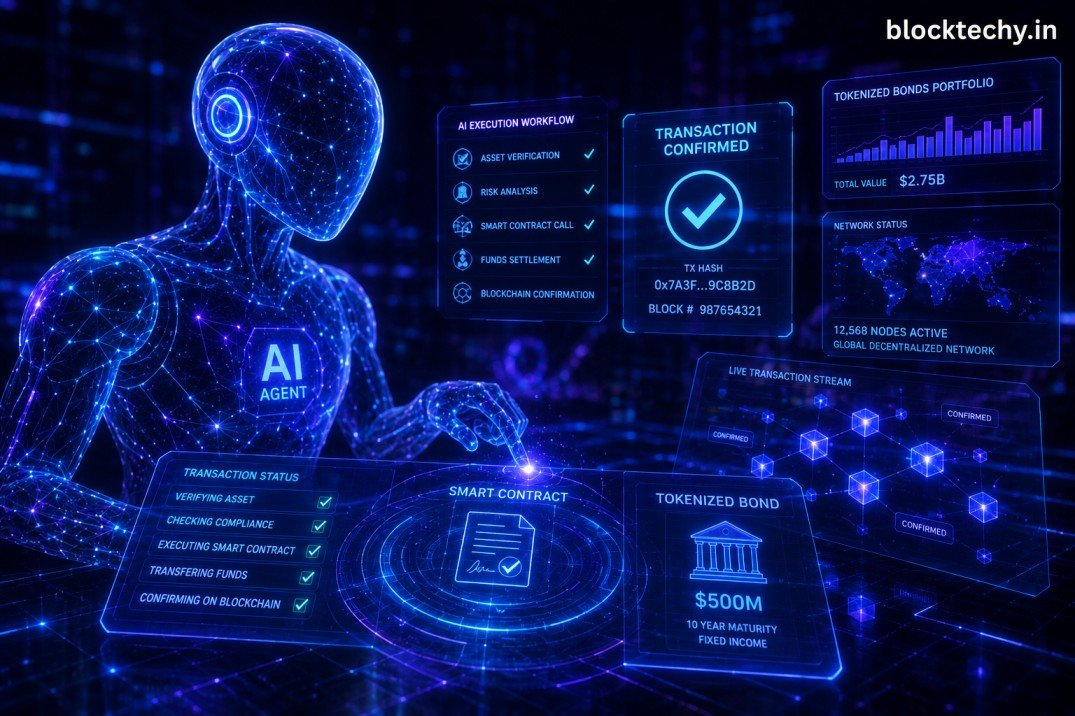
Unlike traditional software, AI agents can:
- Understand user instructions
- Plan tasks
- Interact with blockchain wallets
- Execute smart contracts
- Manage digital assets
- Learn from previous outcomes
Imagine telling your AI assistant:
“Invest $500 in tokenized government bonds with the lowest risk.”
The AI agent could:
- Analyze multiple DeFi protocols.
- Compare APYs.
- Verify protocol security.
- Execute the investment.
- Monitor performance.
- Rebalance automatically.
All actions would be transparently recorded on blockchain.
Smart Contracts Become Smarter
Traditional smart contracts execute only predefined rules.
For example:
If payment received:
Deliver NFT
AI-powered smart contracts go much further.
They can:
- Analyze market conditions
- Detect fraud
- Assess creditworthiness
- Adjust lending rates
- Optimize insurance claims
- Predict supply chain risks
This creates adaptive smart contracts capable of making intelligent decisions based on real-time information.
Decentralized AI: Breaking Big Tech Monopolies
Today’s AI models are mostly controlled by large technology companies.
This creates concerns regarding:
- Data privacy
- Bias
- Centralization
- Lack of transparency
- Vendor lock-in
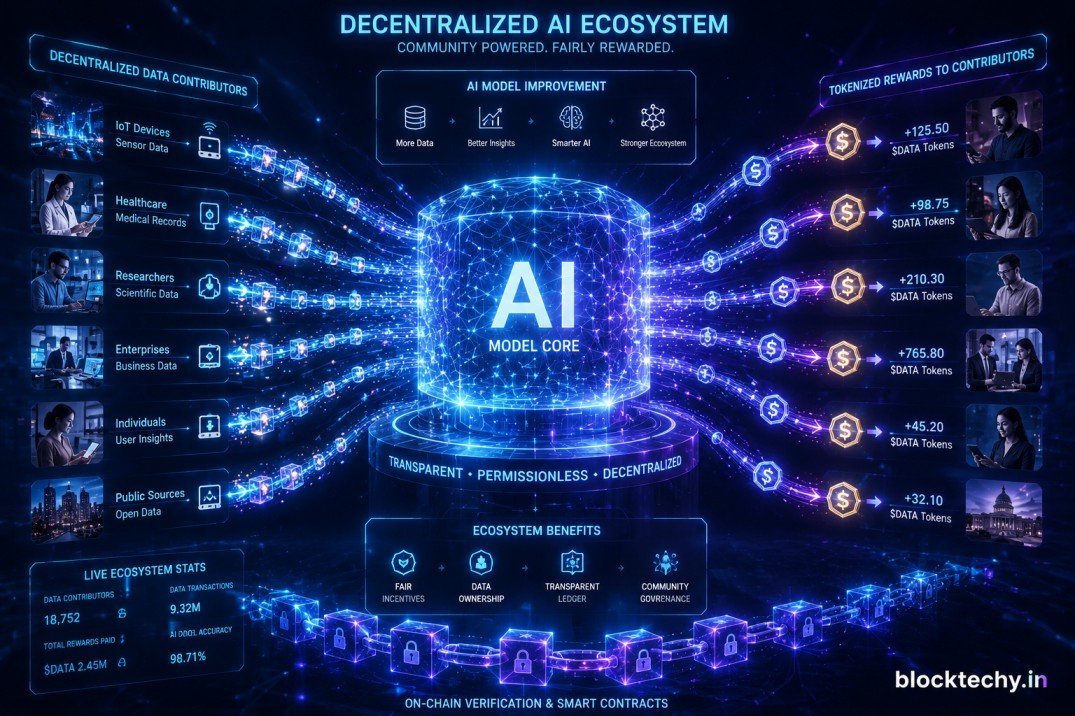
Blockchain enables decentralized AI.
Instead of relying on one company, AI models can be:
- Open-source
- Community governed
- Token incentivized
- Transparent
- Permissionless
Users maintain ownership of both their data and AI interactions.
Tokenized AI Economies
Blockchain introduces token incentives into AI ecosystems.
Participants can earn tokens for:
- Sharing computing power
- Contributing datasets
- Training models
- Validating AI outputs
- Building AI applications
This creates sustainable decentralized AI marketplaces where contributors are rewarded fairly.
AI-Powered DeFi
Decentralized Finance is becoming increasingly intelligent.
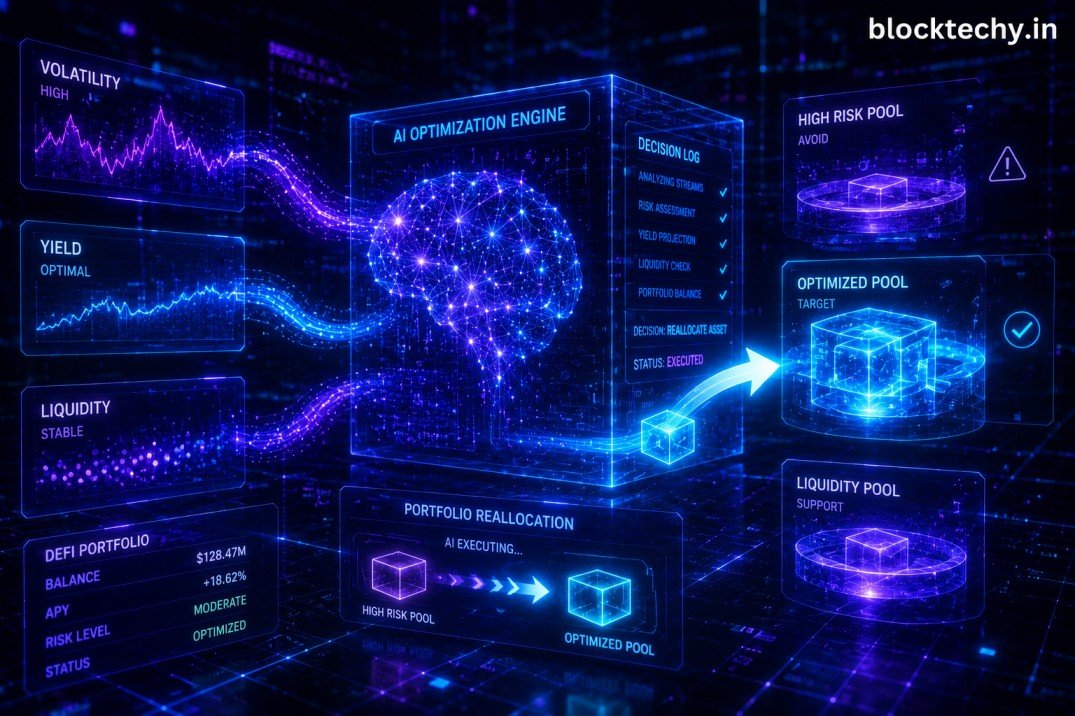
AI can automate:
Portfolio Management
AI continuously analyzes:
- Market volatility
- Token performance
- Liquidity
- User risk profile
Then automatically reallocates investments.
Risk Analysis
AI identifies:
- Rug pulls
- Suspicious smart contracts
- Wash trading
- Market manipulation
- Flash loan attacks
Before users invest.
Yield Optimization
Instead of manually searching for the highest APY,
AI automatically moves funds between protocols to maximize returns while minimizing risk.
AI and Blockchain in Supply Chain
Supply chains generate enormous amounts of data.
Blockchain provides transparent tracking.
AI provides intelligent analysis.
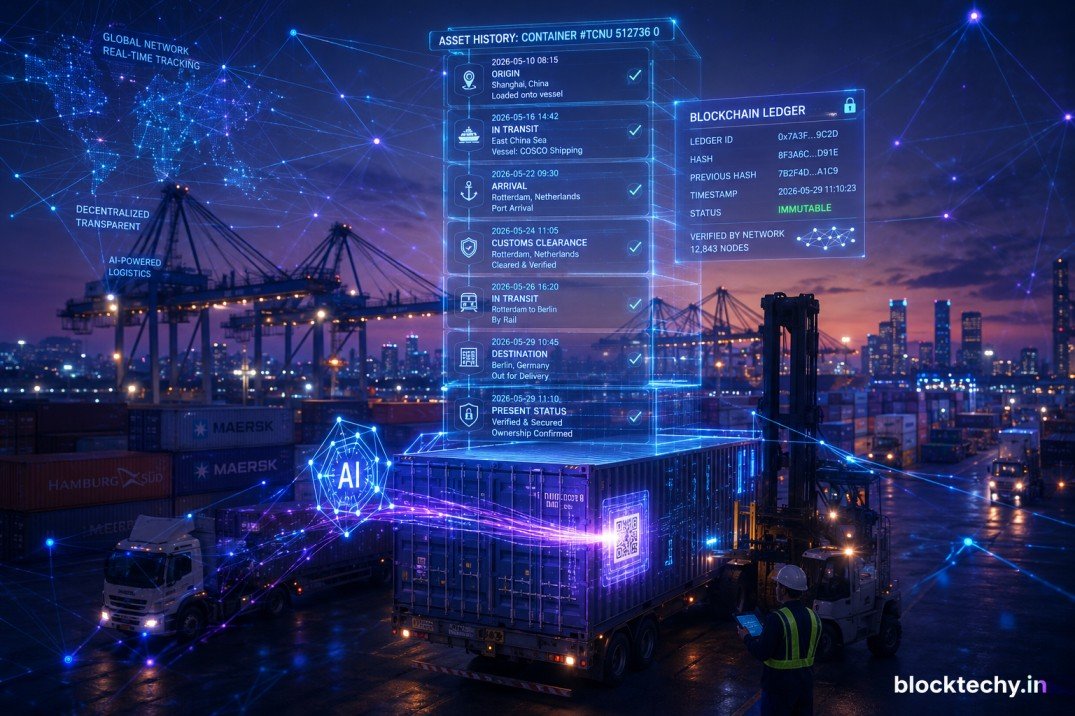
Together they enable:
- Demand forecasting
- Route optimization
- Fraud detection
- Inventory prediction
- Quality control
- Real-time logistics optimization
Consumers can verify product authenticity while companies reduce operational costs.
Healthcare Applications
Healthcare generates sensitive medical records.
Blockchain ensures secure storage.
AI analyzes patient information.
Potential applications include:
- Personalized treatment recommendations
- Early disease detection
- Drug discovery
- Medical imaging analysis
- Secure patient records
- Cross-hospital interoperability
Patients maintain ownership of their health data while allowing authorized AI systems to assist in diagnosis.
AI in NFT Ecosystems
NFTs are evolving beyond digital art.
AI enables:
- Dynamic NFTs
- Intelligent avatars
- Personalized gaming assets
- AI-generated collectibles
- Adaptive digital identities
For example,
An NFT game character could learn from player behavior and evolve over time while blockchain permanently records ownership.
Autonomous DAOs
Decentralized Autonomous Organizations (DAOs) govern Web3 communities.
AI can help DAOs by:
- Summarizing governance proposals
- Detecting spam votes
- Predicting proposal outcomes
- Managing treasury allocation
- Optimizing community incentives
Rather than replacing human governance, AI acts as an intelligent advisor that improves decision-making.
AI for Blockchain Security
Blockchain networks are secure by design, but applications built on top of them often face security risks.
AI improves security through:
- Transaction monitoring
- Wallet anomaly detection
- Smart contract auditing
- Phishing detection
- Identity verification
- Fraud prevention
Machine learning models continuously identify suspicious activity much faster than manual monitoring.
Real-World Asset (RWA) Tokenization Meets AI
One of the fastest-growing sectors in Web3 is Real-World Asset (RWA) tokenization.
Assets include:
- Real estate
- Government bonds
- Gold
- Carbon credits
- Commodities
- Private equity
AI enhances RWA platforms by:
- Predicting asset values
- Detecting fraud
- Assessing market risks
- Optimizing investment portfolios
- Monitoring economic indicators
Investors receive better insights while blockchain guarantees transparent ownership records.
AI and Identity Verification
Digital identity remains one of Web3’s biggest challenges.
AI assists through:
- Facial recognition
- Voice verification
- Behavioral biometrics
- Document authentication
Blockchain stores verified credentials securely without exposing personal information.
This improves:
- KYC
- Digital passports
- Educational certificates
- Healthcare records
- Employment verification
Benefits of Combining AI and Blockchain
Organizations adopting both technologies gain several advantages:
Increased Automation
AI reduces manual work across decentralized applications.
Better Decision Making
Machine learning provides data-driven insights.
Enhanced Security
Blockchain protects data integrity.
Greater Transparency
Every AI-generated action can be verified on-chain.
Reduced Costs
Automation minimizes operational expenses.
Improved Trust
Users can verify transactions instead of trusting intermediaries.
Challenges Ahead
Despite enormous potential, several challenges remain.
Scalability
Blockchain transactions can still be slower than centralized systems.
Data Privacy
AI requires data.
Blockchain is transparent.
Balancing privacy and accessibility remains difficult.
Regulatory Uncertainty
Governments worldwide continue developing regulations for AI and digital assets.
Compliance will become increasingly important.
High Computing Costs
Training advanced AI models requires substantial computational resources.
Decentralized infrastructure is still evolving.
AI Hallucinations
AI can generate inaccurate outputs.
Blockchain cannot determine whether AI-generated information is correct.
Human oversight remains essential.
Future Trends
Over the next five years, expect significant developments including:
- AI-native blockchain networks
- Autonomous financial agents
- Self-operating decentralized businesses
- AI-powered decentralized marketplaces
- Intelligent metaverse economies
- Personalized AI wallets
- Decentralized AI cloud computing
- On-chain AI governance
- Autonomous smart cities
- AI-assisted blockchain development
These innovations will redefine how people interact with digital assets and decentralized applications.
Best Practices for Businesses
Organizations looking to integrate AI and blockchain should:
- Identify processes suitable for automation.
- Choose scalable blockchain infrastructure.
- Protect sensitive user data.
- Use explainable AI models where possible.
- Conduct regular smart contract audits.
- Monitor regulatory developments.
- Educate users about AI-assisted decision-making.
- Continuously evaluate system performance.
A thoughtful implementation strategy will maximize the benefits while minimizing operational risks.
Conclusion
The convergence of Artificial Intelligence and blockchain is shaping the next generation of the internet. Blockchain provides trust, transparency, and decentralized ownership, while AI contributes intelligence, automation, and adaptability. Together, they are transforming Web3 into a smarter, more autonomous ecosystem capable of powering decentralized finance, intelligent supply chains, secure healthcare, tokenized real-world assets, and AI-driven digital identities.
Although challenges such as scalability, privacy, regulation, and AI reliability remain, rapid innovation is steadily addressing these issues. As decentralized AI networks, autonomous agents, and intelligent smart contracts become more mature, businesses and individuals will benefit from faster, more secure, and more efficient digital interactions.
The future of Web3 will not simply be decentralized—it will be intelligent. Organizations that embrace the combination of AI and blockchain today will be well-positioned to lead the next wave of digital transformation.
Frequently Asked Questions (FAQs)
1. How do AI and blockchain work together?
AI analyzes data, makes predictions, and automates decisions, while blockchain provides secure, transparent, and tamper-proof records. Together, they create intelligent and trustworthy decentralized systems.
2. Why is AI important for Web3?
AI enhances Web3 by automating complex tasks, improving user experiences, optimizing decentralized finance (DeFi), strengthening security, and enabling autonomous AI agents to interact with blockchain networks.
3. Can AI improve smart contracts?
Yes. AI can make smart contracts more adaptive by incorporating real-time data analysis, fraud detection, predictive modeling, and automated decision-making, although critical decisions should still include appropriate safeguards.
4. What are AI agents in blockchain?
AI agents are autonomous software systems that can analyze information, interact with wallets, execute smart contracts, manage digital assets, and perform blockchain-related tasks with minimal human intervention.
5. Which industries will benefit most from AI and blockchain?
Finance, healthcare, supply chain management, cybersecurity, insurance, logistics, gaming, real estate, identity verification, and Real-World Asset (RWA) tokenization are expected to see significant benefits.