Introduction
Counterfeit products have become a major challenge for businesses, consumers, and governments around the world. From luxury handbags and electronics to medicines, automotive parts, cosmetics, and food products, counterfeit goods can enter supply chains at almost any stage. These fake products not only cause financial losses for legitimate businesses but can also create serious safety risks for consumers.
Traditional methods of product authentication often rely on labels, serial numbers, certificates, holograms, and centralized databases. While these approaches can be useful, they can also be copied, manipulated, lost, or compromised. This is where blockchain technology offers a promising solution.
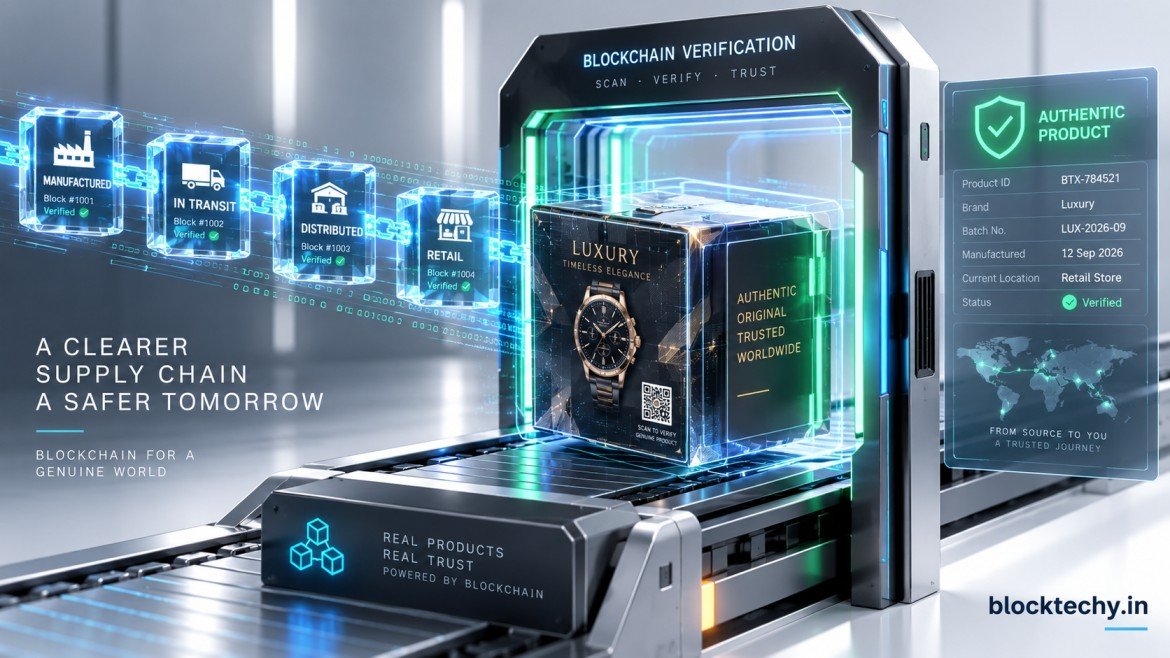
Blockchain provides a decentralized and tamper-resistant digital record that can track products throughout their lifecycle. By recording important information about a product—from manufacturing and transportation to distribution and final sale—blockchain can make it significantly more difficult for counterfeit products to enter legitimate supply chains unnoticed.
In this article, we will explore how blockchain can help prevent counterfeit products, how blockchain-based product authentication works, its benefits and limitations, and what the future of anti-counterfeiting could look like.
What Are Counterfeit Products?
Counterfeit products are unauthorized copies or imitations of genuine products. They are usually designed to appear similar to legitimate products while being sold under another company’s brand, trademark, packaging, or identity.
Counterfeiting affects many industries, including:
- Pharmaceuticals
- Luxury goods
- Consumer electronics
- Automotive components
- Clothing and footwear
- Cosmetics
- Food and beverages
- Industrial equipment
- Software and digital products
- Spare parts
The counterfeit market is particularly dangerous when fake products involve medicines, vehicle components, electrical equipment, or food because consumers may not be able to distinguish them from authentic products.
For businesses, counterfeiting can lead to lost revenue, damaged brand reputation, intellectual property violations, and reduced customer trust.
The problem is made more complicated by increasingly sophisticated counterfeiters. Modern counterfeit products can sometimes replicate packaging, QR codes, serial numbers, and other authentication features.
Blockchain introduces another layer of verification by creating a digital history that can be checked throughout the supply chain.
What Is Blockchain?
Blockchain is a type of distributed ledger technology that stores information across a network of computers rather than relying on a single centralized database.
Information is organized into blocks that are cryptographically connected. Once information has been recorded and confirmed, changing historical records becomes extremely difficult without detection.
Blockchain is best known for supporting cryptocurrencies such as Bitcoin, but its applications extend far beyond digital currencies.
For supply chains, blockchain can be used to create a shared record of a product’s journey.
For example, a blockchain-based record could contain information about:
Manufacturer → Distributor → Logistics Provider → Retailer → Consumer
At each stage, relevant information can be recorded on the blockchain.
This creates a traceable digital history that can help businesses and consumers determine whether a product is likely to be genuine.
How Blockchain Can Prevent Counterfeit Products
Blockchain does not physically stop someone from manufacturing a fake product. Instead, it helps create a system where authentic products can be digitally verified and traced.
Here are some of the most important ways blockchain can help.
1. Creating a Digital Identity for Every Product
One of the most powerful applications of blockchain is assigning products unique digital identities.
A manufacturer could create a unique digital record for every product manufactured.
For example:
Product ID: ABC123456
Manufacturer: XYZ Electronics
Manufacturing Date: September 2026
Batch: XZ-0926
Factory: Factory A
Destination: Mumbai Distribution Center
This information can be linked to a blockchain record.
The product could also have a physical identifier such as:
- QR code
- NFC chip
- RFID tag
- Secure serial number
- Digital watermark
When customers scan the identifier, they can retrieve information associated with the product.
If the product’s identity does not match the blockchain record, it can raise a warning that the product may be counterfeit.
2. Tracking Products Across the Supply Chain
Products often pass through multiple organizations before reaching consumers.
For example, a smartphone could travel through:
Manufacturer → Warehouse → Shipping Company → Distributor → Retailer → Customer
Every transfer creates an opportunity for counterfeit products to enter the supply chain.
Blockchain can record each authorized transaction.
For example:
Factory A manufactured Product #12345.
Then:
Product #12345 was transferred to Distributor B.
Then:
Distributor B shipped Product #12345 to Retailer C.
Finally:
Retailer C received Product #12345.
This creates a traceable chain of custody.
If someone attempts to introduce a counterfeit product with an invalid identity, the product may not have a legitimate blockchain history.
3. Tamper-Resistant Records
Traditional databases are generally controlled by an organization or administrator.
If a database is compromised, information could potentially be modified or deleted.
Blockchain uses cryptographic mechanisms and distributed verification to make unauthorized changes much more difficult.
This is particularly useful for product authentication.
Suppose a company records that a particular batch of medicine was manufactured at a certified facility.
If someone later tries to alter the record to make a counterfeit batch appear legitimate, inconsistencies could become detectable.
Blockchain therefore provides an additional layer of trust to supply-chain records.
However, it is important to understand that blockchain records themselves are not automatically proof that the physical information entered into them was truthful.
This is known as the “garbage in, garbage out” problem.
If false information is entered at the beginning, blockchain can preserve that false information.
Therefore, blockchain needs to be combined with reliable physical authentication and trusted data-entry systems.
4. QR Codes and Blockchain-Based Authentication
QR codes are one of the simplest ways consumers can interact with blockchain-based authentication systems.
A company could place a unique QR code on a product package.
When a customer scans the code, the system could check the product’s blockchain record.
The system might display:
Authentic Product
- Product ID
- Manufacturing location
- Production date
- Batch number
- Distribution history
- Warranty information
Alternatively, it could display:
Verification Failed
This could happen if:
- The product ID doesn’t exist.
- The identifier has already been registered elsewhere.
- The product has an invalid supply-chain history.
- The product was reported as stolen or recalled.
- The identifier has been duplicated.
This approach can make product authentication easier for consumers.
5. NFC and RFID for More Secure Authentication
QR codes are inexpensive, but they can sometimes be copied.
For higher-value products, companies can use technologies such as NFC (Near Field Communication) and RFID (Radio Frequency Identification).
An NFC chip embedded into a product or its packaging can contain a unique identifier that interacts with a blockchain-based authentication system.
For example, a luxury watch could contain an NFC tag.
When a customer taps the watch with a smartphone, the system could verify its digital identity and retrieve information about its manufacturing and ownership history.
Because the physical tag can be more difficult to replicate than a printed QR code, NFC can provide an additional layer of protection.
6. Improving Pharmaceutical Supply Chains
Counterfeit medicines are among the most concerning forms of counterfeiting.
Fake medicines may contain:
- Incorrect ingredients
- Insufficient active ingredients
- Dangerous substances
- No active ingredient at all
Blockchain can help pharmaceutical companies establish a traceable history for medicine batches.
For example, a medicine package could have a unique digital identifier.
The blockchain record could include:
Manufacturer → Batch → Quality Check → Distributor → Pharmacy
A pharmacy could verify the medicine before selling it.
Patients could potentially scan the packaging to receive authentication information.
Blockchain cannot replace pharmaceutical regulation or laboratory testing, but it can strengthen traceability and supply-chain visibility.
7. Protecting Luxury Brands
Luxury brands are frequent targets for counterfeiters.
Handbags, watches, jewelry, clothing, and footwear can command high prices, making them attractive targets for counterfeit operations.
Blockchain can give each luxury product a unique digital certificate of authenticity.
For example, when a luxury handbag is manufactured, the company could create a blockchain record containing:
- Product ID
- Manufacturing location
- Materials
- Production date
- Model
- Serial number
- Ownership information
When the product is resold, ownership can be updated.
This creates a digital history for the product.
The buyer of a second-hand luxury product could therefore verify whether the item has a legitimate history before purchasing it.
8. Fighting Counterfeit Electronics
Counterfeit electronic components can create serious safety and reliability problems.
Fake components may be used in:
- Smartphones
- Computers
- Cars
- Industrial machines
- Medical equipment
- Telecommunications systems
Manufacturers can use blockchain to record information about individual components or batches.
Companies could verify where a component was produced, when it was shipped, and which authorized distributor handled it.
This can be especially useful for complex global supply chains involving multiple suppliers and distributors.
9. Improving Consumer Trust
One of the biggest benefits of blockchain-based authentication is increased transparency.
Consumers increasingly want to know where products come from and whether they are genuine.
A blockchain-based system can provide customers with additional information before making a purchase.
For example, a customer buying an expensive product could scan its digital identity and see:
Manufactured in: Authorized Factory
Production Date: August 2026
Distributor: Authorized Distributor
Retailer: Verified Retailer
Authentication Status: Genuine
This can make consumers more confident about their purchases.
10. Combating Counterfeit Food Products
Counterfeit and adulterated food products can create serious health risks.
Examples can include:
- Fake branded food
- Adulterated spices
- Counterfeit beverages
- Fake organic products
- Misrepresented agricultural products
Blockchain can track agricultural products from farms to consumers.
For example:
Farm → Processing Facility → Packaging → Warehouse → Distributor → Retailer
Each stage can be recorded.
Consumers could scan a product and obtain information about its origin and supply-chain journey.
This can also support broader food traceability and recall systems.
Blockchain and Smart Contracts
Another important blockchain technology that can support anti-counterfeiting is the smart contract.
A smart contract is software deployed on a blockchain that can automatically execute predefined rules.
For example, a smart contract could require that:
- A manufacturer registers a product.
- An authorized distributor receives it.
- The distributor transfers it to an approved retailer.
- The retailer confirms receipt.
- The product becomes eligible for sale.
If an unauthorized party attempts to transfer the product, the system could flag the transaction.
Smart contracts can therefore help automate supply-chain rules and reduce manual verification.
Blockchain + IoT: A Powerful Combination
Blockchain becomes even more useful when combined with the Internet of Things (IoT).
IoT devices can automatically collect information about products during transportation.
For example, sensors could record:
- Location
- Temperature
- Humidity
- Movement
- Time
- Storage conditions
The information could then be connected to blockchain records.
Consider a pharmaceutical shipment.
A temperature sensor could continuously monitor the medicine while it is being transported.
If the shipment remains within the required temperature range, the blockchain-based system can preserve that history.
If the temperature exceeds a defined threshold, the event can be recorded.
This provides more than counterfeit protection—it creates greater visibility across the entire supply chain.
Benefits of Blockchain for Anti-Counterfeiting
Blockchain can provide several advantages.
Transparency
Authorized participants can access a shared record of product movement.
Traceability
Products can be tracked throughout their supply-chain journey.
Data Integrity
Cryptographic mechanisms make unauthorized modification of recorded information more difficult.
Faster Authentication
Digital verification can reduce the time required to check products.
Consumer Confidence
Customers can receive additional information about product authenticity.
Reduced Fraud
A reliable digital identity makes it harder to create convincing fake supply-chain histories.
Better Recalls
Companies can identify affected batches more efficiently.
Improved Supply-Chain Management
Blockchain can provide businesses with better visibility into product movement.
Challenges of Using Blockchain Against Counterfeiting
Despite its potential, blockchain is not a magic solution.
There are several challenges businesses need to consider.
1. Fake Physical Products Can Still Exist
Blockchain protects digital records, not physical objects.
A counterfeiter could potentially copy a QR code from a genuine product.
Therefore, blockchain should be combined with secure physical identifiers.
2. Data Entry Problems
If incorrect information enters the system, blockchain may preserve incorrect information.
Organizations need strong verification procedures.
3. Implementation Costs
Developing blockchain infrastructure, integrating existing systems, training employees, and deploying sensors or tags can require significant investment.
4. Industry Adoption
A supply chain may involve dozens or hundreds of companies.
For blockchain to provide maximum value, relevant participants need to participate in the system.
5. Scalability
Large supply chains can generate enormous quantities of data.
Blockchain networks must be designed to handle transaction volume efficiently.
6. Privacy
Some supply-chain information may be commercially sensitive.
Companies must carefully determine what information should be publicly visible and what should remain restricted.
Is Blockchain Enough to Stop Counterfeiting?
The short answer is no.
Blockchain should be viewed as one component of a larger anti-counterfeiting strategy.
A strong system could combine:
Blockchain + Secure Tags + IoT + AI + Digital Identity + Supply-Chain Monitoring
For example, AI could analyze unusual supply-chain behavior, while blockchain provides an immutable transaction history.
NFC could provide physical product authentication, while IoT sensors could monitor transportation conditions.
Together, these technologies can create a much stronger defense against counterfeit products.
The Future of Blockchain-Based Product Authentication
As blockchain technology, IoT, artificial intelligence, and digital identity systems continue to develop, product authentication is likely to become increasingly digital.
In the future, consumers may not simply purchase a physical product.
They may also receive a digital identity associated with that product.
Imagine purchasing an expensive watch.
You could receive:
- A digital certificate
- Manufacturing information
- Ownership history
- Warranty details
- Repair history
- Authentication records
- Resale information
When the watch is sold to another person, its digital ownership record could be transferred.
This could make the second-hand market more transparent and reduce opportunities for counterfeit products.
Similar systems could eventually become common in fashion, automotive parts, pharmaceuticals, electronics, food, and other industries.
Final Thoughts
Counterfeit products are a complex global problem that cannot be solved by a single technology. However, blockchain can provide an important foundation for creating more transparent, traceable, and verifiable supply chains.
By giving products unique digital identities and recording their movement from manufacturer to consumer, blockchain can make counterfeit activity easier to detect.
The technology becomes even more powerful when combined with QR codes, NFC, RFID, IoT sensors, smart contracts, artificial intelligence, and secure digital identity systems.
The biggest advantage of blockchain is not that it magically makes a product genuine. Instead, it creates a verifiable digital history that can help businesses, supply-chain partners, retailers, and consumers determine whether a product’s journey is consistent with an authentic product.
As businesses continue to digitize their supply chains, blockchain-based authentication could become an important tool in the global fight against counterfeit goods.
In the future, authenticity may not depend only on what a product looks like—it may also depend on the trusted digital history behind it.