Introduction
Losing access to a cryptocurrency wallet can be a frightening experience. Unlike traditional bank accounts, many crypto wallets do not have a central company that can simply reset your password or restore your account. If a user loses their recovery phrase or private key, access to the assets stored in the wallet may be permanently lost.
This is one of the biggest challenges facing crypto adoption.
Social recovery wallets offer a different approach. Instead of relying entirely on a single recovery phrase, social recovery allows users to designate trusted people or entities—often called guardians—who can collectively help restore access to a wallet if the owner loses control of it.
The idea is simple: your crypto wallet should not become permanently inaccessible just because you lost one piece of information.
But how does social recovery actually work? Is it safer than a traditional wallet? Who should be chosen as a guardian? And what happens if a guardian becomes unavailable or malicious?
In this article, we will explore social recovery wallets, how they work, their advantages and risks, and why they could become an important part of the future of cryptocurrency.
What Is a Social Recovery Wallet?
A social recovery wallet is a cryptocurrency wallet that allows users to recover access to their wallet through a group of trusted guardians rather than relying exclusively on a single seed phrase.
A guardian can be a person, another wallet controlled by the user, an organization, or another recovery mechanism, depending on the wallet design.
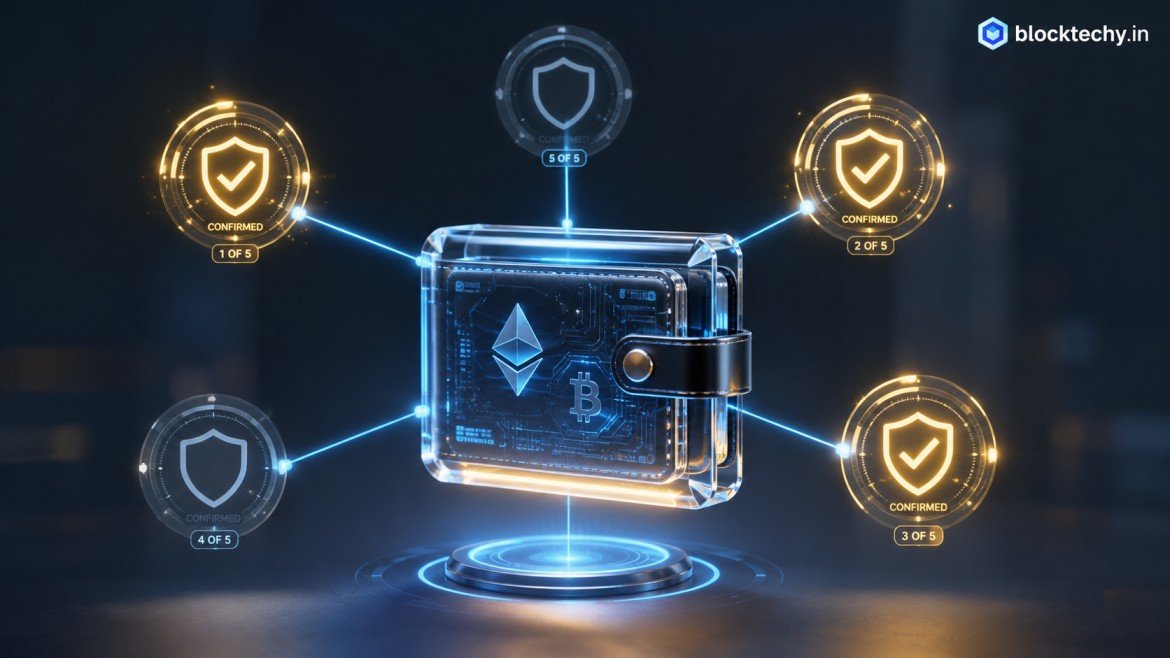
For example, imagine that you have a crypto wallet containing Ethereum and other digital assets. Instead of keeping a 12- or 24-word recovery phrase as your only backup, you could designate five trusted guardians.
You might configure the wallet so that any three out of those five guardians are required to approve a recovery.
This is commonly described as a 3-of-5 recovery model.
If you lose access to your primary wallet, you can initiate the recovery process using the guardians. Once enough guardians approve the request, control of the wallet can be transferred to a new wallet address or recovery key, depending on the implementation.
The important point is that guardians do not necessarily have access to your funds during normal operation.
Their primary role is to help recover control when something goes wrong.
Why Traditional Crypto Wallet Recovery Can Be Difficult
To understand why social recovery matters, it is useful to understand how traditional crypto wallets work.
Most self-custody wallets use a private key or seed phrase to control assets. The seed phrase is essentially a backup that can be used to regenerate the wallet’s private keys.
This provides an important security advantage: you control your assets without depending on a bank or centralized company.
However, it also creates a major responsibility.
If someone loses their seed phrase, they may lose access to their assets.
Consider a simple example.
You create a crypto wallet and receive $10,000 worth of cryptocurrency. You write down the recovery phrase and store it somewhere safe. Several years later, you move to a new home and accidentally throw away the paper containing the phrase.
Your phone may still be lost, damaged, or replaced. If you cannot recover the wallet through another backup, your assets could become inaccessible.
There is no traditional “Forgot Password?” button that can automatically restore a self-custody wallet.
Social recovery attempts to solve this problem while maintaining the benefits of decentralized ownership.
How Does Social Recovery Work?
The exact implementation differs between wallets and blockchain systems, but the basic concept generally follows a similar structure.
1. The User Creates a Wallet
The user first creates a crypto wallet capable of supporting social recovery.
Instead of relying exclusively on one recovery phrase, the wallet allows the user to configure a recovery system.
2. Guardians Are Selected
The user chooses trusted guardians.
These guardians might include:
- Family members
- Close friends
- Business partners
- Personal backup wallets
- Hardware wallets
- Professional recovery services
- Other trusted entities
A good recovery setup generally avoids placing complete control in the hands of a single guardian.
3. A Recovery Threshold Is Established
The user can establish how many guardians must approve a recovery.
For example:
3-of-5 guardians
means that three guardians are required to authorize recovery.
This is similar to a multisignature arrangement, although social recovery and multisig are not exactly the same thing.
4. Normal Wallet Usage Continues
During normal operation, the guardians generally do not control the user’s funds.
The wallet owner can continue to send, receive, and manage crypto normally.
5. Recovery Is Initiated When Access Is Lost
If the user loses their device or wallet credentials, they can begin the recovery process.
The system contacts or interacts with the designated guardians.
6. Enough Guardians Approve the Recovery
Once the required number of guardians approve the recovery, the wallet can update its controlling key or ownership configuration.
The user can then regain control using a new device or recovery credential.
Social Recovery vs. Seed Phrases
The biggest difference between traditional wallets and social recovery wallets is where the recovery responsibility is placed.
With a traditional wallet, the seed phrase is often the central recovery mechanism.
With social recovery, recovery can be distributed among multiple trusted parties.
For example:
| Feature | Traditional Wallet | Social Recovery Wallet |
|---|---|---|
| Primary recovery | Seed phrase/private key | Guardians/recovery mechanism |
| Single point of failure | Potentially yes | Reduced |
| User responsibility | Protect seed phrase | Manage guardians |
| Recovery flexibility | Limited | More flexible |
| Guardian involvement | Usually none | Required during recovery |
| Main risk | Lost or stolen seed phrase | Compromised guardians/recovery process |
Neither approach is automatically perfect.
A traditional wallet can be extremely secure if its recovery phrase is properly protected. A poorly configured social recovery wallet can also create security problems.
The goal of social recovery is to provide another way to balance security, usability, and self-custody.
Social Recovery and Smart Contracts
Social recovery is closely connected with smart contract wallets and account abstraction.
Traditional externally owned accounts generally rely directly on private keys to authorize transactions. Smart contract-based wallets can introduce programmable rules around ownership and recovery.
For example, a smart contract wallet could contain rules such as:
“The owner can change the controlling key if three approved guardians authorize the change.”
The blockchain can enforce these rules automatically.
This is powerful because recovery does not necessarily require a centralized company to intervene.
Instead, the recovery logic can be implemented through code and enforced by the blockchain.
However, smart contract wallets introduce their own considerations, including contract security, implementation bugs, transaction fees, upgrade mechanisms, and compatibility with different applications.
The Role of Guardians
Guardians are one of the most important components of a social recovery system.
Choosing guardians should not be treated casually.
A guardian should ideally be someone or something that:
- You trust.
- Is likely to remain available for a long time.
- Understands basic security practices.
- Is unlikely to lose their own access credentials.
- Does not have an incentive to attack your wallet.
- Can securely participate in the recovery process.
You also need to consider independence.
Suppose you choose five guardians, but all five use the same email provider and their accounts are connected to the same phone number.
Technically, you have five guardians.
Practically, a single compromise could potentially affect several of them.
This is why diversification matters.
Why Social Recovery Can Be Safer
One of the biggest advantages of social recovery is that it can eliminate certain single points of failure.
Imagine a traditional wallet where one seed phrase provides complete access.
If the seed phrase is stolen, an attacker may immediately gain control.
With a properly configured social recovery system, compromising one guardian may not be enough.
For example, in a 3-of-5 configuration, an attacker might need to compromise three guardians before they can satisfy the recovery threshold.
This creates an additional security layer.
Social recovery can also reduce the risk of permanent loss caused by a lost device.
If your phone breaks, your laptop is stolen, or your hardware wallet becomes unavailable, your guardians may still allow you to recover access.
But Social Recovery Is Not Risk-Free
Social recovery should not be considered a magical solution to crypto security.
It changes the risk model rather than eliminating risk.
There are several important risks to understand.
Guardian Collusion
If enough guardians cooperate maliciously, they could potentially trigger an unauthorized recovery.
This is why the recovery threshold matters.
A 2-of-3 system has a different security profile from a 4-of-7 system.
Guardian Account Compromise
A guardian’s own wallet, email account, or device could be compromised.
If the attacker gains access to the guardian’s recovery authority, they may attempt to participate in a fraudulent recovery.
Guardian Unavailability
What happens if your guardian loses their phone?
What if they forget about the wallet?
What if they move away?
What if they die?
A recovery system must consider these real-world problems.
Smart Contract Vulnerabilities
If the wallet relies on smart contracts, bugs in the contract code could potentially create security vulnerabilities.
This makes audits, battle-tested implementations, and careful wallet design important.
Social Engineering
Attackers could try to manipulate guardians.
For example, an attacker might impersonate the wallet owner and convince a guardian to approve a recovery request.
This means guardians need to understand that approving a recovery request is a serious security action.
Social Recovery vs. Multisignature Wallets
Social recovery is sometimes confused with multisignature wallets.
They are related concepts, but their goals can be different.
A multisignature wallet may require multiple parties to approve every transaction.
For example, a company could use a 3-of-5 multisig wallet where three executives must approve a payment before funds can move.
Social recovery generally focuses on recovering or changing wallet ownership/control rather than requiring multiple people to approve every ordinary transaction.
For individual users, social recovery can therefore provide a more convenient experience.
You might use your wallet normally with a single device while maintaining multiple guardians specifically for emergencies.
What Happens If You Lose Your Phone?
This is one of the most practical scenarios for social recovery.
Suppose your wallet is installed on your phone and the phone is destroyed.
With a traditional wallet, you may need your recovery phrase or another backup.
With a social recovery wallet, you could potentially install the wallet on a new device and initiate recovery.
The guardians then approve the recovery according to the wallet’s rules.
After successful recovery, the wallet can recognize the new controlling key or device.
This can make the user experience much closer to what people expect from traditional digital services.
However, the exact recovery process varies significantly between wallet implementations.
Can Guardians Steal Your Crypto?
Normally, simply being a guardian should not mean that the person can freely spend your cryptocurrency.
The guardian’s role is generally related to recovery authorization rather than everyday transaction authorization.
However, the precise security model depends on the wallet’s architecture.
This is why users should understand the wallet’s recovery mechanism before depositing significant funds.
A wallet’s marketing description is not enough.
Users should understand:
- What guardians can do
- What guardians cannot do
- How many guardians are required
- How recovery requests are initiated
- How long recovery takes
- Whether there is a cancellation period
- How guardians are removed
- How guardians are replaced
- What happens if the wallet owner becomes unavailable
These details can have major security implications.
Choosing the Right Recovery Threshold
The number of guardians and required approvals is an important design decision.
Suppose you choose five guardians.
A 2-of-5 system makes recovery relatively easy because only two guardians are needed.
But it also means that compromising two guardians could potentially be enough to attack the recovery mechanism.
A 4-of-5 system provides stronger resistance against collusion but creates a bigger availability problem.
If two guardians disappear or become unavailable, recovery could become difficult.
A 3-of-5 arrangement can provide a middle ground.
There is no universal configuration that is best for everyone.
The correct setup depends on the amount of money involved, the user’s relationships, technical knowledge, and risk tolerance.
Who Should Use Social Recovery Wallets?
Social recovery can be particularly useful for people who want self-custody but are uncomfortable with the idea of protecting a single recovery phrase forever.
Potential users include:
Individual Crypto Users
People holding cryptocurrency for long-term investment may appreciate an additional recovery mechanism.
New Crypto Users
Beginners often struggle with seed phrase management.
A carefully designed social recovery system can make self-custody easier to understand.
Families
Families can establish recovery arrangements involving multiple trusted family members.
Businesses
Organizations can potentially use programmable recovery and authorization systems as part of broader treasury management.
Users With Multiple Devices
People who frequently switch phones or computers may benefit from recovery mechanisms that are not tied to a single physical device.
Why Social Recovery Could Improve Crypto Adoption
One of the biggest barriers to mainstream crypto adoption is the complexity of self-custody.
Traditional financial services have developed systems for:
- Password resets
- Account recovery
- Identity verification
- Fraud monitoring
- Customer support
Crypto often places much more responsibility on the individual.
That philosophy provides powerful ownership and censorship resistance, but it can also be intimidating.
Social recovery attempts to introduce a more user-friendly recovery model without completely returning control to a centralized institution.
Instead of asking users to remember:
“If I lose this phrase, everything is gone.”
the system can offer:
“If I lose access, multiple trusted parties can help me recover.”
This could make decentralized applications more approachable for ordinary users.
The Future of Social Recovery Wallets
As blockchain infrastructure develops, wallet technology is moving beyond the simple private-key model.
Smart contract wallets, account abstraction, passkeys, biometric authentication, multi-device security, and social recovery can potentially work together.
For example, a future wallet might allow users to authenticate using a familiar device while keeping cryptographic recovery mechanisms in the background.
If the device is lost, the user could recover the account through a combination of trusted guardians and additional security factors.
This could make blockchain applications feel less like specialized financial software and more like normal digital services.
The challenge will be maintaining the security guarantees that make decentralized systems valuable in the first place.
Best Practices for Using Social Recovery
If you decide to use a social recovery wallet, consider the following practices.
Choose Guardians Carefully
Do not choose guardians simply because they are close friends.
Think about their reliability, security awareness, and long-term availability.
Diversify Guardians
Avoid making all guardians dependent on the same device, account, or organization.
Use an Appropriate Threshold
Choose a recovery threshold that balances security and availability.
Understand the Recovery Process
Before depositing significant assets, understand exactly how recovery works.
Test the System
If the wallet supports safe recovery testing, make sure you understand the process before an emergency occurs.
Protect Your Normal Wallet Access
Social recovery should complement good security practices, not replace them.
Use strong authentication, secure devices, software updates, and appropriate transaction precautions.
Keep Recovery Information Private
Do not publicly disclose your guardians or recovery configuration.
Information about your recovery structure could potentially help an attacker target you.
The Bottom Line
Social recovery wallets represent an important evolution in cryptocurrency wallet design.
Traditional self-custody gives users complete control, but that control comes with significant responsibility. Losing a private key or recovery phrase can result in permanent loss of access.
Social recovery provides an alternative by distributing recovery authority among trusted guardians.
Instead of relying on one recovery secret, users can create a system where multiple independent parties must cooperate before wallet control can be restored.
This can reduce the impact of a lost device or forgotten recovery credential while preserving much of the philosophy of self-custody.
However, social recovery is not automatically safer in every situation. Poor guardian selection, compromised accounts, collusion, unavailable guardians, and smart contract vulnerabilities can introduce new risks.
The key is understanding the trade-off.
Crypto security is ultimately about managing risk, not eliminating it completely.
As smart contract wallets and account abstraction continue to develop, social recovery could become a major part of making blockchain technology easier and safer for everyday users.
The future of crypto wallets may not be about choosing between convenience and security. Instead, it may be about building systems that combine both—giving users strong ownership while providing practical ways to recover when things go wrong.
For a technology that aims to give individuals greater control over their digital assets, that could be one of the most important steps toward mainstream adoption.