Introduction
The internet has transformed how people communicate, work, shop, learn, and interact with businesses. But behind almost every online activity lies a valuable asset: personal data. Names, email addresses, browsing histories, purchasing behavior, location information, financial details, social connections, and digital identities are collected and stored by countless platforms.
For years, users have had limited control over what happens to this information after they share it. Companies typically store user data in centralized databases, while users depend on those organizations to protect, manage, and sometimes delete it. Data breaches, unauthorized sharing, targeted advertising, identity theft, and unclear privacy policies have made digital data ownership an increasingly important issue.
This is where blockchain technology could introduce a fundamentally different approach.
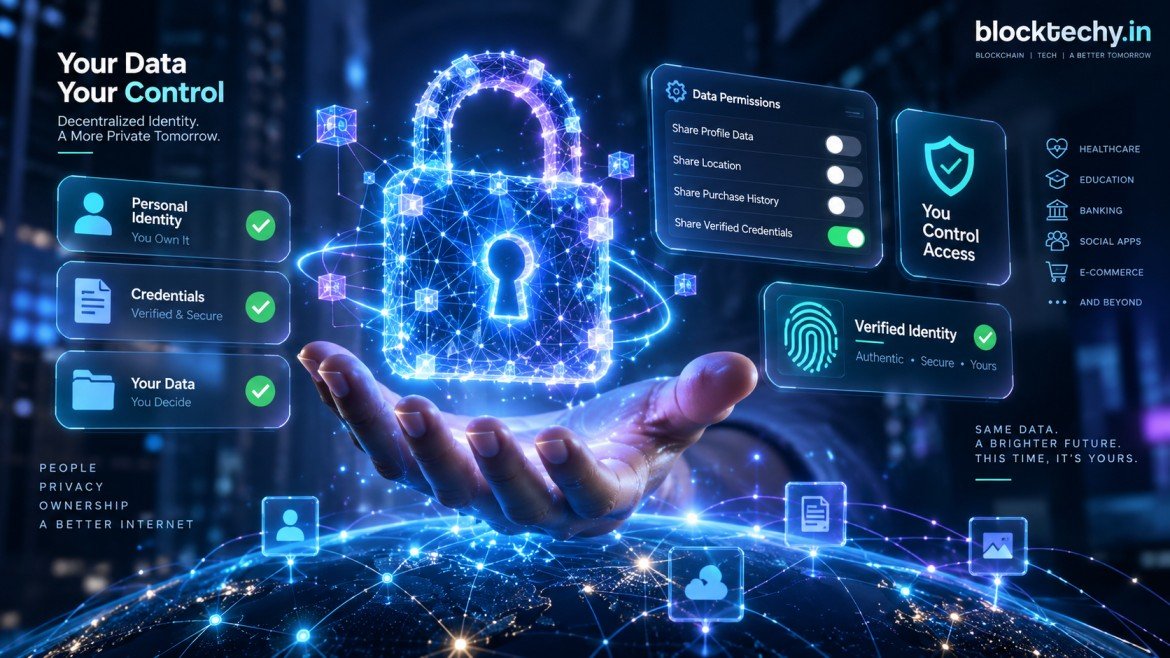
Blockchain data ownership is based on the idea that individuals should have greater control over their digital information. Instead of personal data being controlled entirely by centralized platforms, blockchain-based systems could allow users to manage access, verify ownership, and decide how their information is shared.
However, blockchain does not automatically make data private or give users complete ownership. The technology introduces tools such as decentralized identity, cryptographic signatures, smart contracts, and verifiable credentials that can support a more user-controlled data ecosystem.
In this article, we will explore blockchain data ownership, how it works, its potential benefits, real-world applications, challenges, and the future of user-controlled digital data.
What Is Blockchain Data Ownership?
Blockchain data ownership refers to using blockchain and related decentralized technologies to give individuals more control over their digital identities and personal information.
In the traditional internet model, a user might create an account on a social media platform, shopping website, banking application, or online service. The company stores the user’s information on its own servers.
For example:
Traditional model:
User → Website/App → Centralized Database
The organization controls the database and determines how the data is stored, processed, and shared, subject to applicable laws and agreements.
A blockchain-based model could look more like:
User → Digital Wallet/Identity → Permissioned Access → Service
In this model, the blockchain can serve as a trusted infrastructure for recording permissions, verifying credentials, or proving that a particular digital identity controls certain cryptographic keys.
Importantly, the blockchain generally should not store sensitive personal information directly. Instead, blockchain systems can store proofs, identifiers, hashes, or references while the actual data remains encrypted or stored elsewhere.
Why Data Ownership Matters
Data has become one of the most important resources in the digital economy.
Every time someone searches online, purchases a product, downloads an application, watches a video, or interacts with a website, information about that activity may be generated.
Companies use this information for:
- Personalization
- Advertising
- Fraud detection
- Product development
- Customer analytics
- Recommendation systems
- Machine learning
- Business intelligence
The problem is that users often have limited visibility into how their data moves between organizations.
Consider a simple example.
You provide your email address to an online store. The store may use it to create your account and send notifications. Depending on its practices and applicable permissions, information could potentially also be shared with analytics providers, advertising platforms, payment processors, or other third parties.
This creates a complicated data ecosystem where users may not know:
- Where their data is stored
- Who can access it
- How long it is retained
- Whether it has been shared
- How it is being analyzed
- Whether it has been sold or monetized
- How to completely remove it
Blockchain-based identity and permission systems could potentially give individuals greater visibility and control.
How Blockchain Could Give Users More Control
Blockchain can support data ownership through several technologies working together.
1. Decentralized Identity
One of the most important concepts is decentralized identity, often abbreviated as DID.
Traditional digital identities are usually controlled by centralized organizations.
For example:
You create a Google account → Google manages your account identity.
You create a Facebook account → Meta manages your account identity.
You create a banking account → Your bank manages your account identity.
Decentralized identity attempts to shift some control toward the individual.
A user could have a digital identity controlled through cryptographic keys and a wallet. Rather than creating a completely separate identity for every platform, the individual could potentially use verifiable credentials across multiple services.
For example, a user could possess a digitally signed credential proving that they are over a certain age without necessarily providing their complete date of birth.
This leads to a powerful privacy principle:
Prove what is necessary without revealing everything.
2. Cryptographic Ownership
Blockchain relies heavily on cryptography.
A blockchain wallet contains cryptographic keys that allow users to control digital assets and sign transactions. Similar principles can be applied to digital identity and data permissions.
Instead of relying exclusively on usernames and passwords, a user can prove control over an identity through cryptographic signatures.
For example:
- A user creates a digital identity.
- The identity is associated with cryptographic keys.
- A service requests specific information.
- The user approves the request.
- The user signs or authorizes the interaction.
- The service verifies the authorization.
The blockchain can provide a tamper-resistant record of certain identity-related events without necessarily exposing the user’s private information.
3. Smart Contracts and Data Permissions
Smart contracts are programs deployed on blockchain networks that automatically execute predefined rules.
They could potentially be used to manage data-access permissions.
Imagine that you use an online financial application.
Instead of giving the application permanent access to all your financial information, you could authorize access under specific conditions.
For example:
“Allow this application to access my transaction history for 30 days.”
A smart-contract-based permission system could potentially help enforce or record such rules.
Another example might be:
“Allow this company to verify my educational qualification but do not provide access to my complete academic record.”
This could create a more granular approach to data sharing.
However, smart contracts cannot magically enforce every real-world privacy condition. If an application receives a copy of your information, blockchain cannot automatically guarantee that the recipient will never store, duplicate, or misuse it. Additional technical, legal, and organizational controls are required.
4. Verifiable Credentials
Verifiable credentials are another major component of decentralized identity systems.
A verifiable credential is a digitally signed statement that can prove something about an individual.
Examples include:
- University degrees
- Professional certifications
- Government-issued identity claims
- Membership credentials
- Age verification
- Employment credentials
- Licenses
- Training certificates
Suppose you apply for a job.
Instead of emailing a PDF certificate that anyone could potentially alter, a university could issue a cryptographically verifiable credential.
The employer could verify that:
- The credential was issued by the university
- It belongs to the applicant
- It has not been revoked
- The information has not been modified
The user retains the credential and decides when to present it.
This could reduce unnecessary data sharing.
Blockchain vs Traditional Data Ownership
The differences become clearer when we compare the two models.
| Feature | Traditional Model | Blockchain-Based Model |
|---|---|---|
| Identity control | Usually platform-controlled | Potentially user-controlled |
| Data storage | Centralized databases | Distributed architecture possible |
| Access permissions | Platform-defined | User-controlled permissions possible |
| Verification | Central authority | Cryptographic verification |
| Data portability | Often limited | Potentially improved |
| Transparency | Depends on organization | Blockchain records can be auditable |
| Single point of failure | Common | Can be reduced |
| Privacy | Depends heavily on provider | Can use cryptographic privacy techniques |
This does not mean blockchain is automatically better.
Centralized databases remain extremely useful, efficient, and necessary for many applications. Blockchain introduces trade-offs involving performance, cost, usability, governance, and privacy.
Benefits of Blockchain Data Ownership
Greater User Control
The biggest potential advantage is giving individuals more control over their digital identity and permissions.
Instead of repeatedly handing personal information to different platforms, users could maintain a reusable digital identity.
Improved Data Portability
Data portability is another important benefit.
Imagine changing from one service provider to another without rebuilding your digital profile from scratch.
A user could potentially move credentials and identity information between compatible applications.
This could reduce platform lock-in.
Better Transparency
Blockchain networks can provide transparent and tamper-resistant records.
For example, a blockchain could record that:
- A credential was issued
- A credential was revoked
- A permission was granted
- A permission was changed
- A transaction occurred
The actual personal information does not have to be publicly exposed.
This distinction is important.
Transparency of events does not require transparency of personal data.
Reduced Identity Fraud
Blockchain-based identity systems could potentially make certain types of identity fraud more difficult.
Cryptographic signatures can help verify that information came from a legitimate issuer and has not been altered.
For example, a digitally signed professional certification can be easier to authenticate than an ordinary image or PDF.
However, blockchain cannot prevent every form of identity theft. If someone obtains a user’s private keys or credentials, they may be able to impersonate the user.
Blockchain and Data Monetization
One of the more controversial ideas surrounding data ownership is personal data monetization.
Today, companies can generate enormous economic value from user data.
Blockchain could potentially create systems where individuals participate more directly in this value exchange.
For example:
A company wants access to a particular category of consumer information.
Instead of collecting the information without meaningful user participation, a decentralized marketplace could theoretically allow users to:
- Decide whether to share the data.
- Review the requested purpose.
- Grant permission.
- Receive compensation.
- Revoke future access where technically and legally possible.
This could create a different economic relationship between businesses and consumers.
However, monetizing personal data also raises serious ethical concerns.
People may feel pressured to sell sensitive information because they need money. Certain forms of personal data should arguably never become ordinary commodities.
Therefore, blockchain-based data marketplaces would need strong privacy protections, informed consent, regulation, and ethical standards.
Real-World Applications
Blockchain data ownership has potential applications across several industries.
Healthcare
Healthcare data is highly sensitive and often fragmented across hospitals, laboratories, insurers, and patients.
A blockchain-supported identity system could help patients manage access to medical records.
For example, a patient might authorize a specialist to verify selected medical information without giving permanent access to everything.
Blockchain could also help establish audit trails showing when certain records were accessed or when credentials were issued.
However, actual medical records would generally need to remain in secure healthcare systems rather than being placed directly on a public blockchain.
Education
Educational institutions issue large numbers of certificates and qualifications.
Blockchain-based credentials could make verification faster and more reliable.
Instead of manually contacting a university to verify a degree, an employer could verify a digitally signed credential.
Students could also maintain a portable collection of academic achievements throughout their careers.
Banking and Finance
Know Your Customer (KYC) processes require organizations to verify customer identity.
A reusable decentralized identity could potentially reduce repeated verification.
For example:
Bank A verifies a customer’s identity → customer receives a verifiable credential → Bank B verifies the credential.
This could reduce duplication while allowing users to control which information they share.
E-Commerce
Online stores could potentially use decentralized identity systems to reduce the amount of personal information they retain.
Customers might prove:
- Their age
- Their location eligibility
- Their membership
- Their payment authorization
without necessarily sharing unrelated identity information.
Social Media
Social media is one of the most interesting areas for decentralized data ownership.
In traditional platforms, your profile, followers, posts, and social graph are generally tied to the platform.
A decentralized social ecosystem could potentially allow users to carry identity and social relationships between compatible applications.
This could make it easier for users to switch platforms without completely rebuilding their digital presence.
The Role of Zero-Knowledge Proofs
One of the most promising technologies associated with privacy-preserving blockchain systems is the zero-knowledge proof.
A zero-knowledge proof allows someone to demonstrate that a statement is true without revealing the underlying information.
For example, imagine a website needs to confirm that you are over 18.
Traditional approach:
You provide your complete date of birth.
Zero-knowledge approach:
You prove that you satisfy the age requirement without revealing your exact birthday.
This could significantly reduce unnecessary data exposure.
The broader principle is:
Verification without excessive disclosure.
When combined with decentralized identity, zero-knowledge proofs could become an important component of privacy-preserving digital identity systems.
Challenges of Blockchain Data Ownership
Despite its potential, blockchain-based data ownership faces significant challenges.
Privacy Problems
Public blockchains are designed to provide transparency.
That can conflict with privacy.
Putting personal information directly onto a public blockchain could create permanent exposure.
Therefore, developers generally need to avoid storing sensitive personal data directly on-chain.
Encryption, off-chain storage, selective disclosure, and zero-knowledge techniques can help, but they add complexity.
The “Delete” Problem
One major challenge is data deletion.
Many privacy regulations give individuals rights related to deletion or correction of personal information.
Blockchain records are intentionally difficult to modify or remove.
This creates a fundamental tension:
Blockchains prioritize immutability, while privacy systems sometimes require deletion.
One approach is to keep sensitive data off-chain and place only cryptographic references or proofs on-chain.
Even then, system designers must carefully consider whether hashes or metadata could themselves reveal information.
Lost Private Keys
Traditional platforms often provide password recovery.
Blockchain systems can work differently.
If a user loses their private key, recovering access can be difficult depending on the system design.
For mass adoption, decentralized identity systems need secure and user-friendly recovery mechanisms.
Potential solutions include:
- Social recovery
- Multi-signature systems
- Hardware security
- Backup credentials
- Guardians
- Account abstraction
- Institutional recovery mechanisms
User Experience
Blockchain technology can be complicated for ordinary users.
Most people do not want to understand:
- Private keys
- Gas fees
- Wallet addresses
- Smart contracts
- Network confirmations
- Cryptographic signatures
For blockchain data ownership to become mainstream, these complexities need to disappear behind simple interfaces.
Users should experience:
“Allow access”
rather than:
“Sign transaction 0x7a… on network X.”
Good user experience will be just as important as technical innovation.
Is Blockchain Really About Data Ownership?
This is an important distinction.
Blockchain does not necessarily give someone legal ownership of personal data.
Technical control and legal ownership are not always the same thing.
A blockchain wallet can prove control over a cryptographic key. It does not automatically establish legal rights over every piece of information associated with that identity.
Legal ownership, privacy rights, consent, data processing, and intellectual property are governed by laws and contracts.
Therefore, the phrase “blockchain data ownership” is best understood as a broader concept involving:
- Technical control
- Identity management
- Access permissions
- Data portability
- Consent
- Verification
- Privacy
Blockchain can support these capabilities, but legislation and governance remain essential.
The Future of User-Controlled Data
The future of data ownership is unlikely to be completely centralized or completely decentralized.
Instead, we may see hybrid architectures.
Sensitive data could remain in secure databases or encrypted personal storage, while blockchain networks provide:
- Identity verification
- Credential validation
- Permission records
- Audit trails
- Interoperability
- Cryptographic proofs
Artificial intelligence could also become an important part of this ecosystem.
AI agents may increasingly act on behalf of users, managing permissions and deciding which information should be shared with applications.
Imagine an AI assistant that receives a request from an online service:
“We need proof of your age and country of residence.”
The assistant could automatically determine the minimum information required, retrieve appropriate credentials, generate a privacy-preserving proof, and ask for user approval.
In such a model, users would not manually manage hundreds of permissions.
Their digital assistant could help manage them.
Blockchain Data Ownership and Web3
The idea of user-controlled data is closely connected with the broader Web3 movement.
Traditional Web2 platforms generally store identity and content within centralized services.
Web3 experiments with decentralized ownership models involving wallets, tokens, decentralized applications, and distributed networks.
However, the future of Web3 data ownership will likely depend less on speculation around digital assets and more on practical infrastructure.
The important question is not:
“Can users own a token?”
The more important question is:
“Can users control their digital identity, credentials, permissions, and relationships across the internet?”
If blockchain technology can help answer that question effectively, its impact could extend far beyond cryptocurrencies.
What Blockchain Data Ownership Could Look Like
A future user-controlled internet might work like this:
You create a decentralized digital identity.
Your university issues a verified education credential.
Your bank issues verified identity credentials.
Your employer issues employment credentials.
Your healthcare provider provides encrypted medical credentials.
You store or control these credentials through a secure digital wallet.
When an application needs information, it requests permission.
You approve only the required information.
The application verifies the information cryptographically.
Blockchain infrastructure provides trust and verification.
Zero-knowledge technology minimizes unnecessary disclosure.
If you stop using the application, you can revoke future permissions where supported.
This model would not eliminate centralized companies.
Instead, it could change the relationship between users and those companies.
Users could become active participants in managing their digital identities rather than passive sources of data.
Conclusion
Blockchain data ownership could represent a major shift in how people interact with their personal information.
The traditional internet has largely been built around centralized platforms that collect and control user data. Blockchain introduces a different architecture where cryptographic identity, decentralized credentials, smart contracts, and privacy-preserving technologies could give individuals greater control.
The potential benefits include better data portability, stronger identity verification, improved transparency, reduced dependence on centralized identity providers, and more selective data sharing.
But blockchain is not a magic solution.
Privacy challenges, scalability, key management, regulation, data deletion, user experience, and legal questions must all be addressed. Most importantly, personal information should not simply be placed on public blockchains and labeled “owned” by the user.
The most promising future is likely to involve a combination of blockchain, decentralized identity, encrypted storage, zero-knowledge proofs, AI, privacy technologies, and strong legal protections.
The ultimate goal is not simply to put data on a blockchain.
It is to create an internet where people have meaningful control over their digital identities and information.
As the digital economy continues to expand, data ownership could become one of the defining technology and privacy issues of the next decade. Blockchain may play an important role in that transformation—not by replacing every centralized database, but by providing new tools for proving identity, controlling access, and putting users closer to the center of the digital ecosystem.