Introduction
The internet has always been built around data. Every search, purchase, social media interaction, online payment, app login, and digital transaction creates information. For years, most users have accepted that their data is collected and stored by the companies providing online services. We click “Accept,” create an account, and continue using the platform without thinking deeply about what happens to the information we generate.
But the rise of Web3 is challenging this traditional model.
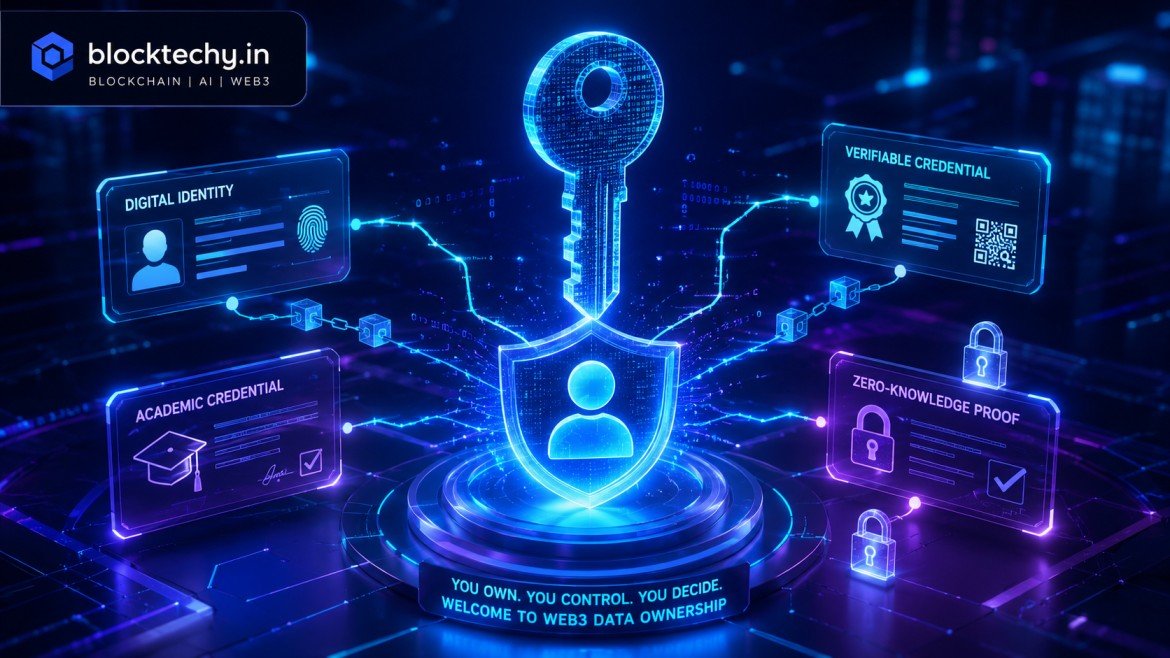
Web3 introduces a different vision of the internet—one where users can have greater control over their digital identities, assets, credentials, and potentially their personal data. Instead of information being controlled entirely by centralized platforms, blockchain technology, decentralized applications, cryptographic wallets, and decentralized identity systems can give individuals new ways to manage digital ownership.
This raises an important question:
What does it actually mean to own your data?
Is data ownership simply having the ability to store information in your own wallet? Does it mean companies cannot use your information without permission? Can users sell their own data? And can blockchain really solve the privacy and control problems created by today’s internet?
The answers are more complicated than they first appear.
In this article, we will explore what user-owned data means, how Web3 changes the traditional data model, how blockchain and decentralized identity can contribute to data ownership, the benefits and challenges of the approach, and what the future of user-controlled data could look like.
What Does Data Ownership Mean?
Before discussing Web3, it is important to understand what “data ownership” actually means.
In simple terms, data ownership refers to the rights and control associated with information about an individual or organization.
However, ownership can involve several different concepts:
- Who created the data?
- Who stores the data?
- Who can access it?
- Who can modify it?
- Who can share it?
- Who can monetize it?
- Who can delete it?
- Who is legally responsible for protecting it?
These questions demonstrate why data ownership is more complicated than owning a physical object.
If you purchase a smartphone, you generally know that the device belongs to you. Digital information does not work the same way. A social media company may store information about your profile, while you created much of that information. A bank may maintain your financial records, while you are the person described by those records.
Therefore, “user-owned data” does not necessarily mean that every piece of information about a person can simply be placed into a blockchain wallet and treated like a cryptocurrency.
Instead, the concept is better understood as giving users meaningful control over how their data is accessed, shared, verified, and used.
The Traditional Internet Data Model
The traditional internet largely follows a centralized data model.
Consider what happens when you create an account on an online platform.
You provide information such as:
- Name
- Email address
- Phone number
- Location
- Profile information
- Payment details
- Preferences
- Search behavior
- Purchase history
The platform typically stores this information on servers controlled by the company.
The company decides how the information is processed within the limits of applicable laws, contracts, and its privacy policies. Users may have certain rights, but they generally do not control the underlying infrastructure.
This creates a major imbalance.
Users generate enormous amounts of valuable data, while large platforms often control the systems that collect, analyze, and monetize it.
For example, your online activity can help a platform understand what products interest you, what content you engage with, and what advertisements might be relevant to you.
The platform may benefit economically from these insights even though the underlying behavioral information was generated through your activity.
This model has helped build today’s digital economy, but it also creates concerns around privacy, surveillance, data breaches, platform dependency, and lack of transparency.
How Web3 Changes the Data Conversation
Web3 proposes a more decentralized model.
Instead of users interacting exclusively through accounts controlled by centralized companies, Web3 applications can use blockchain networks and cryptographic wallets as part of their infrastructure.
A wallet can function as more than a place to hold digital assets. In some systems, it can also act as a form of digital identity or an authentication mechanism.
Rather than creating a username and password for every application, users may connect a wallet or decentralized identity to services.
This creates an important shift:
The user can potentially carry their digital identity and credentials between applications instead of rebuilding an identity separately on every platform.
This concept is often associated with self-sovereign identity, decentralized identity, and user-controlled credentials.
The goal is not necessarily to put all personal information on a public blockchain.
In fact, storing sensitive personal information directly on a public blockchain can create serious privacy problems.
Instead, blockchain can provide infrastructure for proving ownership, authenticity, permissions, and transactions while sensitive information remains stored elsewhere.
Blockchain and User-Owned Data
Blockchain technology provides several properties that are relevant to user-owned data.
1. Cryptographic Ownership
Blockchain networks use cryptographic keys to control assets and authorize transactions.
A private key can give a user control over blockchain-based assets without requiring a centralized institution to approve every transaction.
The same basic principle can support certain forms of digital identity and credential management.
Users can hold cryptographic credentials and prove control over them.
However, it is important to distinguish cryptographic control from legal ownership.
Having a private key does not automatically mean that a person legally owns every piece of information associated with that key.
This distinction is essential when discussing Web3 data ownership.
2. Decentralized Identity
Decentralized identity aims to give people greater control over their digital identities.
Instead of depending completely on centralized identity providers, users can potentially manage identifiers and credentials through decentralized technologies.
Imagine applying for a service that requires proof that you are over a certain age.
A traditional system might require you to provide your full date of birth and additional personal information.
A decentralized identity system could potentially allow you to prove a specific fact—such as being above a required age—without revealing unnecessary information.
This is where Web3 and privacy technologies can complement each other.
3. Verifiable Credentials
Verifiable credentials are another important part of the user-owned data conversation.
A credential could represent information such as:
- Educational qualifications
- Professional certifications
- Memberships
- Employment history
- Identity attributes
- Age verification
- Licenses
Instead of asking a centralized organization to confirm the information every time, a user could hold a digital credential and present proof when required.
For example, a university could issue a digitally verifiable academic credential to a graduate.
The graduate could then use that credential when applying for jobs or further education.
This creates a model where the individual carries the credential instead of relying entirely on the issuing institution’s database during every interaction.
Why Data Should Not Simply Be Stored on a Blockchain
One of the biggest misconceptions about Web3 data ownership is the idea that all personal data should be stored directly on a blockchain.
That is usually a poor design choice.
Public blockchains are designed for transparency, verification, and persistence. These properties can conflict with privacy requirements.
Imagine putting your:
- Home address
- Medical records
- Passport information
- Personal phone number
- Private conversations
on a permanent public blockchain.
Even if the information were encrypted, storing sensitive information permanently on infrastructure designed for public verification can create significant risks.
Blockchain records can also be difficult or impossible to alter or remove.
This creates tension with privacy principles that may require information to be corrected or deleted.
A more practical architecture is often a hybrid approach.
Sensitive information can remain off-chain in secure storage, while blockchain records can contain proofs, references, permissions, hashes, or transactions.
This allows blockchain to provide verification without necessarily exposing the underlying personal information.
The Role of Digital Wallets
Digital wallets are central to many Web3 experiences.
In cryptocurrency, a wallet allows users to control blockchain assets.
In a broader Web3 identity model, wallets could also become interfaces through which users manage credentials, permissions, and digital relationships.
For example, a user might have a wallet containing:
- Digital identity credentials
- Membership credentials
- Education certificates
- Digital assets
- Access permissions
- Reputation information
The user could decide which credentials to present to different applications.
This could reduce the need for users to repeatedly hand over personal information to centralized databases.
However, wallets also introduce responsibility.
In traditional online services, forgetting a password may be inconvenient, but account recovery is usually possible.
With self-custody systems, losing access to cryptographic credentials can potentially mean losing access to assets or identity-related resources.
Therefore, user ownership also means user responsibility.
User-Owned Data vs. User-Controlled Data
These terms are sometimes used interchangeably, but they are not exactly the same.
User-owned data suggests that the individual has rights over the information.
User-controlled data emphasizes practical ability to decide how information is accessed and used.
The second concept may be more useful when discussing Web3.
A user may not legally own every piece of information generated about them. For example, an organization may have legal obligations to maintain certain records.
But the user could still benefit from stronger control over:
- What information is shared
- Who receives it
- How long access remains valid
- Which credentials are presented
- Whether information can be reused across applications
This distinction helps avoid unrealistic claims about blockchain “solving” data ownership.
Data Monetization in Web3
Another interesting possibility is data monetization.
Today, large platforms often generate revenue from user data indirectly through advertising, personalization, analytics, and other business models.
Web3 raises the possibility that users could have greater participation in the economic value generated by their information.
For example, decentralized platforms could potentially create systems where users voluntarily contribute certain data in exchange for rewards.
However, this area requires careful consideration.
Not every type of data should be treated as a commodity.
Personal information can reveal highly sensitive details about a person’s life. Turning everything into a tradable asset could create new risks rather than solving existing ones.
A better future may involve consent-based data sharing, where users have meaningful choices and understand how their information will be used.
Privacy and Zero-Knowledge Proofs
Zero-knowledge proofs could become particularly important for user-owned data.
A zero-knowledge proof allows one party to demonstrate that a statement is true without necessarily revealing the underlying information.
For example, suppose a website needs to verify that a user is over a certain age.
Instead of receiving the user’s complete birth date, the system could potentially receive cryptographic proof that the required age condition is satisfied.
This represents an important change in digital identity:
Prove what is necessary without revealing everything.
Combined with decentralized identity and verifiable credentials, privacy-preserving technologies could allow Web3 applications to build more selective data-sharing systems.
Benefits of User-Owned Data
If implemented responsibly, user-owned data models could provide several benefits.
Greater Privacy
Users could share only the information required for a particular service.
Better Portability
Digital credentials and identity information could potentially move between compatible applications.
Reduced Platform Lock-In
Users may become less dependent on a single company’s identity system.
Greater Transparency
Blockchain can make certain transactions and permissions verifiable.
Better Digital Identity
Users could potentially maintain a persistent identity across multiple services.
New Economic Models
Users could participate more directly in data-sharing ecosystems.
Improved Credential Verification
Organizations could verify digital credentials without relying exclusively on manual processes or centralized databases.
Challenges of Web3 Data Ownership
Despite its potential, user-owned data is not a perfect solution.
1. User Experience
Blockchain systems can still be difficult for mainstream users.
Wallets, private keys, transaction fees, and cryptographic signatures can create unnecessary complexity.
If user-owned data requires technical knowledge that ordinary users do not have, adoption will remain limited.
2. Key Management
Self-custody introduces security responsibilities.
A lost private key can create serious consequences.
Future systems will need secure recovery mechanisms that preserve user control without making the experience unnecessarily complicated.
3. Privacy Risks
Public blockchain data can sometimes be analyzed.
Even when users do not publish their real names, transaction patterns and other metadata may reveal relationships and behaviors.
Privacy therefore requires more than simply replacing usernames with wallet addresses.
4. Regulatory Questions
Data protection laws vary across countries and continue to evolve.
Questions around consent, deletion, data portability, identity verification, and responsibility can become complicated when decentralized networks are involved.
5. Interoperability
For user-owned data to become truly useful, different applications need ways to recognize and verify credentials.
If every Web3 platform creates a completely different identity system, users could still experience fragmentation.
6. Scams and Social Engineering
Giving users greater control does not automatically make systems safer.
Users can still be tricked into signing malicious transactions, sharing credentials, or connecting wallets to fraudulent applications.
Security education will remain important.
Real-World Applications
The concept of user-owned data could have applications across multiple industries.
Education
Students could hold verifiable academic credentials and share them with employers or universities.
Healthcare
Patients could potentially gain greater control over access permissions for certain health-related records, although sensitive medical information requires strong privacy and regulatory safeguards.
Finance
Users could manage reusable identity credentials for financial services while minimizing repeated submission of documents.
Employment
Professional certifications and employment credentials could become digitally verifiable.
E-Commerce
Users could potentially control loyalty credentials, purchase histories, and digital memberships across multiple platforms.
Social Media
Decentralized social networks could allow users to maintain portable identities and social graphs rather than having everything locked inside one company’s platform.
Gaming
Players could control digital assets, achievements, identities, and credentials that can potentially interact with multiple applications.
Is Web3 Really the Future of Data Ownership?
Web3 should not be viewed as a magical replacement for every existing database.
Blockchain has specific strengths.
It is useful for decentralized verification, tamper-resistant records, programmable transactions, and cryptographic coordination between parties that may not completely trust one another.
Traditional databases remain better for many forms of high-volume private data storage.
The future is therefore likely to involve a combination of technologies.
A possible architecture could look like this:
User → Digital Wallet/Identity → Privacy Layer → Secure Data Storage → Blockchain Verification → Web3 Applications
In this model, the blockchain does not necessarily store the user’s entire life.
Instead, it provides a trust and verification layer that helps users and applications interact.
That distinction is critical.
What Data Ownership Could Look Like in the Future
Imagine creating a digital identity once and using it across dozens of services.
You apply for a job and provide proof of your qualifications without sending multiple PDF certificates.
You sign up for a financial service and prove specific identity attributes without repeatedly uploading unnecessary documents.
You join an online community and carry your reputation with you.
You move from one social platform to another without losing your digital identity.
You choose which companies can access specific information and for what purpose.
You can revoke access when it is no longer necessary.
This is the broader vision behind user-owned data.
It is not simply about putting data on a blockchain.
It is about changing the relationship between individuals, information, and digital platforms.
The Difference Between Data Ownership and Data Freedom
One of the most important ideas to remember is that ownership alone does not guarantee freedom.
If users technically control their data but do not understand what they are signing, cannot recover their accounts, or cannot easily move between services, the system may not feel meaningfully decentralized.
True user empowerment requires several components:
Control + Privacy + Portability + Security + Transparency + Usability
All of these elements need to work together.
A system that provides control but poor security can be dangerous.
A system that provides privacy but no portability can create another form of lock-in.
A system that is decentralized but impossible for ordinary users to understand may struggle to achieve mainstream adoption.
Conclusion
Web3 is changing the conversation around digital ownership.
For years, the internet has operated largely around centralized platforms that collect, store, process, and monetize enormous quantities of user information. Users benefit from these services, but they often have limited practical control over the data generated through their digital lives.
Web3 offers an alternative vision.
Through blockchain, decentralized identity, verifiable credentials, cryptographic wallets, zero-knowledge proofs, and decentralized applications, users could gain greater control over how their identities and information are used.
But user-owned data does not mean putting every personal record on a blockchain.
The most realistic future is likely to combine blockchain verification with privacy-preserving technologies and secure off-chain storage. Blockchain can provide trust, authentication, and proof, while sensitive information can remain protected elsewhere.
The biggest opportunity is therefore not simply “putting data on-chain.”
It is creating an internet where users can decide what information they reveal, who can access it, how it can be verified, and when that access should end.
If Web3 can make these systems secure, affordable, private, interoperable, and easy to use, data ownership could become one of the most important changes in the next generation of the internet.
The future of Web3 may ultimately be less about owning digital assets—and more about owning and controlling our digital identities.