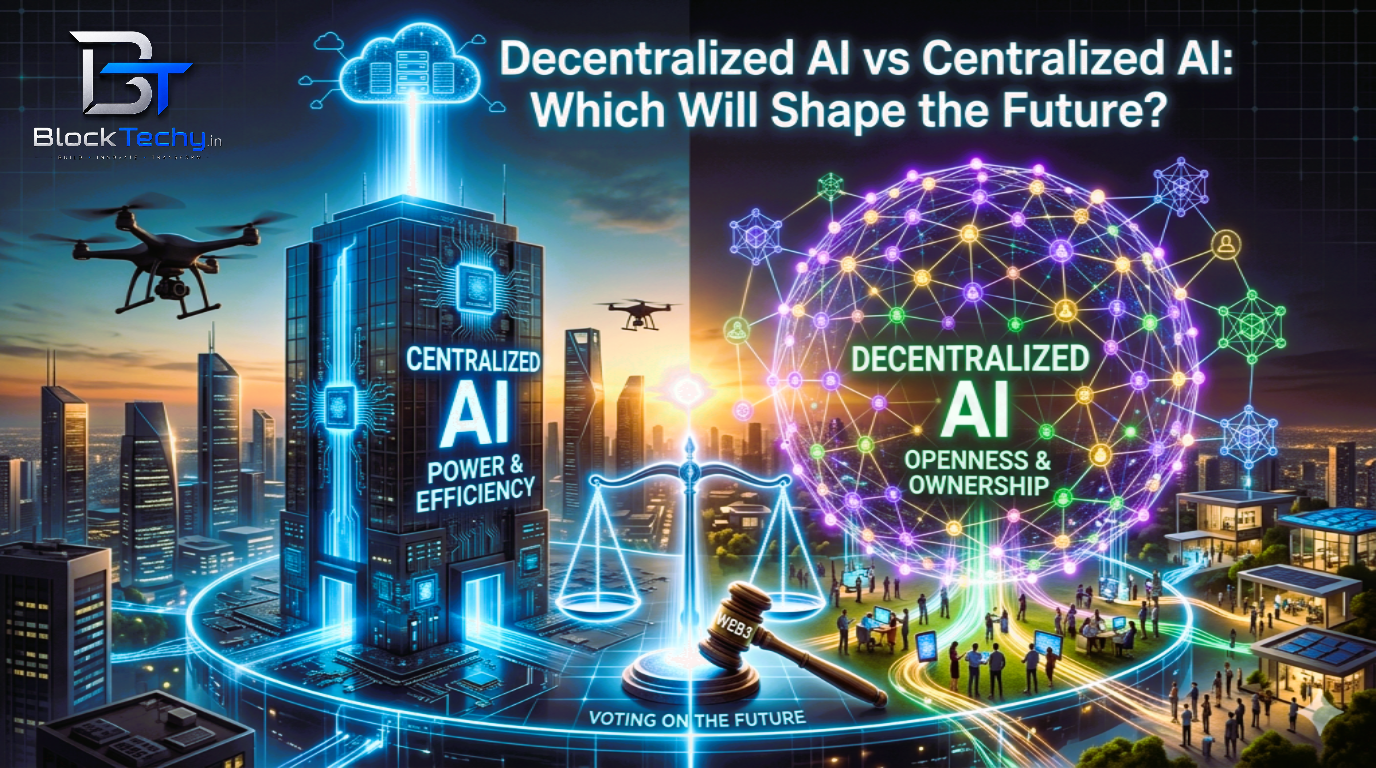
Artificial intelligence (AI) is transforming industries at an unprecedented pace, from healthcare and finance to marketing and entertainment. But as AI becomes more powerful, an important debate is taking center stage: Should AI remain centralized under the control of a few major tech companies, or should it become decentralized and community-driven?
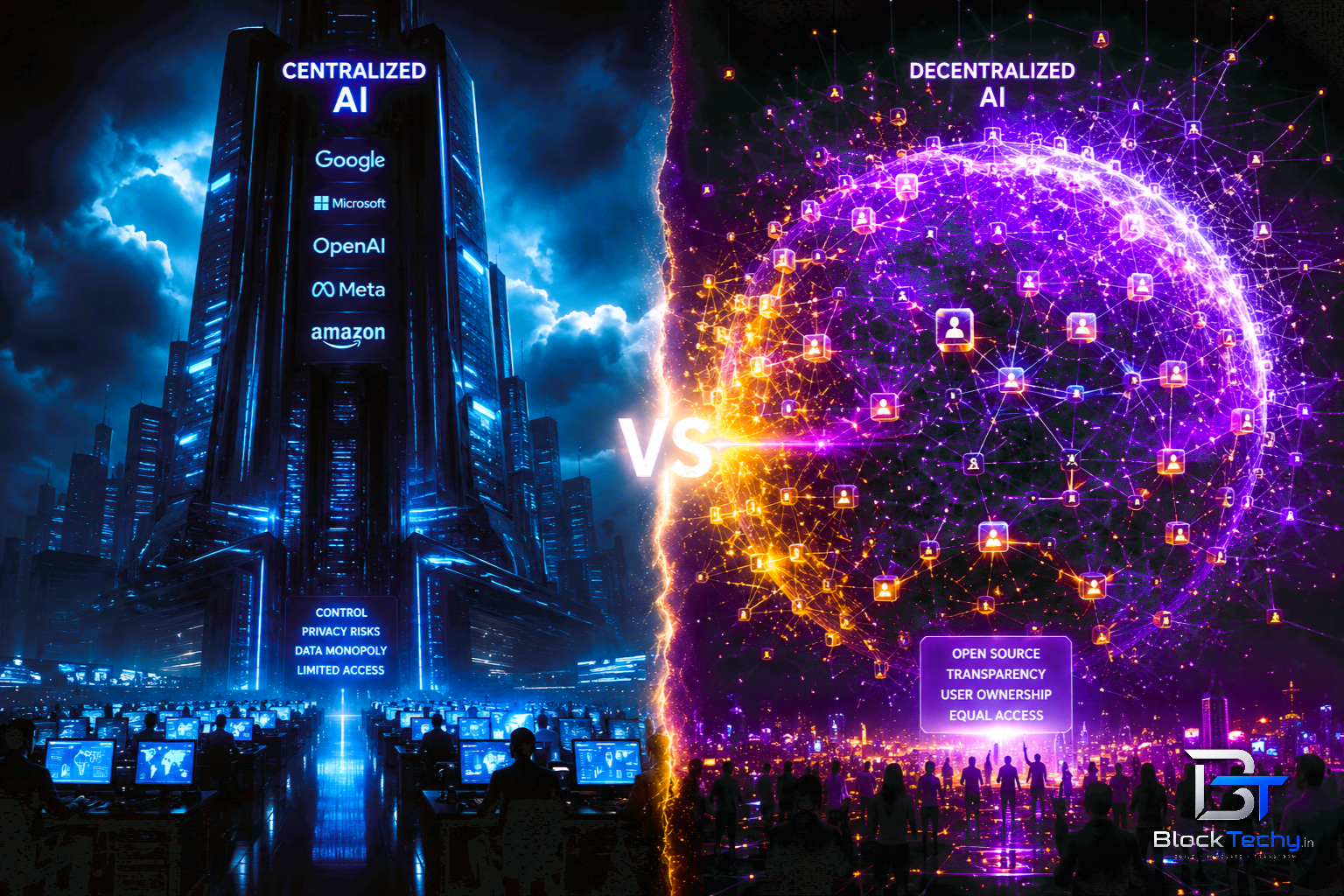
This discussion is especially relevant in the Web3 era, where decentralization, transparency, and user ownership are core principles. While centralized AI currently dominates the market, decentralized AI is emerging as a disruptive alternative that promises greater privacy, openness, and democratic access.
So, decentralized AI vs centralized AI—which model will shape the future? Let’s explore.
What Is Centralized AI?
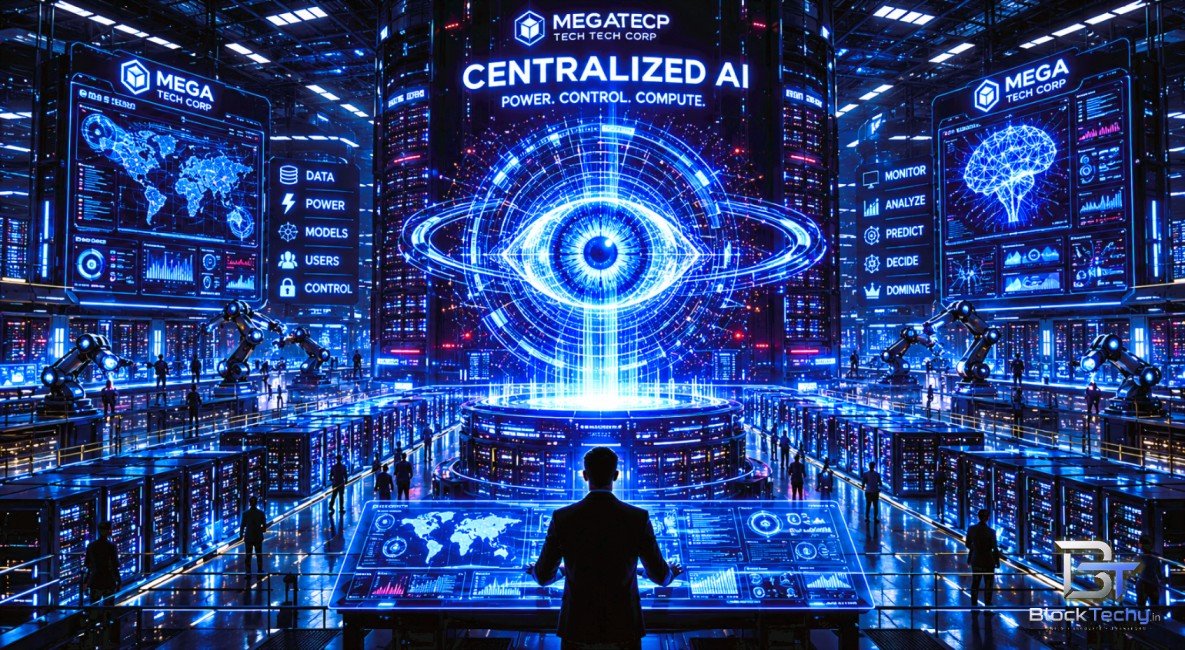
Centralized AI refers to artificial intelligence systems that are developed, controlled, and operated by a single organization or company. These organizations manage the infrastructure, datasets, models, and decision-making processes.
Popular examples include:
- OpenAI
- Google DeepMind
- Microsoft AI
- Amazon AI
- Meta AI
In this model, AI systems run on privately owned cloud servers, and users typically access them through APIs, apps, or subscription services.
Key Characteristics of Centralized AI
- Controlled by one organization
- Proprietary datasets and algorithms
- High computational power
- Faster model training and deployment
- Limited transparency
- Users depend on platform rules and pricing
Centralized AI has fueled massive innovation, but it also raises concerns around data ownership, censorship, and monopolistic control.
What Is Decentralized
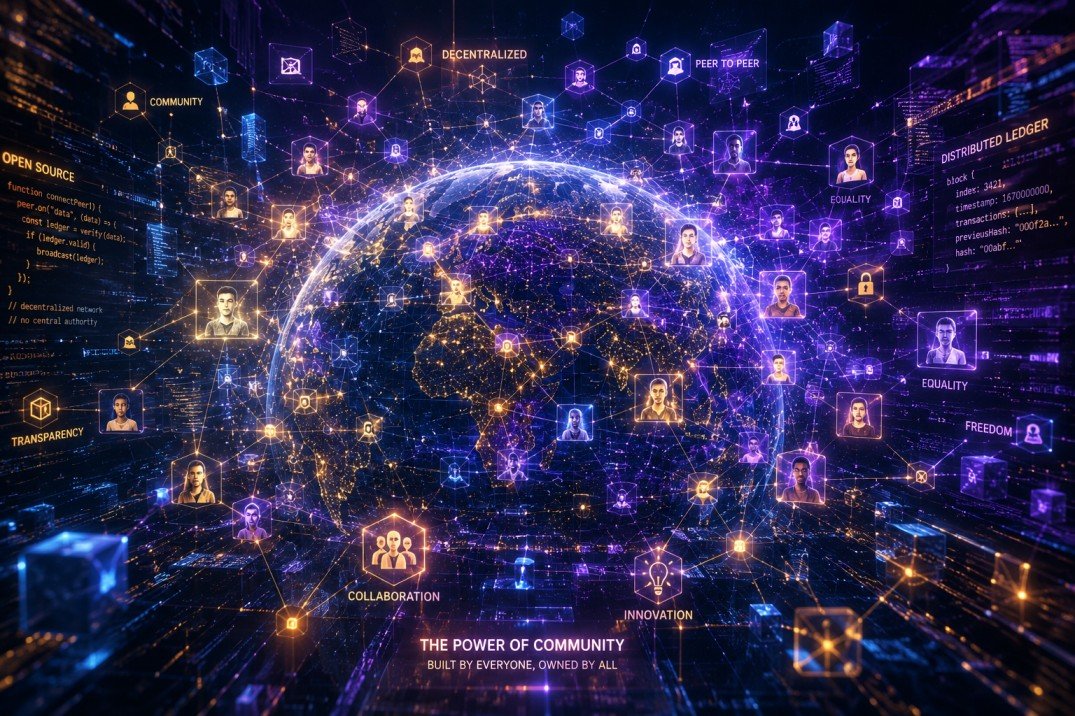
Decentralized AI distributes AI development, computation, and governance across a network instead of relying on a single authority.
This approach often combines blockchain technology
, distributed computing, token incentives, and open-source collaboration to create AI systems that are transparent and community-owned.
Examples of decentralized AI projects include:
Instead of one company controlling everything, participants contribute computing power, data, models, or services to the ecosystem.
Key Characteristics of Decentralized AI
- Community-driven development
- Distributed infrastructure
- Transparent governance
- Token-based incentives
- Open participation
- Greater resistance to censorship
Decentralized AI aligns closely with Web3’s philosophy of ownership and openness.
Decentralized AI vs Centralized AI: Key Differences
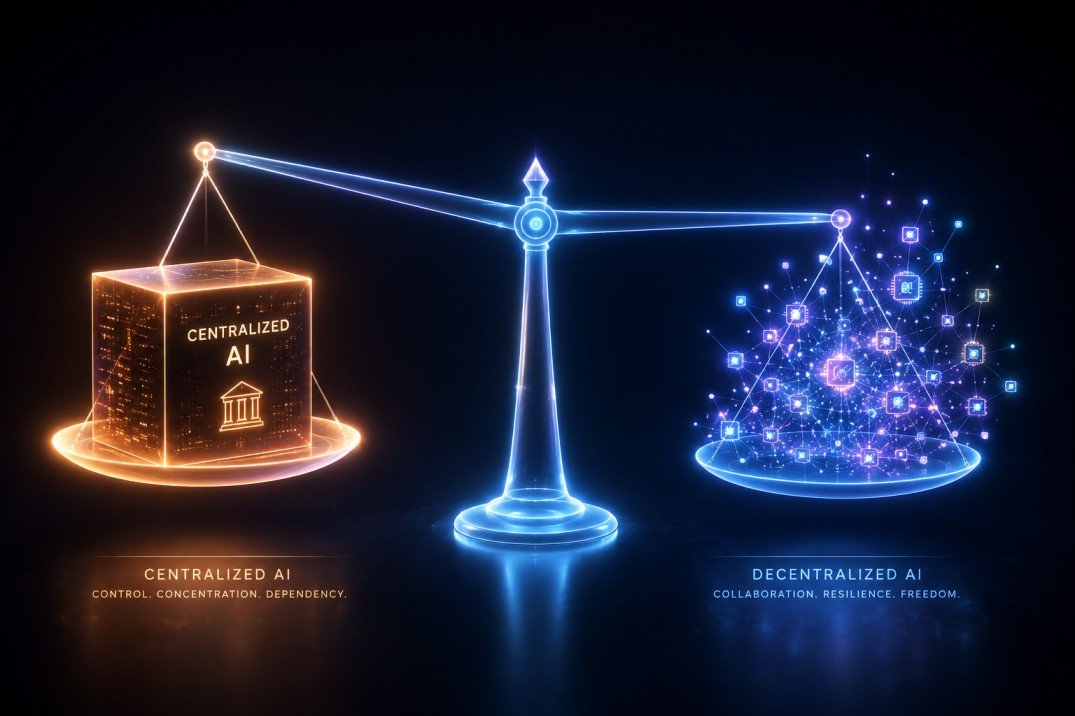
| Feature | Centralized AI | Decentralized AI |
|---|---|---|
| Control | Single organization | Distributed network |
| Transparency | Low | High |
| Data Ownership | Company-controlled | User/community-controlled |
| Scalability | Strong | Improving |
| Security | Single point of failure | Distributed resilience |
| Innovation Speed | Fast | Moderate |
| Cost Efficiency | Expensive infrastructure | Shared resource model |
| Governance | Corporate decisions | Community voting |
Advantages of Centralized AI
Despite criticism, centralized AI has significant strengths.
1. Superior Performance
Companies like OpenAI and Google have access to enormous computational resources, enabling them to train highly advanced models quickly.
Training large AI models requires:
- Massive GPU clusters
- Huge datasets
- Specialized engineering teams
This scale gives centralized players a major advantage.
2. Faster Innovation
Decision-making is streamlined because one company controls the roadmap.
There’s no need for community governance votes or distributed consensus delays.
As a result:
- New features launch faster
- Updates happen quickly
- Bugs are fixed efficiently
3. Better User Experience
Centralized platforms usually offer polished interfaces and reliable uptime.
For example:
- ChatGPT
- Gemini
- Claude
These products are designed for mainstream users.
4. Strong Funding
Big tech companies can invest billions into research.
This financial power accelerates breakthroughs in:
- Large language models
- Robotics
- AI chips
- Multimodal AI
Challenges of Centralized AI

Centralized AI also has serious limitations.
Privacy Risks
User data often flows through centralized servers.
This creates concerns about:
- Data misuse
- Surveillance
- Lack of ownership
Users rarely have full control over how their information is used.
Lack of Transparency
Many AI systems operate as black boxes.
Users don’t know:
- How models were trained
- Which datasets were used
- Why certain outputs occur
This reduces trust.
Monopoly Concerns
A few corporations dominate AI development.
This can lead to:
- Market concentration
- Higher prices
- Reduced competition
- Innovation bottlenecks
Censorship and Control
Centralized providers can:
- Restrict access
- Filter outputs
- Change policies anytime
This creates dependency.
Advantages of Decentralized AI
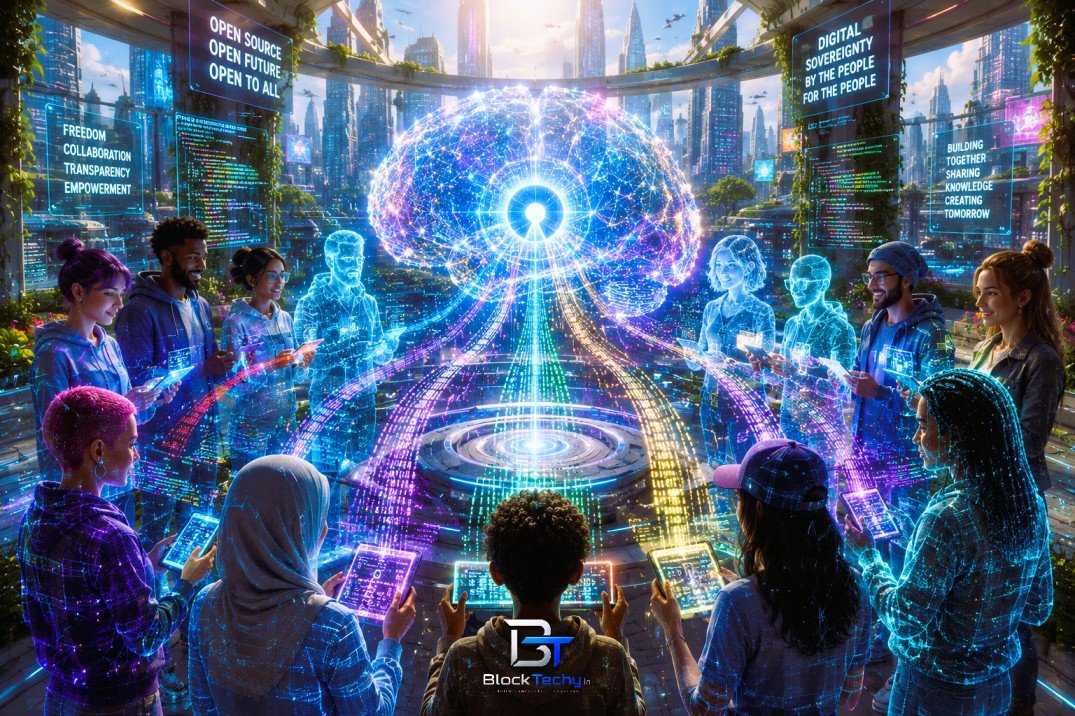
Decentralized AI addresses many of these concerns.
1. Greater Transparency
Open systems allow users to inspect:
- Governance rules
- Incentive structures
- Sometimes even model logic
Transparency improves trust.
2. User Ownership
In decentralized ecosystems, users may own:
- Their data
- Tokens
- Governance rights
- AI-generated assets
This shifts power from corporations to communities.
3. Censorship Resistance
Because infrastructure is distributed, no single entity can easily shut down the system.
This supports:
- Open access
- Global participation
- Reduced platform dependency
4. Incentivized Collaboration
Token economies encourage participation.
Contributors can earn rewards for:
- Supplying compute power
- Sharing data
- Building models
- Improving services
This creates a collaborative innovation ecosystem.
5. Alignment With Web3 Principles
Decentralized AI fits naturally into Web3.
Shared values include:
- Decentralization
- Ownership
- Permissionless access
- Community governance
Challenges of Decentralized AI
Despite its promise, decentralized AI faces hurdles.
Scalability Issues
Distributed systems often struggle with speed and coordination.
AI workloads are computationally intense.
Challenges include:
- Network latency
- Resource fragmentation
- Performance inconsistencies
Governance Complexity
Community governance sounds ideal—but can be messy.
Problems include:
- Slow decisions
- Token whales influencing votes
- Governance disputes
Decentralization can reduce efficiency.
Funding Constraints
Most decentralized projects cannot match Big Tech budgets.
Training cutting-edge AI models is extremely expensive.
Without strong funding, progress may lag.
User Experience Gaps
Many decentralized platforms remain difficult for non-technical users.
Challenges:
- Wallet setup
- Token management
- Complex onboarding
Mass adoption requires simplicity.
Real-World Examples
Centralized AI Leaders
OpenAI
Known for ChatGPT and advanced language models.
Strengths:
- Cutting-edge performance
- Strong infrastructure
- Rapid deployment
Google DeepMind
A leader in AI research and large-scale innovation.
Meta AI
Aggressive open model development with strong centralized infrastructure.
Decentralized AI Innovators
Bittensor
A decentralized machine learning network where contributors earn rewards.
SingularityNET
A decentralized marketplace for AI services.
Fetch.ai
Combines autonomous agents with decentralized infrastructure.
Ocean Protocol
Focuses on decentralized data sharing for AI.
These projects represent the Web3 vision of AI.
Which Model Is Better for Businesses?
The answer depends on priorities.
Choose centralized AI if your business values:
- Speed
- Reliability
- Enterprise support
- Proven performance
Choose decentralized AI if your priorities include:
- Transparency
- Data ownership
- Community participation
- Reduced vendor lock-in
Hybrid adoption may become common.
The Future: Hybrid AI May Win
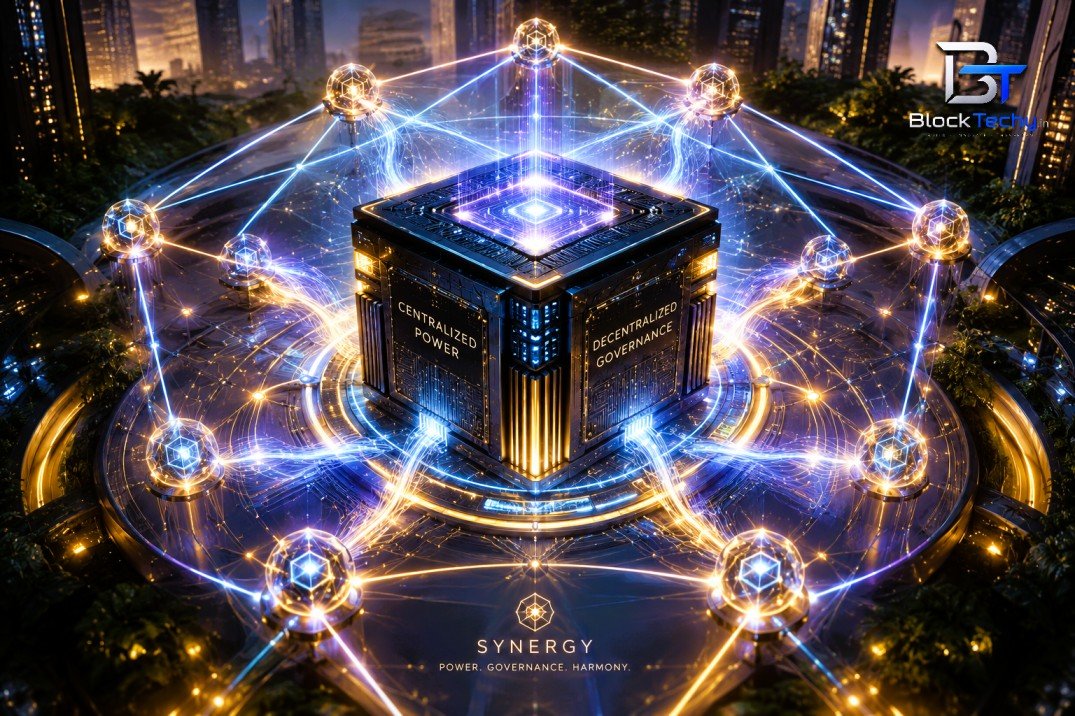
The future may not be a winner-takes-all battle.
A hybrid model could emerge where:
- Centralized AI delivers performance
- Decentralized AI delivers openness
Possible scenario:
A business uses centralized large models for computation but decentralized infrastructure for data ownership and governance.
This combines:
- Efficiency
- transparency
- scalability
- trust
Many experts believe hybrid AI is the most realistic path.
Final Verdict: Which Will Shape the Future?
Right now, centralized AI leads in capability, funding, and adoption.
But decentralized AI is gaining momentum as privacy concerns, censorship fears, and monopoly risks grow.
If the future prioritizes:
- Convenience
- Speed
- enterprise performance
Centralized AI may dominate.
If the future prioritizes:
- Ownership
- openness
- transparency
- digital sovereignty
Decentralized AI could reshape the industry.
The most likely outcome?
Both models will coexist—but decentralized AI may become one of the most important forces in the Web3 economy.
Conclusion

The debate between decentralized AI and centralized AI reflects a broader question about the future of technology itself: Should intelligence be controlled by a few powerful institutions, or shared across global communities?
Centralized AI delivers unmatched performance today.
Decentralized AI offers a compelling vision for tomorrow.
As AI and Web3 continue to evolve, the real winner may be the ecosystem that successfully balances innovation, trust, openness, and usability.
One thing is certain: the future of AI will not be shaped by technology alone—but by who controls it.
Follow this link to join my WhatsApp group: https://chat.whatsapp.com/JvmrMTxkdgt9u6kGMT73XY
Great analysis. The future of AI may not be a winner-takes-all scenario between centralized and decentralized models. Centralized AI offers scale and efficiency, while decentralized AI promotes transparency, ownership, and resilience. The real innovation could come from combining the strengths of both approaches.
Thanks ! Glad you found it useful. Always exciting to discuss new tech and innovations.
The debate isn’t just about technology—it’s about who controls intelligence, data, and value creation. Decentralized AI challenges existing power structures and opens the door to a more inclusive AI ecosystem. Fascinating topic.
Appreciate your feedback! Technology keeps evolving, and there’s always something new to learn.
Great insights. As AI becomes increasingly integrated into our lives, questions around transparency, governance, and accessibility become more important. Decentralized AI brings an interesting perspective to solving these challenges.
Appreciate your feedback! Technology keeps evolving, and there’s always something new to learn.
The most valuable takeaway is that AI infrastructure and governance matter just as much as model performance. Decentralized AI brings critical discussions around censorship resistance, data sovereignty, and incentive alignment to the forefront. Great article.
Appreciate your feedback! Technology keeps evolving, and there’s always something new to learn.
“I’ve been looking for a review on [Product/Tool] that cuts through the marketing fluff. This gave me a great, honest look at the pros and cons. Thanks!”