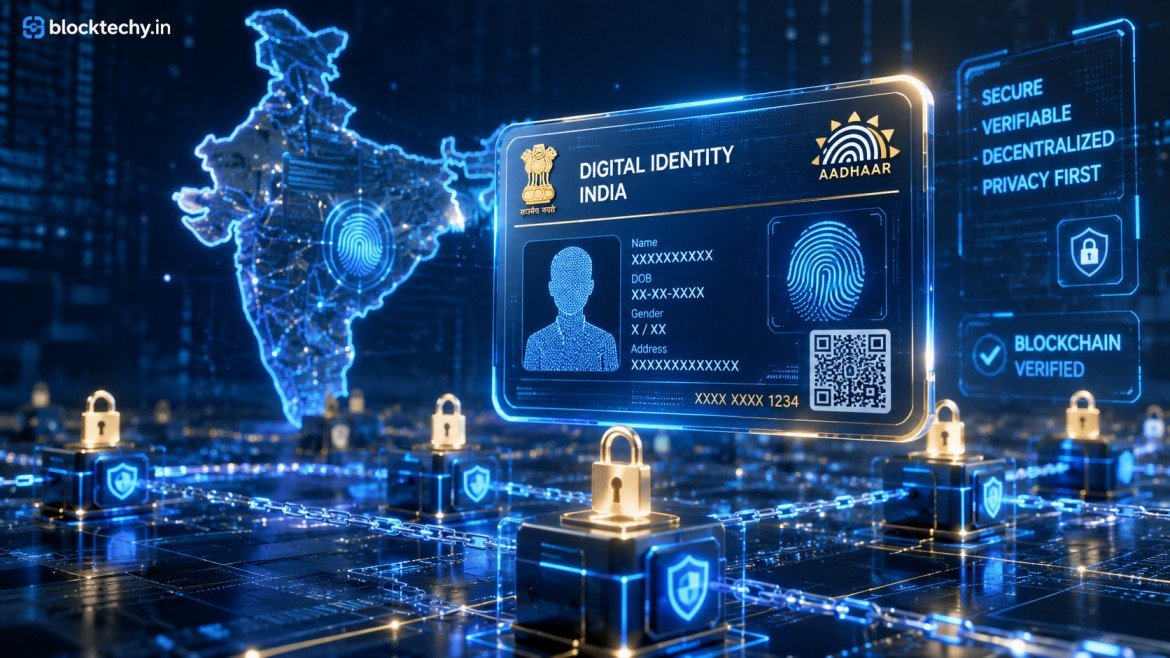
Introduction
India has emerged as a global leader in digital transformation, with Aadhaar serving as the backbone of the country’s digital identity ecosystem. Introduced by the Unique Identification Authority of India (UIDAI), Aadhaar has enabled over 1.4 billion residents to access banking, government welfare schemes, healthcare, taxation, and countless digital services through a single unique identity number.
While Aadhaar has undoubtedly revolutionized identity verification, concerns surrounding data privacy, centralized storage, cyberattacks, unauthorized access, and user control over personal information continue to spark public debate. As India rapidly moves toward a fully digital economy, the question becomes increasingly relevant:
Could blockchain technology make Aadhaar more secure, transparent, and privacy-friendly?
Blockchain has already transformed industries such as finance, supply chain management, healthcare, and digital assets by introducing decentralized trust and tamper-proof records. Many experts now believe similar principles could strengthen digital identity systems worldwide.
This article explores how blockchain could complement—not necessarily replace—Aadhaar, examines its potential benefits and challenges, discusses global blockchain identity initiatives, and analyzes what the future of India’s digital identity might look like.
Understanding Aadhaar Today
Aadhaar is a 12-digit unique identification number linked to biometric and demographic information, including:
- Fingerprints
- Iris scans
- Facial photograph
- Name
- Date of birth
- Address
- Mobile number
Today Aadhaar powers numerous services including:
- Bank account verification
- PAN linking
- Digital KYC
- Government subsidies
- Direct Benefit Transfer (DBT)
- SIM verification
- Passport applications
- Healthcare authentication
- Education services
The system has significantly reduced identity fraud and improved welfare distribution efficiency.
However, because Aadhaar relies primarily on a centralized database, it also creates concerns regarding data security and centralized risk.
The Challenges Facing Aadhaar
Although Aadhaar has been remarkably successful, several challenges remain.
1. Centralized Database Risks
Large centralized databases become attractive targets for hackers.
Even with advanced security mechanisms, no centralized infrastructure is completely immune from:
- Cyberattacks
- Insider threats
- Data leaks
- System outages
A single breach could potentially affect millions of citizens.
2. Privacy Concerns
Digital privacy has become one of the biggest global issues.
Many citizens worry about:
- Who can access their data
- How long their information is stored
- Whether organizations collect more data than necessary
- How consent is managed
Users often have limited visibility into how their identity data is shared.
3. Identity Theft
Although Aadhaar itself is secure, criminals increasingly attempt:
- Fake KYC
- SIM swap fraud
- Identity impersonation
- Social engineering attacks
The stronger identity systems become, the more sophisticated attackers evolve.
4. Data Sharing Between Organizations
Today multiple institutions independently verify Aadhaar information.
This process may involve:
- Repeated KYC
- Multiple data copies
- Different storage systems
- Inconsistent security standards
Each additional copy increases exposure.
What is Blockchain?
Blockchain is a decentralized digital ledger that stores information across multiple computers instead of relying on a single central server.
Each block contains:
- Data
- Timestamp
- Cryptographic hash
- Link to the previous block
Once information is recorded, altering it becomes extremely difficult without network consensus.
Key blockchain features include:
- Decentralization
- Transparency
- Tamper resistance
- Cryptographic security
- Immutable records
- Smart contracts
These characteristics make blockchain an attractive technology for identity management.
Can Blockchain Replace Aadhaar?
The short answer is:
Probably not.
Aadhaar already has:
- Nationwide infrastructure
- Legal framework
- Biometric enrollment
- Massive user adoption
- Government integration
Replacing it entirely would be extremely expensive and operationally challenging.
Instead, blockchain could enhance Aadhaar by improving security, privacy, consent management, and auditability.
Think of blockchain as an additional trust layer rather than a replacement.
How Blockchain Could Improve Aadhaar
1. Decentralized Identity (DID)
One of blockchain’s most exciting innovations is Decentralized Identity (DID).
Instead of organizations storing copies of your identity documents, users own their credentials in secure digital wallets.
For example:
Instead of uploading your Aadhaar card repeatedly, you could simply prove:
- I am over 18
- I live in Maharashtra
- I am an Indian citizen
without revealing your complete Aadhaar details.
This concept is known as selective disclosure.
2. Better User Control
Blockchain identity systems give users greater ownership over their data.
Citizens could decide:
- Who accesses their information
- What information is shared
- How long access remains active
- Whether access can be revoked
This creates a privacy-first approach.
3. Immutable Audit Trails
Every access request could be recorded on blockchain.
Citizens would know:
- Which organization viewed their identity
- When it happened
- What information was accessed
- Why it was requested
Such transparency builds trust.
4. Reduced Identity Fraud
Blockchain records are extremely difficult to manipulate.
Benefits include:
- Preventing fake identities
- Detecting duplicate records
- Stronger authentication
- Better verification mechanisms
Fraudsters would find identity manipulation much harder.
5. Faster Digital Verification
Banks, telecom companies, insurers, and government departments could verify credentials almost instantly.
Instead of repeated KYC processes, verified blockchain credentials could dramatically reduce paperwork.
Benefits include:
- Faster onboarding
- Reduced operational costs
- Better customer experience
6. Smart Contract Automation
Blockchain smart contracts could automate many Aadhaar-related workflows.
Examples include:
- Scholarship verification
- Pension eligibility
- Welfare distribution
- Educational certificates
- Digital licenses
Rules execute automatically once predefined conditions are met.
Self-Sovereign Identity (SSI)
One emerging concept closely related to blockchain is Self-Sovereign Identity (SSI).
In SSI systems:
- Individuals own their identity.
- Organizations issue verifiable credentials.
- Users choose when to share them.
- Blockchain verifies authenticity.
For example:
A university issues a digital degree.
Instead of contacting the university every time an employer wants verification, the employer simply verifies the credential cryptographically.
The same model could apply to Aadhaar-based identity verification.
Real-World Countries Exploring Blockchain Identity
India is not alone in exploring blockchain identity solutions.
Estonia
Estonia is often considered the world’s most advanced digital society.
Its citizens enjoy:
- Digital healthcare
- Digital voting
- Online business registration
- Secure government portals
Blockchain-inspired technologies protect many government services.
European Union
The European Union is developing the European Digital Identity Wallet, allowing citizens to securely store and share identity credentials across member states.
Privacy and user consent are central to the design.
South Korea
South Korea has invested heavily in blockchain-powered digital identity for financial services and public administration.
Canada
Several Canadian organizations are experimenting with decentralized identity solutions for secure credential verification.
Challenges of Blockchain-Based Aadhaar
Despite its promise, blockchain is not a magic solution.
Several challenges remain.
1. Scalability
Aadhaar authenticates millions of users every day.
Blockchain networks may struggle with:
- High transaction volumes
- Storage requirements
- Network latency
Large-scale optimization would be essential.
2. Privacy vs Transparency
Public blockchains expose transaction histories.
Identity systems require confidentiality.
Future solutions would likely rely on:
- Permissioned blockchains
- Zero-Knowledge Proofs
- Encryption
- Off-chain storage
Only verification proofs—not personal information—should reside on-chain.
3. Regulatory Framework
Identity systems require strong legal support.
Questions include:
- Who governs the blockchain?
- Who validates transactions?
- Who resolves disputes?
- How is data deleted when legally required?
These issues need careful policy design.
4. Infrastructure Costs
Migrating national identity systems requires:
- Software upgrades
- Hardware investments
- Staff training
- Public awareness
- Integration with existing systems
The transition would likely occur gradually.
5. Digital Literacy
Millions of citizens still rely on assisted digital services.
Managing cryptographic wallets or decentralized credentials may initially be challenging for many users.
User-friendly interfaces would be essential.
The Role of Zero-Knowledge Proofs
One exciting technology that complements blockchain identity is Zero-Knowledge Proofs (ZKPs).
ZKPs allow users to prove a statement is true without revealing the underlying data.
Examples:
Instead of sharing:
- Date of birth
You prove:
- I am older than 18.
Instead of sharing:
- Complete Aadhaar number
You prove:
- I am a verified Indian resident.
This significantly enhances privacy while maintaining trust.
Could India Build a Hybrid Aadhaar System?
Rather than replacing Aadhaar, experts often suggest a hybrid architecture.
Possible design:
Current Aadhaar Infrastructure
↓
Identity Verification
↓
Blockchain Verification Layer
↓
Citizen Consent Layer
↓
Decentralized Credential Wallet
↓
Government & Private Services
This model preserves existing investments while adding blockchain’s strengths.
Benefits for Citizens
If implemented carefully, blockchain-enhanced Aadhaar could provide:
- Greater privacy
- Stronger cybersecurity
- Better transparency
- Faster verification
- Reduced paperwork
- Less fraud
- More user control
- Secure digital credentials
Citizens become active owners of their digital identity rather than passive data providers.
Benefits for Government
Government agencies could benefit from:
- Lower fraud
- Better audit trails
- Efficient welfare delivery
- Reduced duplicate identities
- Easier cross-department verification
- Increased citizen trust
Blockchain could improve governance while reducing administrative overhead.
Benefits for Businesses
Businesses performing KYC could experience:
- Faster customer onboarding
- Lower compliance costs
- Reduced fraud
- Better identity verification
- Secure credential validation
Industries such as banking, fintech, healthcare, insurance, and education would particularly benefit.
Future Technologies That Could Work Alongside Blockchain
Blockchain alone is not enough.
Future digital identity systems may combine:
- Artificial Intelligence
- Zero-Knowledge Proofs
- Biometric authentication
- Decentralized Identity (DID)
- Verifiable Credentials
- Multi-Factor Authentication
- Confidential Computing
- Secure Digital Wallets
Together, these technologies could create one of the world’s most advanced identity ecosystems.
What Could the Next 10 Years Look Like?
Over the next decade, India may gradually move toward more privacy-preserving identity systems.
Possible developments include:
- Blockchain-based consent management
- Paperless KYC
- Digital credential wallets
- Verifiable educational certificates
- Blockchain-powered land records
- Cross-border digital identity interoperability
- AI-assisted fraud detection
- Stronger citizen data ownership
Rather than a sudden transformation, blockchain adoption is likely to happen incrementally through pilot projects and targeted integrations.
Conclusion
Aadhaar has already transformed India’s digital landscape by providing billions of identity verifications, enabling financial inclusion, and improving access to public services. Yet, as digital ecosystems grow more interconnected, the demand for stronger privacy, security, and user control continues to rise.
Blockchain offers an opportunity to address many of these challenges. Its decentralized architecture, tamper-resistant records, smart contracts, and support for decentralized identity models could complement Aadhaar by creating more transparent and privacy-preserving identity verification systems. Technologies such as Decentralized Identity (DID), Verifiable Credentials, and Zero-Knowledge Proofs demonstrate how users could verify essential information without exposing unnecessary personal data.
However, implementing blockchain within a national identity framework is far from simple. Scalability, governance, legal compliance, infrastructure costs, and digital literacy remain significant hurdles. A full replacement of Aadhaar is unlikely in the foreseeable future. Instead, a hybrid approach—where blockchain enhances existing infrastructure—appears to be the most practical path forward.
As India continues its digital transformation journey, the convergence of blockchain, artificial intelligence, cryptography, and secure digital identity standards could redefine how citizens interact with government services and private organizations. If executed thoughtfully, the next generation of India’s digital identity system could become a global benchmark for security, transparency, and user empowerment.
The future of digital identity may not be about choosing between Aadhaar and blockchain—it may be about combining the strengths of both to build a safer, smarter, and more trustworthy digital India.
Frequently Asked Questions (FAQs)
1. Can blockchain completely replace Aadhaar?
No. Aadhaar is deeply integrated into India’s digital infrastructure. Blockchain is more likely to enhance Aadhaar by adding layers of security, transparency, and user-controlled identity rather than replacing it.
2. What is Decentralized Identity (DID)?
Decentralized Identity (DID) is a model where individuals control their digital identity and selectively share verified information without exposing unnecessary personal data.
3. How can blockchain improve Aadhaar security?
Blockchain can strengthen Aadhaar through tamper-resistant audit trails, decentralized verification, consent management, reduced identity fraud, and privacy-preserving technologies like Zero-Knowledge Proofs.
4. Which countries are exploring blockchain-based digital identity?
Countries such as Estonia, South Korea, Canada, and members of the European Union are actively experimenting with blockchain or decentralized identity frameworks for secure digital identity management.
5. What is the biggest challenge in combining blockchain with Aadhaar?
The major challenges include scalability, privacy protection, legal governance, infrastructure upgrades, and ensuring that blockchain solutions remain accessible and user-friendly for India’s diverse population.