Introduction
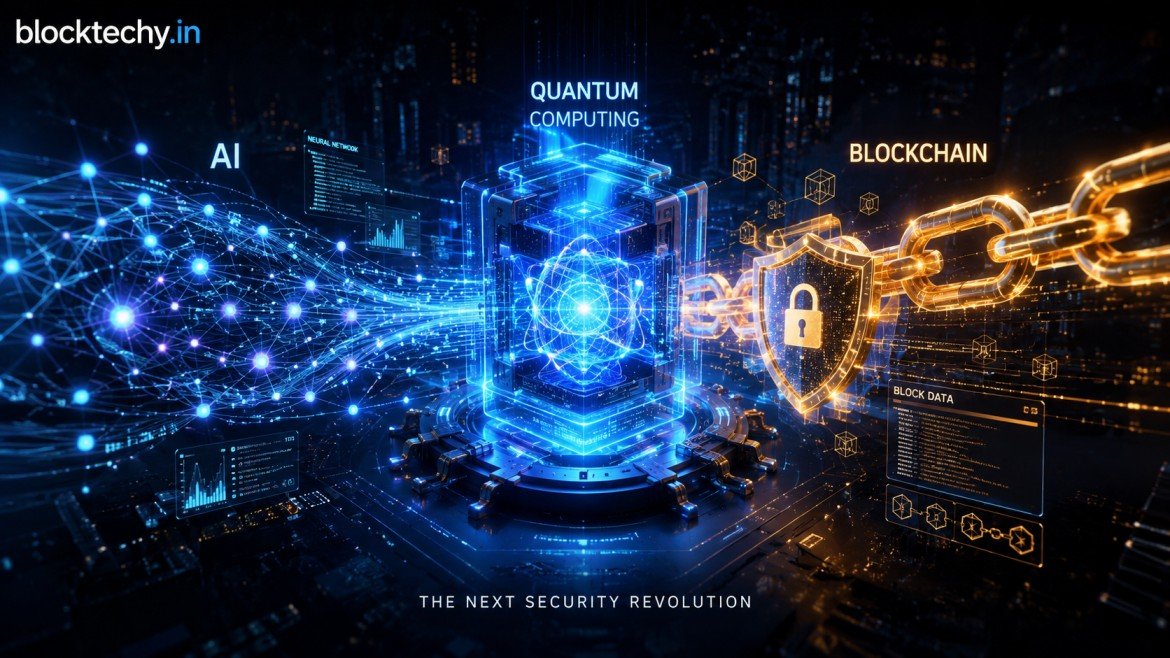
The world is entering a new era of technology where Quantum Computing, Artificial Intelligence (AI), and Blockchain are no longer developing independently. Instead, they are beginning to merge into a powerful ecosystem capable of transforming cybersecurity, finance, healthcare, scientific research, and digital trust.
For years, blockchain has been considered one of the most secure technologies because of its cryptographic foundation. AI has revolutionized automation, decision-making, and cybersecurity. Meanwhile, quantum computing promises computational power beyond anything classical computers can achieve.
But this technological evolution brings both opportunities and challenges.
Can quantum computers break blockchain encryption?
Can AI defend blockchain networks from quantum attacks?
Will post-quantum cryptography become the new global standard?
This article explores how these three technologies are shaping the next security revolution.
Understanding the Three Technologies
What is Quantum Computing?
Quantum computing is a completely different approach to computing compared to traditional computers.
Traditional computers use bits, which can be either 0 or 1.
Quantum computers use qubits, which can exist in multiple states simultaneously because of principles like:
- Superposition
- Entanglement
- Quantum interference
This enables quantum computers to solve certain complex mathematical problems exponentially faster than today’s supercomputers.
Industries expected to benefit include:
- Drug discovery
- Climate modeling
- Financial optimization
- Logistics
- Material science
- Cryptography
However, this same computational power could threaten current internet security systems.
What is Artificial Intelligence?
Artificial Intelligence enables machines to learn patterns, analyze massive datasets, and make intelligent decisions without explicit programming.
Modern AI powers:
- Chatbots
- Fraud detection
- Recommendation engines
- Autonomous vehicles
- Medical diagnosis
- Cybersecurity monitoring
In cybersecurity, AI continuously analyzes billions of events to detect suspicious activities much faster than humans.
What is Blockchain?
Blockchain is a decentralized digital ledger where transactions are grouped into blocks linked together using cryptographic hashes.
Key features include:
- Decentralization
- Transparency
- Immutability
- Cryptographic security
- Consensus mechanisms
Popular blockchain networks include:
- Bitcoin
- Ethereum
- Solana
- Cardano
- Avalanche
Blockchain eliminates the need for centralized trust by allowing distributed verification.
Why Security is Becoming More Challenging
Cyberattacks are increasing every year.
Organizations now face:
- AI-powered phishing attacks
- Deepfake fraud
- Ransomware
- Smart contract exploits
- Identity theft
- Quantum computing threats
Traditional security systems are struggling to keep pace.
This is where the combination of AI and blockchain becomes increasingly important.
The Quantum Threat to Cryptography
Almost every secure internet protocol today depends on mathematical problems that are extremely difficult for classical computers.
Examples include:
- RSA
- ECC (Elliptic Curve Cryptography)
- Diffie-Hellman
Blockchain wallets also rely heavily on elliptic curve cryptography.
For classical computers, breaking these algorithms would require millions of years.
However, quantum computers running Shor’s Algorithm could theoretically solve these problems dramatically faster.
If large-scale fault-tolerant quantum computers become practical, they may:
- Recover private keys from public keys
- Forge digital signatures
- Break encrypted communications
- Compromise blockchain wallets
- Attack banking systems
This is why researchers are preparing for a post-quantum future today.
Is Blockchain Really in Danger?
The answer is:
Not immediately—but eventually, yes, if no upgrades are made.
Today’s quantum computers are still limited by:
- High error rates
- Limited qubit counts
- Short coherence times
Current machines cannot break Bitcoin or Ethereum encryption today.
However, experts warn about the “Harvest Now, Decrypt Later” strategy.
Attackers may collect encrypted data today and decrypt it years later when sufficiently powerful quantum computers become available.
Sensitive information with long-term value could therefore be at risk even before quantum computers mature.
AI as the First Line of Defense
Artificial Intelligence is becoming one of cybersecurity’s strongest defensive tools.
AI systems can:
- Detect unusual wallet behavior
- Identify suspicious blockchain transactions
- Monitor network traffic
- Predict fraud patterns
- Discover zero-day attacks
- Prevent account takeovers
Unlike rule-based systems, AI continuously learns from new attack patterns.
Large financial institutions already use AI-driven security systems that analyze millions of transactions every second.
AI + Blockchain = Smarter Security
The integration of AI and blockchain creates several new security capabilities.
Intelligent Fraud Detection
AI can analyze blockchain transactions to detect:
- Money laundering
- Wash trading
- Rug pulls
- Fake NFT trading
- Insider trading
Blockchain provides transparent transaction histories while AI identifies hidden patterns.
Automated Smart Contract Auditing
Smart contracts often contain vulnerabilities.
AI can automatically:
- Analyze Solidity code
- Detect security flaws
- Recommend fixes
- Simulate attack scenarios
This significantly reduces development risks.
Decentralized AI
Today’s AI systems are usually controlled by large centralized companies.
Blockchain enables decentralized AI by allowing:
- Distributed model training
- Transparent datasets
- Verifiable AI outputs
- Privacy-preserving collaboration
This reduces bias while improving trust.
Post-Quantum Cryptography
Instead of waiting for quantum computers to become a threat, researchers are developing Post-Quantum Cryptography (PQC).
PQC algorithms are designed to resist attacks from both classical and quantum computers.
Examples include:
- CRYSTALS-Kyber
- CRYSTALS-Dilithium
- Falcon
- SPHINCS+
These algorithms rely on mathematical problems believed to remain difficult even for quantum computers.
Many governments and technology companies are already preparing to migrate toward PQC standards.
Blockchain’s Transition to Quantum Resistance
Future blockchain networks will gradually adopt post-quantum cryptography.
Possible improvements include:
Quantum-resistant wallets
Wallets using post-quantum signature algorithms.
Hybrid cryptography
Using both traditional and quantum-resistant algorithms during transition periods.
Network upgrades
Blockchain protocols may introduce new consensus rules supporting PQC.
Secure key migration
Allowing users to safely transfer assets into quantum-safe addresses.
These upgrades will likely happen gradually over several years.
How AI Helps During Quantum Migration
Migrating billions of blockchain wallets is an enormous challenge.
AI can assist by:
- Identifying vulnerable addresses
- Prioritizing high-risk wallets
- Automating migration processes
- Monitoring suspicious activity
- Predicting attack attempts
- Optimizing network upgrades
This reduces human error while accelerating adoption.
Industries That Will Benefit
Banking
Banks will combine:
- AI fraud detection
- Blockchain settlements
- Quantum-resistant encryption
Benefits include:
- Faster transactions
- Lower fraud
- Better compliance
Healthcare
Medical records require long-term privacy.
Blockchain secures patient records.
AI improves diagnostics.
Quantum-resistant encryption protects sensitive health data for decades.
Government
Governments increasingly rely on digital identity systems.
Future identity infrastructure may include:
- Blockchain verification
- AI threat detection
- Post-quantum cryptography
This strengthens national cybersecurity.
Supply Chains
Blockchain tracks product authenticity.
AI predicts disruptions.
Quantum-safe encryption protects global logistics from future attacks.
Defense
Military communications require protection against future quantum adversaries.
Post-quantum cryptography is becoming a strategic priority for national defense.
Challenges Ahead
Despite the excitement, several obstacles remain.
Quantum Hardware Limitations
Large fault-tolerant quantum computers are still under development.
Significant engineering challenges remain.
Expensive Migration
Replacing global cryptographic infrastructure will cost billions of dollars.
Organizations must upgrade:
- Servers
- Software
- Wallets
- Hardware security modules
- Certificates
AI Bias
Poor-quality training data may produce incorrect security decisions.
Human oversight remains essential.
Blockchain Scalability
Quantum-resistant cryptographic algorithms often require:
- Larger signatures
- More storage
- Increased bandwidth
Developers must optimize performance carefully.
Major Companies Driving the Revolution
Several technology leaders are investing heavily in this convergence.
Researching quantum processors and AI technologies.
IBM
Developing enterprise quantum computing while contributing to quantum-safe security research.
Microsoft
Building Azure Quantum and integrating AI with cloud security.
NVIDIA
Powering AI training while supporting quantum simulation research.
Intel
Developing hardware for AI acceleration and quantum research.
The Road to 2030
Experts expect gradual changes rather than overnight disruption.
Possible timeline:
2026–2027
- AI security adoption accelerates.
- More blockchain security automation.
- Initial post-quantum migration planning.
2028–2029
- Enterprise adoption of post-quantum cryptography increases.
- Hybrid blockchain security becomes common.
- AI-powered blockchain monitoring matures.
2030 and Beyond
- Quantum-resistant wallets become standard.
- AI autonomously manages security operations.
- Blockchain protocols fully integrate post-quantum cryptography.
- Quantum computing solves scientific problems while secure cryptography protects digital assets.
Best Practices for Businesses
Organizations should begin preparing now.
Recommended steps:
- Conduct cryptographic risk assessments.
- Inventory systems using RSA or ECC.
- Follow post-quantum cryptography developments.
- Adopt AI-powered security monitoring.
- Secure blockchain smart contracts with automated auditing.
- Educate employees about evolving cyber threats.
- Develop a phased migration strategy toward quantum-safe encryption.
Early preparation reduces future disruption and strengthens resilience.
Final Thoughts
Quantum Computing, Artificial Intelligence, and Blockchain represent three of the most transformative technologies of our era. While quantum computing introduces new risks to today’s cryptographic foundations, it also drives innovation in stronger security standards. At the same time, AI is becoming an indispensable tool for detecting threats, automating defenses, and helping organizations transition to a quantum-safe future.
Blockchain will not disappear because of quantum computing. Instead, it is expected to evolve with post-quantum cryptography, smarter consensus mechanisms, and AI-assisted security. The result will be a more resilient digital ecosystem where trust, transparency, and intelligent protection work together.
The next decade will not be defined by a competition between these technologies—it will be defined by their collaboration. Businesses, developers, and governments that begin preparing today will be best positioned to thrive in this new era of cybersecurity and digital innovation.
FAQs
1. Can quantum computers hack Bitcoin today?
No. Current quantum computers are not powerful enough to break Bitcoin’s cryptographic security, though future advancements could pose risks if networks do not upgrade.
2. What is post-quantum cryptography?
It is a new generation of cryptographic algorithms designed to remain secure against attacks from both classical and quantum computers.
3. How does AI improve blockchain security?
AI detects suspicious transactions, identifies fraud, audits smart contracts, predicts cyber threats, and automates security monitoring.
4. Will blockchain become obsolete because of quantum computing?
No. Blockchain is expected to evolve by adopting quantum-resistant cryptography and enhanced security mechanisms.
5. Why is this called the next security revolution?
Because the convergence of Quantum Computing, AI, and Blockchain will redefine how digital systems are protected, moving from reactive defenses to intelligent, quantum-safe security architectures.