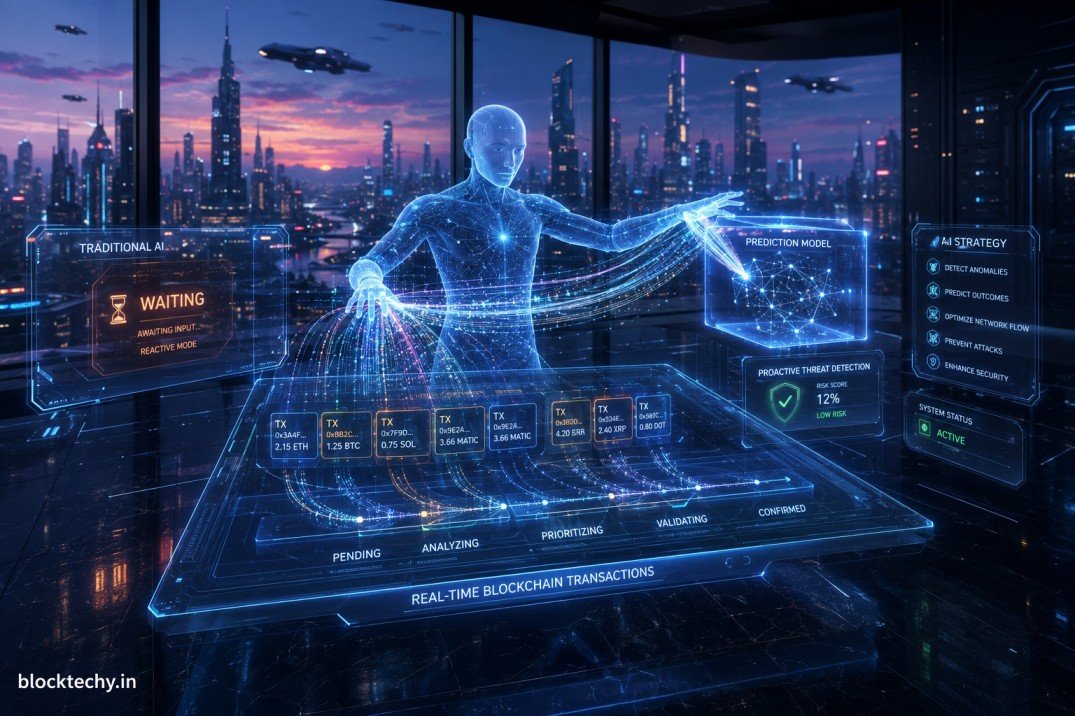
Introduction
Artificial Intelligence has already transformed industries ranging from healthcare to finance. Blockchain, on the other hand, has revolutionized trust by enabling decentralized, transparent, and tamper-proof systems. But what happens when these two groundbreaking technologies merge?
The answer is Agentic AI.
Unlike traditional AI systems that simply respond to commands, Agentic AI can reason, plan, make decisions, and execute actions independently. By 2030, these autonomous AI agents could become one of the most powerful defenses protecting blockchain ecosystems from increasingly sophisticated cyber threats.
As decentralized finance (DeFi), tokenized real-world assets (RWAs), decentralized identities (DIDs), and autonomous AI agents become mainstream, blockchain security will evolve from reactive protection into intelligent, self-healing security systems.
In this article, we’ll explore how Agentic AI could redefine blockchain security by 2030, the opportunities it presents, the challenges it introduces, and why the future of Web3 may depend on autonomous security agents.
Understanding Agentic AI
Traditional AI works like an assistant. It performs tasks based on user instructions.
Agentic AI behaves more like an autonomous employee. It can:
- Analyze situations
- Set goals
- Make decisions
- Execute multiple tasks
- Learn from previous outcomes
- Coordinate with other AI agents
- Operate continuously without human intervention
Instead of waiting for someone to notice a blockchain attack, an Agentic AI security system could detect suspicious behavior, isolate compromised smart contracts, notify validators, deploy security patches, and continue monitoring—all within seconds.
This level of automation represents a major shift in cybersecurity.
Why Blockchain Security Must Evolve
Blockchain networks are highly secure by design, but they are not immune to attacks.
Some of today’s biggest blockchain threats include:
- Smart contract vulnerabilities
- Flash loan attacks
- Oracle manipulation
- Private key theft
- Rug pulls
- Phishing attacks
- Bridge exploits
- Sybil attacks
- Governance attacks
- Validator compromise
As blockchain adoption grows globally, attackers are also becoming more advanced.
By 2030, cybercriminals may themselves use autonomous AI agents capable of discovering vulnerabilities much faster than humans.
Fighting AI-powered attackers with traditional security methods will simply not be enough.
Why Agentic AI Is Different from Traditional Security
Current blockchain security tools usually work like this:
- Detect suspicious activity
- Alert developers
- Wait for human investigation
- Deploy manual fixes
This process can take hours—or even days.
During that time, millions of dollars may already be stolen.
Agentic AI changes this workflow completely.
Instead, autonomous agents could:
- Monitor every transaction in real time
- Predict attacks before execution
- Freeze suspicious contracts automatically
- Alert network participants instantly
- Generate security recommendations
- Patch vulnerabilities
- Resume operations safely
This proactive approach could significantly reduce financial losses.
1. Autonomous Smart Contract Auditing
Smart contracts control billions of dollars across blockchain networks.
Yet even a single coding mistake can lead to catastrophic losses.
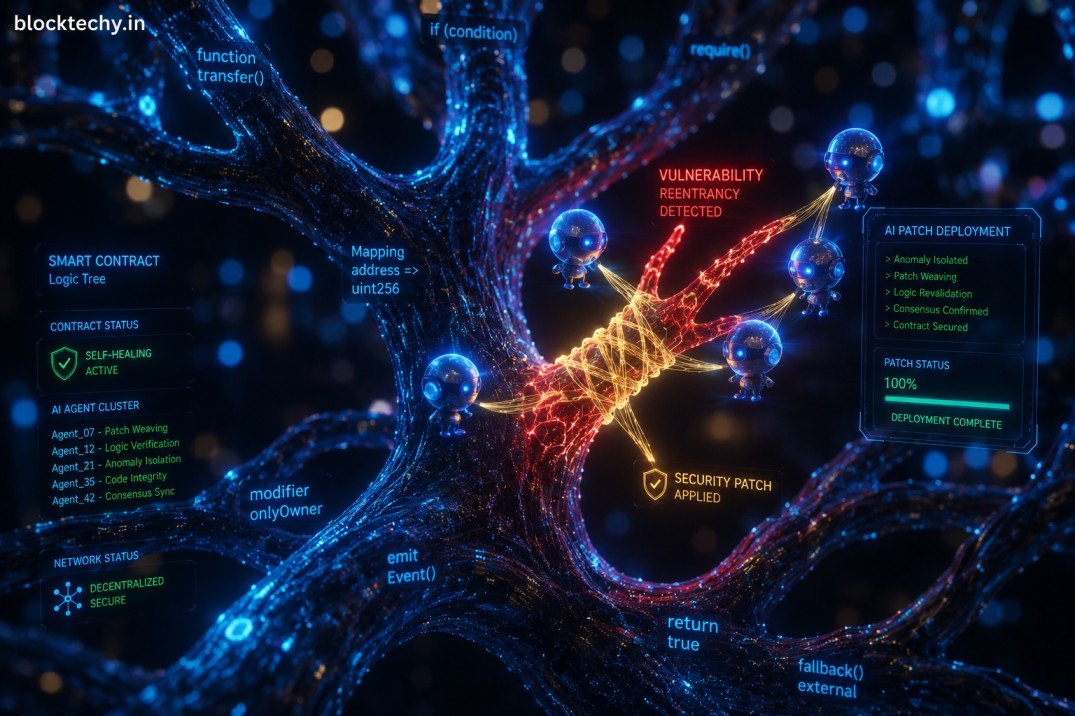
Today’s auditing process involves:
- Human auditors
- Automated scanning tools
- Manual verification
By 2030, Agentic AI could continuously audit smart contracts throughout their entire lifecycle.
Instead of reviewing code only before deployment, AI agents could monitor:
- Code updates
- Contract interactions
- Permission changes
- Dependency risks
- Gas usage anomalies
- Suspicious function calls
The AI could even simulate millions of attack scenarios before hackers discover them.
This creates continuously secured smart contracts rather than one-time audited contracts.
2. Real-Time Threat Detection
Traditional security systems mostly react after attacks begin.
Agentic AI introduces predictive security.
AI agents could monitor:
- Wallet behavior
- Transaction patterns
- Validator performance
- Cross-chain activity
- User authentication
- Contract execution sequences
If abnormal activity appears, the system can immediately investigate.
For example:
A wallet that has never interacted with DeFi suddenly initiates dozens of high-value transactions across multiple chains.
Instead of simply flagging this activity, an AI agent may:
- Verify wallet history
- Compare behavior with known attack models
- Check reputation databases
- Evaluate transaction intent
- Calculate attack probability
If necessary, emergency protocols can activate automatically.
3. Intelligent Fraud Detection
Fraud detection is becoming increasingly difficult.
Attackers constantly invent new techniques.
Agentic AI can identify subtle behavioral anomalies that humans may overlook.
Examples include:
- Fake governance proposals
- Coordinated bot attacks
- Wallet clustering
- Identity spoofing
- Market manipulation
- Wash trading
- NFT fraud
- Insider trading patterns
Rather than relying solely on predefined rules, AI agents continuously learn from new attack methods.
This makes the defense system smarter over time.
4. Self-Healing Blockchain Networks
One of the most exciting possibilities is the emergence of self-healing blockchains.
Imagine a blockchain network capable of repairing itself.
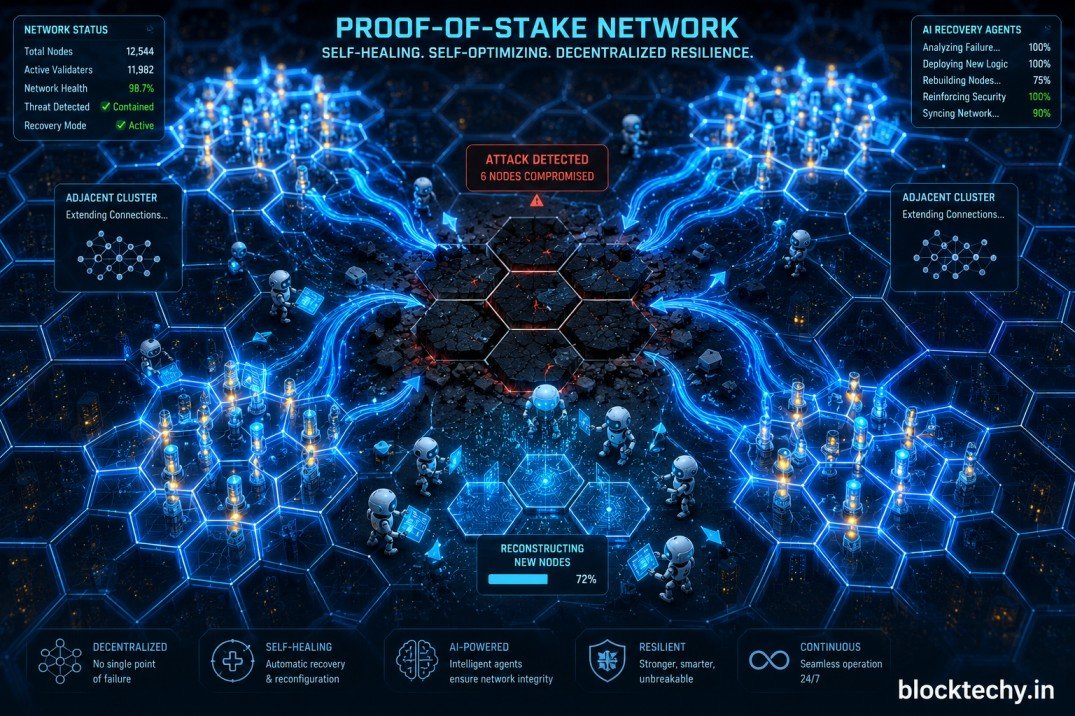
If an AI agent detects:
- Node failures
- Consensus instability
- Contract vulnerabilities
- Network congestion
- Validator attacks
It could automatically:
- Reassign workloads
- Isolate malicious nodes
- Restore healthy configurations
- Update security policies
- Recommend governance actions
Self-healing infrastructure could dramatically improve blockchain resilience.
5. AI-Powered Validator Protection
Validators secure Proof-of-Stake networks.
Compromising validators can threaten entire ecosystems.
Agentic AI could continuously monitor validator health by analyzing:
- CPU usage
- Network latency
- Signing behavior
- Geographic distribution
- Uptime
- Hardware anomalies
If suspicious behavior emerges, AI agents can:
- Alert network operators
- Reassign validation responsibilities
- Recommend temporary suspension
- Reduce attack impact
This strengthens network integrity.
6. Cross-Chain Security Intelligence
Future blockchain ecosystems will be highly interconnected.
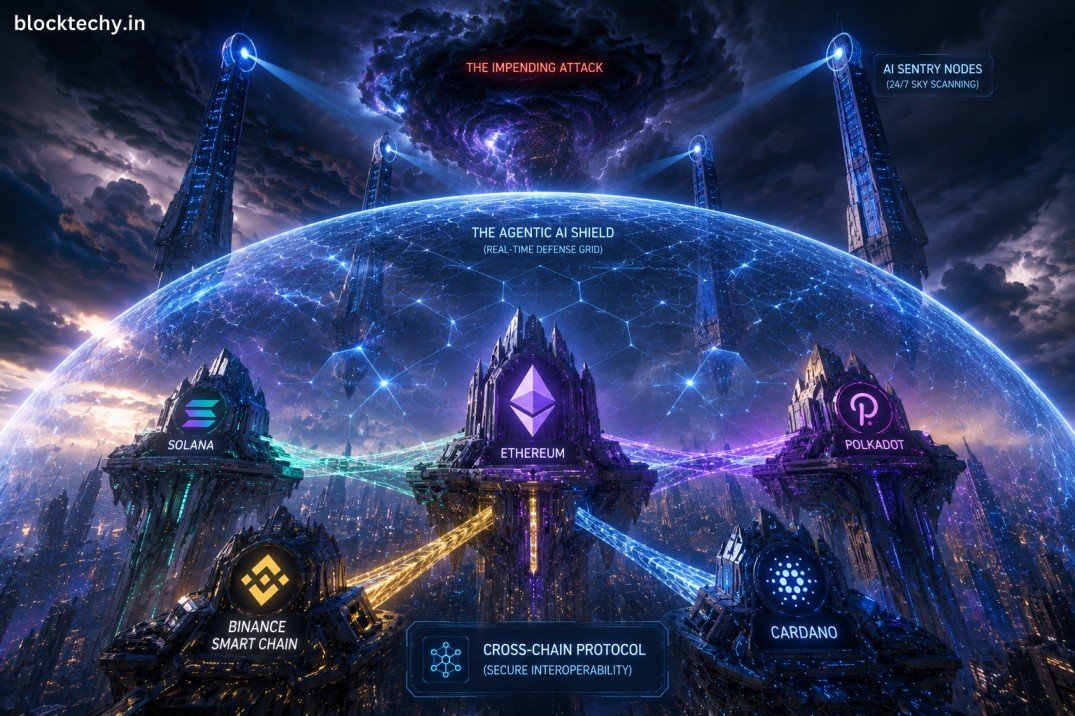
Assets will move seamlessly across:
- Ethereum
- Solana
- Avalanche
- Polygon
- Cosmos
- Polkadot
- Bitcoin Layer-2 networks
Cross-chain bridges remain one of the weakest security points.
Agentic AI could monitor multiple blockchains simultaneously.
Instead of protecting only one network, AI agents could correlate suspicious events across different ecosystems.
For example:
An exploit detected on one blockchain may immediately trigger preventive actions on connected chains.
This creates a unified security intelligence network.
7. Autonomous Incident Response
Today, incident response often depends on human availability.
By 2030, AI agents may independently coordinate emergency responses.
Possible actions include:
- Lock vulnerable contracts
- Notify exchanges
- Inform validators
- Pause bridge operations
- Recommend governance votes
- Deploy emergency updates
- Preserve forensic evidence
These actions could happen within seconds instead of hours.
8. Predictive Risk Assessment
Rather than reacting to attacks, Agentic AI could predict them.
Using historical blockchain data, market behavior, and network analytics, AI agents can estimate risk levels.
Factors may include:
- Wallet reputation
- Smart contract complexity
- Code similarity to previous exploits
- Validator concentration
- Liquidity movement
- Governance activity
Each protocol could receive a dynamic security score updated continuously.
Developers and investors would benefit from real-time risk insights.
9. AI Agents Securing Decentralized Identity
Decentralized Identity (DID) is expected to become fundamental in Web3.
Agentic AI could verify:
- Identity authenticity
- Credential validity
- Access permissions
- Reputation scores
- Authentication anomalies
Instead of passwords, AI-powered identity verification could continuously evaluate trust during every blockchain interaction.
This significantly reduces identity theft.
10. Continuous Compliance Monitoring
As governments introduce blockchain regulations, compliance becomes increasingly complex.
Agentic AI could automatically monitor:
- AML compliance
- KYC verification
- Transaction reporting
- Privacy regulations
- Token issuance rules
- Cross-border requirements
Organizations would receive immediate alerts whenever compliance risks appear.
Potential Challenges
While Agentic AI offers enormous benefits, it also introduces new risks.
AI Manipulation
Attackers may attempt to manipulate AI decision-making using adversarial inputs.
Security models must remain robust against AI-specific attacks.
Over-Automation
Giving AI complete control over blockchain security could create unintended consequences.
Human oversight will remain important.
Privacy Concerns
Continuous behavioral monitoring raises questions about user privacy.
Blockchain ecosystems must balance security with decentralization and anonymity.
Governance Issues
Who controls autonomous AI agents?
Should validators vote on AI behavior?
Should decentralized autonomous organizations (DAOs) supervise AI decisions?
These governance questions remain open.
Industries That Could Benefit
Many sectors could leverage Agentic AI-powered blockchain security.
Decentralized Finance (DeFi)
- Fraud detection
- Liquidity monitoring
- Flash loan protection
Supply Chain
- Counterfeit detection
- Shipment verification
- Automated compliance
Healthcare
- Medical record security
- Identity verification
- Data integrity
Banking
- Anti-money laundering
- Transaction monitoring
- Risk analysis
Government
- Digital identity
- Public records
- Secure voting systems
Gaming
- NFT fraud prevention
- Asset verification
- Anti-cheat monitoring
What Blockchain Developers Should Learn Today

Developers preparing for the AI-driven blockchain era should focus on:
- Solidity security best practices
- AI fundamentals
- Machine Learning basics
- Smart contract auditing
- Decentralized Identity (DID)
- Zero-Knowledge Proofs (ZKPs)
- Cryptography
- Agentic AI frameworks
- Multi-agent systems
- Blockchain analytics
Professionals skilled in both blockchain and AI will likely become some of the most sought-after experts by 2030.
The Road to 2030
The next few years will likely bring major advances in autonomous security systems.
We may see:
- AI security agents working alongside validators
- Self-auditing smart contracts
- AI-managed decentralized security operations centers (SOC)
- Autonomous blockchain governance assistants
- Predictive cyber defense powered by blockchain intelligence
- Fully autonomous Web3 infrastructure maintenance
Instead of simply defending blockchain networks, AI agents may continuously optimize, repair, and strengthen them.
Conclusion
Agentic AI has the potential to become one of the most transformative innovations in blockchain security by 2030. As cyber threats grow more intelligent and blockchain ecosystems become increasingly interconnected, traditional security methods alone will no longer be sufficient.
Autonomous AI agents promise a future where smart contracts are continuously audited, attacks are predicted before they happen, validators are protected in real time, and blockchain networks can detect, respond to, and even recover from incidents with minimal human intervention. This shift from reactive defense to proactive, self-healing security could significantly improve the resilience and trustworthiness of Web3.
However, the adoption of Agentic AI also brings important challenges. Governance, transparency, privacy, and accountability must evolve alongside the technology to ensure these autonomous systems remain secure and aligned with decentralized principles.
By 2030, the strongest blockchain ecosystems are unlikely to rely solely on cryptography or consensus mechanisms—they will combine them with intelligent AI agents capable of safeguarding decentralized networks around the clock. Organizations, developers, and security professionals who embrace this convergence of AI and blockchain today will be better positioned to build the secure, scalable, and trustworthy digital infrastructure of tomorrow.