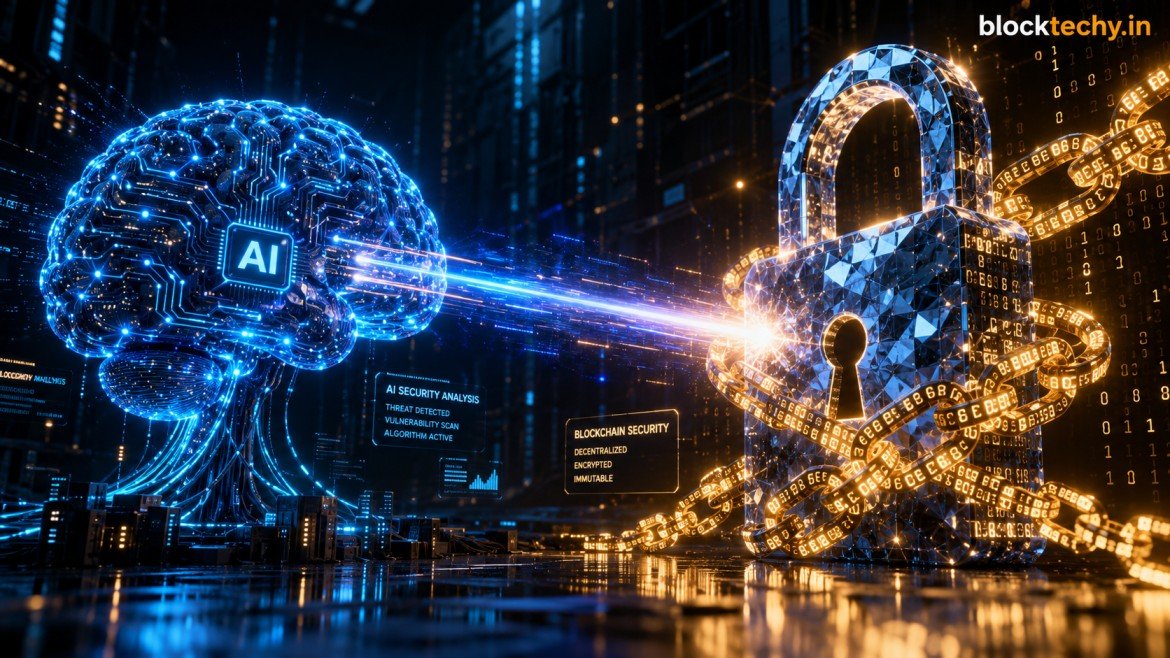
Introduction
Artificial Intelligence (AI) and blockchain are two of the most transformative technologies of the decade. AI is becoming smarter every year, capable of writing code, detecting vulnerabilities, and automating complex tasks. Meanwhile, blockchain continues to secure billions of dollars in cryptocurrencies, decentralized finance (DeFi), NFTs, and enterprise applications.
This naturally raises an important question:
Can AI hack blockchain?
Many people imagine AI becoming so intelligent that it could instantly crack Bitcoin, steal Ethereum wallets, or take over decentralized networks. Movies and social media often exaggerate AI’s capabilities, creating confusion between science fiction and reality.
The truth is more nuanced.
AI alone cannot magically “hack” blockchain because blockchain security is built on strong cryptography, decentralized consensus mechanisms, and mathematical principles. However, AI can make cyberattacks faster, smarter, and more automated, creating new security challenges for blockchain ecosystems.
In this article, we’ll separate myths from facts, explore real-world risks, examine how AI could change blockchain security in the future, and explain why AI is becoming both a potential attacker and one of blockchain’s strongest defenders.
Understanding Blockchain Security
Before discussing AI attacks, it’s important to understand what protects blockchain.
A blockchain network relies on several security layers:
- Cryptographic hashing
- Digital signatures
- Consensus algorithms
- Distributed nodes
- Immutable transaction history
- Economic incentives
For example, Bitcoin uses SHA-256 hashing and Proof of Work, while Ethereum uses Proof of Stake combined with cryptographic signatures.
Because thousands of independent nodes verify every transaction, altering historical records becomes extremely difficult.
This decentralized architecture is the primary reason blockchain has remained highly secure for over a decade.
What AI Can Actually Do
Artificial Intelligence excels at:
- Pattern recognition
- Large-scale data analysis
- Code generation
- Automation
- Predictive analytics
- Machine learning
- Decision-making
Modern AI systems can analyze millions of smart contract lines within minutes, identify suspicious wallet behavior, detect phishing websites, and even generate exploit code.
However, AI does not possess magical powers.
It still depends on:
- Available data
- Computing resources
- Existing vulnerabilities
- Human instructions
AI cannot simply “break encryption” because it is intelligent.
Myth 1: AI Can Crack Bitcoin Encryption Overnight
One of the biggest myths is that AI can instantly crack Bitcoin’s cryptography.
Reality
Bitcoin security relies on:
- SHA-256 hashing
- Elliptic Curve Digital Signature Algorithm (ECDSA)
These algorithms are based on mathematical problems that remain computationally infeasible to solve using today’s classical computers.
Even the most advanced AI models cannot reverse SHA-256 hashes or derive private keys through intelligence alone.
Without a breakthrough in mathematics or quantum computing, AI cannot simply decrypt Bitcoin wallets.
Myth 2: AI Can Control the Entire Blockchain
Some believe AI could take over Bitcoin or Ethereum.
Reality
Blockchain networks rely on decentralized consensus.
To manipulate Bitcoin, an attacker would need:
- Massive computational power
- Network dominance
- Economic resources
- Infrastructure control
AI cannot automatically gain majority control over mining power or staking validators.
Consensus remains a human-controlled and economically protected system.
Myth 3: AI Can Guess Wallet Private Keys
Wallet security depends on private keys.
Private keys are randomly generated 256-bit numbers.
The number of possible private keys is approximately:
2²⁵⁶
This number is unimaginably large.
Even if every computer on Earth worked for billions of years, randomly guessing a specific wallet key remains practically impossible.
AI does not change this mathematical reality.
Fact: AI Can Find Vulnerabilities Faster
This is where AI becomes dangerous.
Instead of attacking blockchain directly, AI can attack the software built around blockchain.
Examples include:
- Wallet applications
- Smart contracts
- Exchanges
- APIs
- Browser extensions
- DeFi protocols
AI-powered vulnerability scanners can review thousands of smart contracts in minutes.
Human auditors might take weeks.
Attackers can use AI to discover coding mistakes much faster than before.
AI and Smart Contract Exploits
Smart contracts are programs.
Like all software, they may contain bugs.
AI can:
- Analyze Solidity code
- Detect logic flaws
- Find reentrancy vulnerabilities
- Identify integer overflows
- Spot permission errors
- Suggest exploit paths
If developers release insecure contracts, AI can help attackers identify weaknesses much faster.
The blockchain itself remains secure.
The application becomes vulnerable.
AI-Powered Phishing Attacks
The biggest blockchain attacks rarely involve cryptography.
Instead, they target humans.
AI now creates:
- Fake support chats
- Fake crypto websites
- Voice cloning
- Personalized phishing emails
- Deepfake videos
- Scam social media posts
An attacker may use AI to imitate a crypto company’s CEO or customer support representative.
Victims unknowingly reveal:
- Seed phrases
- Private keys
- Recovery passwords
In these cases, blockchain wasn’t hacked.
The user was deceived.
AI Can Automate Crypto Scams
AI dramatically lowers the cost of cybercrime.
Attackers can automatically generate:
- Scam websites
- Fraudulent token projects
- Fake NFT collections
- Pump-and-dump campaigns
- Rug-pull marketing
- Fake investment bots
Generative AI enables scammers to create convincing content in multiple languages within minutes.
AI Against DeFi Protocols
Decentralized Finance (DeFi) contains billions of dollars in locked assets.
AI may help attackers:
- Analyze liquidity pools
- Study governance mechanisms
- Detect arbitrage opportunities
- Identify flash-loan attack vectors
- Simulate economic exploits
Rather than breaking blockchain security, AI helps attackers exploit protocol design weaknesses.
AI Can Analyze Blockchain Transactions
Every public blockchain is transparent.
Anyone can analyze transactions.
AI makes this analysis significantly more powerful.
It can:
- Track wallet behavior
- Cluster related addresses
- Detect large whale movements
- Identify suspicious transfers
- Predict market manipulation
- Monitor laundering attempts
This capability benefits both attackers and defenders.
Can AI Perform a 51% Attack?
A 51% attack occurs when one entity controls most of the network’s validation power.
AI alone cannot perform this attack.
The attacker still needs:
- Mining hardware
- Electricity
- Validators
- Capital investment
AI may improve mining efficiency or resource allocation.
However, it cannot replace the enormous infrastructure required.
Future Risk: AI-Driven Autonomous Hackers
Future AI agents may become increasingly autonomous.
Instead of waiting for human commands, future AI systems could:
- Scan blockchain projects continuously
- Discover vulnerabilities automatically
- Develop exploit strategies
- Execute attacks
- Hide evidence
- Adapt to defenses
This represents a significant future cybersecurity concern.
Fortunately, defensive AI is evolving just as quickly.
Quantum Computing vs AI
Many people confuse AI with quantum computing.
They are different technologies.
AI focuses on learning and decision-making.
Quantum computing focuses on solving specific mathematical problems much faster.
If blockchain cryptography is ever seriously threatened, quantum computers—not AI—are more likely to be responsible.
Fortunately, researchers are already developing quantum-resistant cryptography to prepare for that future.
How AI Can Protect Blockchain
Interestingly, AI may become blockchain’s greatest security partner.
Security companies increasingly use AI for:
Smart Contract Auditing
AI reviews code before deployment.
It detects:
- Logic errors
- Security flaws
- Gas inefficiencies
- Unsafe functions
This reduces human mistakes.
Fraud Detection
AI monitors transactions continuously.
It can identify:
- Suspicious wallet activity
- Money laundering
- Token theft
- Flash-loan attacks
- Exchange exploits
Detection happens much faster than manual monitoring.
Real-Time Threat Monitoring
Modern blockchain security platforms increasingly rely on AI to:
- Detect unusual transaction patterns
- Monitor validator behavior
- Identify compromised wallets
- Alert security teams instantly
This enables proactive defense rather than reactive incident response.
Predictive Risk Analysis
AI can analyze historical attacks and predict:
- High-risk smart contracts
- Potential governance attacks
- Network anomalies
- Insider threats
Organizations can fix vulnerabilities before attackers exploit them.
AI vs Human Hackers
| Human Hacker | AI-Assisted Hacker |
|---|---|
| Slower research | Instant code analysis |
| Limited working hours | 24/7 automation |
| Manual vulnerability search | Automated scanning |
| Small-scale phishing | Mass personalized phishing |
| Limited language skills | Multilingual attacks |
| Smaller data analysis | Massive blockchain analytics |
AI doesn’t replace hackers.
It amplifies their capabilities.
How Developers Can Stay Safe
Developers should adopt AI responsibly.
Best practices include:
Conduct Regular Smart Contract Audits
Use both human experts and AI auditing tools before deployment.
Keep Dependencies Updated
Many exploits target outdated software libraries rather than blockchain itself.
Use Multi-Signature Wallets
Require multiple approvals for high-value transactions.
Implement Real-Time Monitoring
Monitor unusual transactions continuously.
AI-based monitoring systems can detect suspicious activity within seconds.
Train Users
Many attacks succeed because users:
- Share seed phrases
- Click phishing links
- Install fake wallet extensions
Education remains one of the strongest security measures.
The Future of AI and Blockchain Security
Over the next decade, AI will become deeply integrated into blockchain infrastructure.
Future developments may include:
- AI security agents protecting validator nodes
- Autonomous smart contract auditing
- AI-powered DAO governance assistants
- Self-healing blockchain networks
- Predictive exploit prevention
- Intelligent decentralized threat intelligence
Rather than replacing blockchain security, AI will likely become an essential security layer.
The competition won’t be AI versus blockchain.
It will be:
Defensive AI versus malicious AI.
Final Verdict
So, can AI hack blockchain?
The answer is not directly—but it can significantly enhance cyberattacks against blockchain ecosystems.
AI cannot magically break Bitcoin encryption, guess private keys, or instantly control decentralized networks. Blockchain’s cryptographic foundations remain exceptionally strong.
However, AI can:
- Discover smart contract vulnerabilities faster
- Automate phishing campaigns
- Generate sophisticated scams
- Analyze blockchain transactions
- Accelerate exploit development
At the same time, AI is becoming one of the most powerful tools for blockchain defense. Security firms, exchanges, developers, and enterprise blockchain platforms increasingly rely on AI for auditing, fraud detection, threat intelligence, and real-time monitoring.
As AI technology continues to evolve, blockchain security will become a race between increasingly intelligent attackers and equally advanced defensive systems. The organizations that combine strong cryptography, secure development practices, decentralized governance, and AI-driven security will be best positioned to protect digital assets in the years ahead.
Ultimately, the future is not about AI replacing blockchain security—it is about using AI responsibly to make blockchain ecosystems even more resilient.
Frequently Asked Questions (FAQs)
Can AI break Bitcoin encryption?
No. Current AI cannot break Bitcoin’s SHA-256 hashing or ECDSA cryptography.
Is blockchain safe from AI attacks?
The blockchain protocol is highly secure, but surrounding applications like wallets, exchanges, and smart contracts can be vulnerable.
Can AI steal cryptocurrency?
Not directly. AI can assist scammers through phishing, malware, and vulnerability discovery, but it cannot magically access secure wallets.
Is quantum computing a bigger threat than AI?
Yes. Quantum computing poses a more direct long-term challenge to current cryptographic algorithms than AI.
Will AI improve blockchain security?
Yes. AI is already helping detect fraud, audit smart contracts, monitor networks, and respond to threats in real time.