
Introduction
When people talk about blockchain development today, the conversation usually revolves around languages like Solidity, Rust, and Go. These languages power many of the modern blockchain networks and Web3 applications that are making headlines. However, before any of these technologies became popular, there was Bitcoin—the first successful cryptocurrency—and it was primarily built using C++.
This raises an interesting question: Why did Bitcoin’s creator, Satoshi Nakamoto, choose C++ instead of another programming language?

The answer lies in Bitcoin’s unique requirements. Bitcoin wasn’t designed to be just another application. It needed to operate as a decentralized network, process transactions securely, validate blocks, and run continuously on computers around the world. To achieve this, performance, reliability, and control over system resources were critical.
C++ provided all of these advantages. More than fifteen years later, Bitcoin Core—the reference implementation of Bitcoin—still relies heavily on C++. That alone speaks volumes about the language’s effectiveness.
In this article, we’ll take a closer look at how C++ helped build Bitcoin, why it was such a good fit for blockchain technology, and whether aspiring blockchain developers should still consider learning it today.
The State of Software Development in 2008
To understand why C++ was chosen, it’s important to look at the technology landscape in 2008.
At that time, cloud computing was still in its early stages. Mobile applications were just beginning to gain popularity. Many of today’s modern programming tools and frameworks did not exist.

Developers who wanted maximum performance often turned to languages like C and C++. These languages offered direct control over hardware resources and allowed software to run efficiently even on less powerful computers.
When Satoshi Nakamoto began developing Bitcoin, the goal was to create a peer-to-peer digital currency that could function without banks, governments, or central servers. Every participant in the network would help maintain the system.
This required software that was fast, lightweight, and dependable. C++ was one of the best options available for achieving these goals.
Why C++ Was the Right Choice for Bitcoin
Exceptional Performance
One of the biggest reasons C++ was chosen is performance.
Bitcoin nodes perform a variety of tasks. They verify transactions, validate blocks, maintain copies of the blockchain, and communicate with other nodes across the network. These activities happen continuously.

Because C++ compiles directly into machine code, programs written in C++ generally execute faster than those written in many interpreted languages.
For a decentralized financial system where efficiency matters, this speed advantage was extremely valuable.
Greater Control Over Memory
Memory management is a critical aspect of software development.
Unlike many high-level programming languages that automatically manage memory, C++ gives developers direct control over how memory is allocated and released.
This level of control allows developers to optimize applications for efficiency and performance.
For Bitcoin, which was designed to run on a wide variety of computers, efficient memory usage helped ensure accessibility and reliability.
Cross-Platform Compatibility
Bitcoin needed to work on different operating systems.
Whether users preferred Windows, Linux, or macOS, they needed access to the same software and network.
C++ supports cross-platform development, making it easier to maintain software that works consistently across multiple environments.
This compatibility played an important role in Bitcoin’s early growth and adoption.
Reliability and Stability
Financial systems require reliability.
Users need confidence that transactions will be processed correctly and that the software will function consistently over time.
C++ had already established a reputation for powering critical systems in industries such as finance, telecommunications, and operating systems.
This made it a logical choice for building a decentralized monetary network.
How C++ Powers Bitcoin Core
Bitcoin Core is the software that implements the Bitcoin protocol.
Although the project has evolved significantly over the years, much of its foundation remains rooted in C++.

Let’s look at some of the key areas where C++ plays a role.
Transaction Verification
Every Bitcoin transaction must be validated before it can be accepted by the network.
Nodes verify digital signatures, check balances, and ensure that transactions comply with protocol rules.
These validation processes occur millions of times across the network and require efficient execution.
C++ helps ensure that verification can happen quickly and accurately.
Block Validation
Blocks contain groups of transactions that are added to the blockchain.
Before a block is accepted, nodes verify its structure, cryptographic data, and compliance with consensus rules.
The performance benefits of C++ make these operations more efficient.
Network Communication
Bitcoin operates as a peer-to-peer network.
Nodes constantly exchange information about transactions and newly mined blocks.
Managing this communication efficiently is essential for maintaining network synchronization.
C++ helps handle these networking functions with minimal overhead.
Wallet Functionality
Bitcoin Core also includes wallet features that allow users to manage their funds.
Many of these functions are implemented using C++ and contribute to the overall reliability of the software.
The Engineering Challenge Behind Bitcoin
Many people focus on Bitcoin’s economic impact, but the technical achievement behind it is equally impressive.
Imagine building a system where thousands of computers around the world maintain the same ledger without trusting one another.
Each node must independently verify information while remaining synchronized with the rest of the network.
There is no central authority to resolve disputes or correct mistakes.
This creates significant engineering challenges.
The software must be efficient enough to process data continuously, secure enough to resist attacks, and reliable enough to maintain consensus across the entire network.
C++ provided the tools necessary to meet these demanding requirements.
Other Blockchain Projects That Use C++
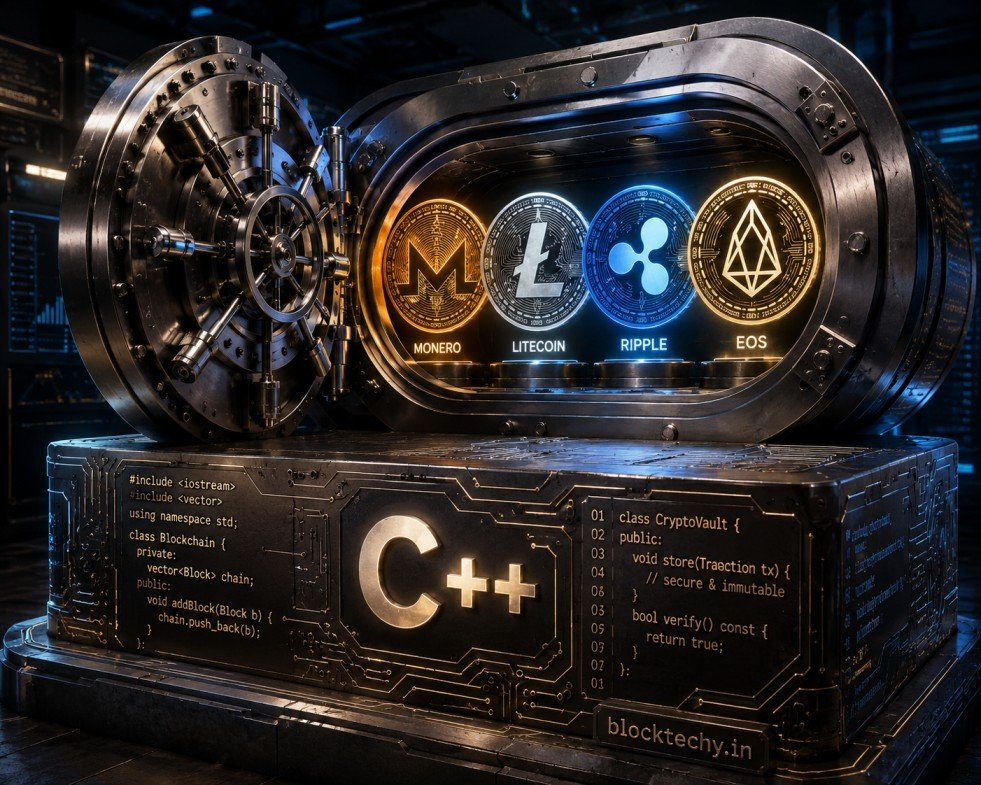
Bitcoin is not the only blockchain project that relies on C++.
Several major blockchain networks and platforms have also used the language.
EOS
EOS is known for its focus on performance and scalability.
Its infrastructure and smart contract development tools make extensive use of C++.
Monero
Monero is a privacy-focused cryptocurrency that emphasizes anonymity and security.
The project’s core software is largely written in C++.
Ripple
Ripple’s technology stack includes significant C++ components designed to support fast transaction processing.
Litecoin
As one of the earliest Bitcoin alternatives, Litecoin inherited many design principles from Bitcoin, including extensive use of C++.
These examples demonstrate that C++ continues to play an important role in blockchain development.
C++ vs Modern Blockchain Languages
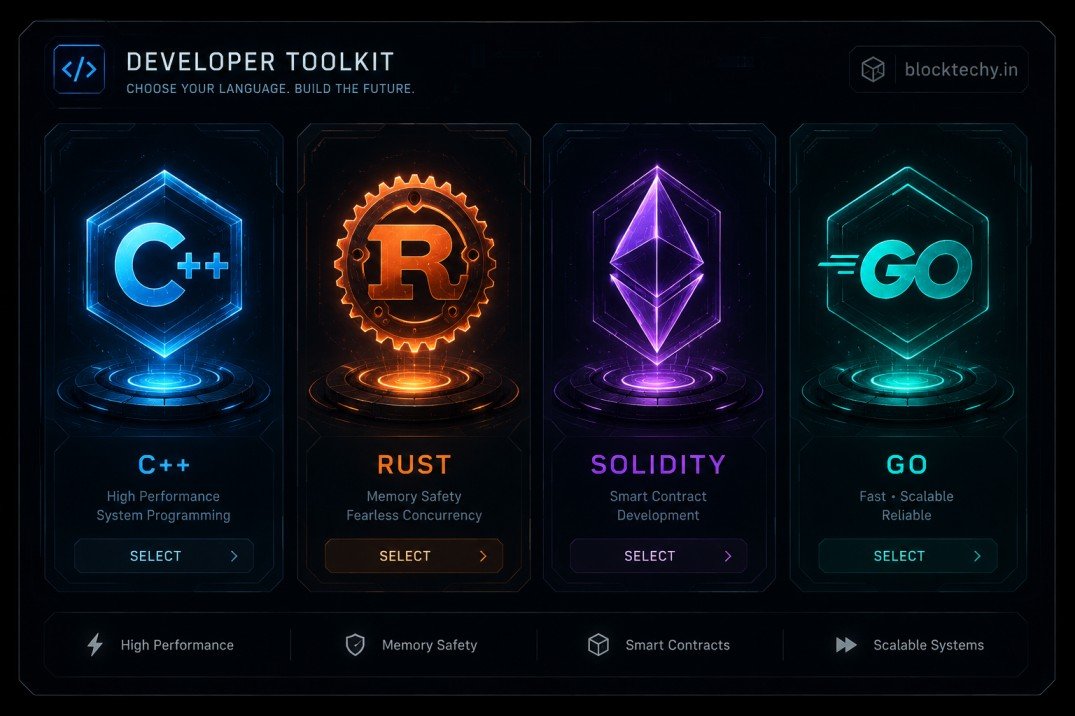
Today, blockchain developers have access to a wider range of programming languages than ever before.
Each language offers unique advantages.
Solidity
Solidity is specifically designed for Ethereum smart contracts.
It is often the first language developers learn when entering the Web3 space.
Rust
Rust has gained popularity because of its strong focus on memory safety and performance.
Many modern blockchain projects, including Solana, utilize Rust.
Go
Go is known for its simplicity and strong support for concurrent programming.
It is commonly used in enterprise blockchain solutions.
C++
While newer languages offer convenience and specialized features, C++ remains one of the best options for building blockchain infrastructure and core protocols.
Its combination of speed, control, and maturity continues to make it relevant.
Should Aspiring Blockchain Developers Learn C++?
The answer depends on your goals.
If your primary interest is building decentralized applications or smart contracts, learning Solidity or JavaScript may provide a faster path into the industry.
However, if you want to understand blockchain technology at a deeper level, C++ is worth considering.
Learning C++ can help you:
- Understand how blockchain protocols work internally
- Build high-performance software
- Develop strong programming fundamentals
- Contribute to open-source blockchain projects
- Improve problem-solving and optimization skills
Many experienced developers believe that learning a lower-level language like C++ makes it easier to understand higher-level technologies later.
The Future of C++ in Blockchain
Blockchain technology continues to evolve.
New programming languages and development frameworks appear regularly, offering developers more options than ever before.
Despite this evolution, C++ remains highly relevant.

Bitcoin continues to be one of the most secure and widely adopted blockchain networks in existence. Its ongoing success demonstrates the effectiveness of the engineering decisions made during its development.
As long as performance, efficiency, and reliability remain important, C++ is likely to maintain a place within the blockchain ecosystem.
Rather than being replaced entirely, it will continue to coexist alongside newer languages, each serving different purposes.
Conclusion
Bitcoin’s creation marked a turning point in the history of technology and finance. Behind the revolutionary concept of decentralized digital money was a carefully engineered software system built largely with C++.
The language provided the performance, reliability, and control needed to create a network capable of operating without central authority. More than a decade later, Bitcoin’s continued success highlights the strength of those design choices.
While modern blockchain development often focuses on newer languages such as Solidity and Rust, C++ remains an important part of the industry’s foundation. Understanding its role in Bitcoin offers valuable insight into how blockchain technology works and why engineering decisions matter.
For developers interested in blockchain infrastructure, protocol development, or simply gaining a deeper understanding of decentralized systems, learning C++ can still be a worthwhile investment. After all, the world’s first successful cryptocurrency was built with it—and that legacy continues today.