Introduction
Search engines have become one of the most important gateways to the internet. Whether we are looking for a news article, watching a tutorial, researching a product, finding a location, or learning about a new technology, search engines help us discover information within seconds.
For years, traditional search engines have dominated this process. They crawl websites, index billions of pages, rank results using complex algorithms, and provide users with answers to their queries. However, the traditional search model also raises important questions about privacy, data ownership, censorship, advertising, algorithmic control, and centralization.
This is where Web3 and decentralized search engines enter the discussion.
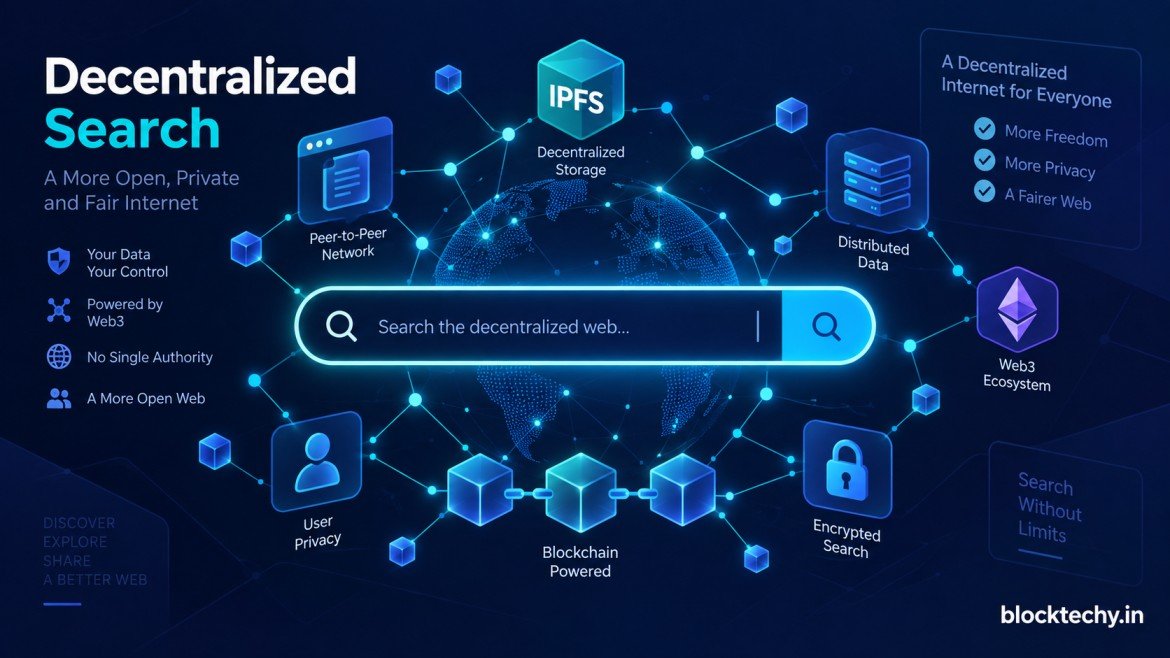
Decentralized search engines aim to create a more open search ecosystem where information discovery is not controlled by a single company or centralized authority. Instead, technologies such as blockchain, peer-to-peer networks, decentralized storage, cryptography, and community-driven protocols can potentially change how search data is collected, indexed, ranked, and delivered.
But can decentralized search engines actually replace traditional search engines? Or will they remain a niche technology for privacy-conscious and Web3 users?
Let’s explore how decentralized search works, its benefits, challenges, real-world possibilities, and what the future of Web3 search could look like.
What Is a Decentralized Search Engine?
A decentralized search engine is a search system designed to reduce dependence on a single centralized organization for indexing, ranking, and delivering internet information.
In a traditional search engine, a centralized company generally operates the infrastructure responsible for crawling websites, maintaining indexes, processing queries, and ranking results.
A decentralized search engine attempts to distribute some or all of these functions across a network of independent participants.
Instead of relying on one central database, decentralized search can potentially use:
- Distributed networks
- Peer-to-peer systems
- Blockchain technology
- Decentralized storage
- Cryptographic verification
- Community-operated nodes
- Open-source algorithms
- User-controlled identity and data
The exact architecture differs from one project to another. Not every decentralized search engine needs blockchain for every part of its operation.
The broader objective is to make internet search more distributed, transparent, user-controlled, and resistant to centralized points of failure.
How Traditional Search Engines Work
Before understanding decentralized search, it is useful to understand the conventional model.
Traditional search engines generally perform three major tasks:
1. Crawling
Automated programs known as crawlers or bots visit websites and discover pages.
They follow links between pages and continuously collect information about newly created or updated content.
2. Indexing
The collected information is processed and stored in a large search index.
The index allows the search engine to quickly identify pages that may be relevant to a user’s query.
3. Ranking
When a user searches for something, algorithms determine which results should appear first.
Ranking can consider many factors, including:
- Relevance
- Content quality
- Website authority
- Freshness
- User intent
- Links
- Location
- Search history
- Other signals
This centralized model is extremely efficient. However, it also means that a relatively small number of companies have enormous influence over how information is discovered online.
Why Is Decentralized Search Becoming Interesting?
The growth of Web3 has introduced a different philosophy for internet infrastructure.
Web3 generally emphasizes ideas such as:
Ownership + decentralization + transparency + user control
These principles have encouraged developers to rethink many parts of the traditional internet, including payments, social networks, storage, identity, and potentially search.
There are several reasons why decentralized search is attracting attention.
1. Greater Privacy
Privacy is one of the biggest arguments for alternative search systems.
Traditional search services can collect various forms of information depending on the service and settings, such as search queries, device information, IP-related data, cookies, and behavioral signals.
A privacy-focused decentralized search system could minimize the amount of personal information associated with individual searches.
Instead of building detailed user profiles for advertising purposes, a decentralized architecture could potentially allow users to search without revealing unnecessary personal information.
However, decentralization does not automatically guarantee privacy. A decentralized network still needs careful privacy engineering.
2. Reduced Centralized Control
One of the biggest concerns about centralized platforms is the concentration of power.
A single organization may control:
- Search infrastructure
- Indexing policies
- Ranking algorithms
- Advertising systems
- Data collection
- Access policies
A decentralized system can distribute these responsibilities among multiple participants.
This could make it more difficult for one organization to unilaterally control the entire search ecosystem.
For Web3 advocates, this is particularly important because decentralization is intended to reduce dependence on centralized intermediaries.
3. Censorship Resistance
Decentralized networks can potentially make information more resistant to centralized censorship.
If search infrastructure is distributed across many independent nodes, removing information from one server does not necessarily remove it from the entire network.
However, censorship resistance is not the same thing as guaranteeing that all information will appear in search results.
A decentralized search network would still need mechanisms for handling:
- Illegal content
- Malware
- Spam
- Copyright violations
- Fraudulent websites
- Dangerous information
Therefore, decentralized search faces the difficult challenge of balancing openness with responsible moderation.
4. Transparent Search Infrastructure
Another potential advantage is transparency.
Many traditional search-ranking systems are proprietary. Users generally cannot inspect every factor that determines why one result appears above another.
Decentralized protocols could potentially make important parts of their infrastructure open source.
For example, developers could inspect:
- Indexing protocols
- Ranking mechanisms
- Reputation systems
- Data verification methods
- Node participation rules
Blockchain can also provide verifiable records for certain types of activity.
This does not automatically make search results unbiased, but it can create opportunities for greater accountability.
How Blockchain Could Be Used in Search
Blockchain is not necessarily required to build a decentralized search engine, but it can provide useful infrastructure.
One possible application is content verification.
Imagine that a website publishes an article. A cryptographic hash could represent the content. A blockchain could store a verifiable record associated with that content.
Later, users could verify whether the content has been modified.
Blockchain could also potentially be used for:
Identity
Decentralized identities could allow users or websites to establish verifiable identities without relying entirely on centralized login providers.
Reputation
Websites, content creators, and data providers could potentially build reputation scores based on verifiable activity.
Incentives
Blockchain-based tokens could reward network participants for contributing computing resources, indexing data, or maintaining infrastructure.
Payments
Users could potentially pay directly for premium search services without traditional intermediaries.
Ownership
Creators could potentially establish verifiable relationships with digital content and datasets.
However, putting an entire search index directly on a blockchain would generally be inefficient and expensive. More practical architectures would likely combine blockchain with off-chain or decentralized storage systems.
The Role of Decentralized Storage
Decentralized search may work closely with decentralized storage technologies.
Traditional websites typically store content on centralized servers or cloud infrastructure.
Decentralized storage networks distribute files across multiple nodes.
Examples of technologies associated with decentralized storage include:
- IPFS
- Filecoin
- Arweave
These systems can provide alternative ways to store and retrieve digital information.
A future Web3 search ecosystem could potentially index content stored across decentralized networks rather than relying entirely on conventional web servers.
For example:
User → Decentralized Search Protocol → Distributed Index → Decentralized Content Network
This could create a more distributed information infrastructure.
How Would Decentralized Search Ranking Work?
Ranking is probably one of the hardest problems in decentralized search.
Traditional search engines have sophisticated ranking systems developed over many years.
A decentralized search protocol could experiment with alternative ranking mechanisms.
Community-Based Ranking
Users could collectively contribute signals about content quality.
Reputation-Based Ranking
Websites could accumulate reputation through verifiable interactions.
Cryptographic Verification
Search systems could prioritize content with verifiable authenticity.
Open Algorithms
Ranking algorithms could be publicly available for inspection.
Multiple Ranking Models
Instead of one company determining the ranking system, users could potentially select different ranking algorithms.
For example, one user might prioritize:
Freshness
Another might prioritize:
Technical authority
Another might prioritize:
Privacy
Another might prioritize:
Community reputation
This could create a more customizable search experience.
Web3 Search and Token Incentives
Token economics could become an important part of decentralized search.
Running search infrastructure requires resources.
Nodes need:
- Storage
- Bandwidth
- Computing power
- Maintenance
- Indexing infrastructure
A decentralized network could reward participants with cryptocurrency or tokens.
For example:
Content Creator → Provides Data
Indexer → Indexes Content
Node Operator → Provides Infrastructure
User → Performs Search
Protocol → Distributes Rewards
This creates an economic system around search infrastructure.
However, token incentives also introduce risks.
Poorly designed reward systems could encourage:
- Spam
- Fake websites
- Manipulation
- Sybil attacks
- Low-quality content
- Artificial engagement
Therefore, decentralized search protocols would need strong incentive and reputation mechanisms.
Advantages of Decentralized Search Engines
Decentralized search has several potential benefits.
Privacy
Users could potentially search with less tracking and profiling.
Decentralization
Infrastructure could be distributed across multiple participants.
Transparency
Open-source protocols could make search mechanisms easier to inspect.
Censorship Resistance
Distributed infrastructure may reduce dependence on a single authority.
User Ownership
Web3 identity and wallet infrastructure could give users greater control over digital identity.
Open Participation
Developers and organizations could potentially participate in building the search infrastructure.
Alternative Business Models
Search services could experiment with models beyond traditional advertising.
The Biggest Challenges
Despite its potential, decentralized search faces significant technical and economic challenges.
1. Search Speed
Users expect search results almost instantly.
Building and maintaining a globally distributed search index is extremely difficult.
Centralized companies have massive data centers and sophisticated infrastructure optimized for low-latency search.
A decentralized network needs to compete with that level of performance.
2. Spam
The internet already contains enormous amounts of spam.
A decentralized search engine could face even greater problems if participation is open.
Attackers might create thousands of fake websites or identities to manipulate rankings.
This is commonly known as a Sybil attack in decentralized systems.
Effective reputation and anti-spam mechanisms would therefore be essential.
3. Ranking Quality
Search quality is extremely difficult to reproduce.
Users do not simply want millions of matching pages. They want the most useful results.
A decentralized search engine must answer questions such as:
- Which website is trustworthy?
- Which article is authoritative?
- Which information is current?
- Is the content AI-generated?
- Is the website trying to manipulate rankings?
- Is the information accurate?
These problems require sophisticated ranking systems.
4. Content Moderation
Complete decentralization creates difficult moderation questions.
A search network may encounter:
- Malware
- Fraud
- Extremist content
- Copyright infringement
- Illegal material
- Misinformation
- Scam websites
If no central authority controls the index, who decides what should be excluded?
Different decentralized projects may use different approaches, including community moderation, reputation systems, filtering layers, or client-side controls.
There is no single universally accepted solution.
5. User Experience
Web3 applications sometimes have additional complexity involving:
- Wallets
- Tokens
- Decentralized identities
- Network fees
- Cryptographic signatures
Most internet users do not want to understand blockchain infrastructure just to search for information.
For decentralized search to achieve mainstream adoption, the technology will probably need to become almost invisible to ordinary users.
The experience should ideally be as simple as:
Open → Search → Get Results
Are Decentralized Search Engines Going to Replace Google?
It is too early to say that decentralized search will replace traditional search engines.
Traditional search companies have enormous advantages in:
- Infrastructure
- Data
- Crawling technology
- Search algorithms
- Machine learning
- User experience
- Global distribution
Decentralized search therefore faces a significant technical challenge.
A more realistic possibility is that decentralized search develops alongside traditional search.
Different users may choose different search systems depending on their priorities.
For example:
Traditional Search
Could remain popular because of convenience and broad coverage.
Privacy-Focused Search
Could attract users who prioritize reduced tracking.
Decentralized Search
Could attract users interested in open infrastructure, censorship resistance, and user ownership.
This could create a more diverse search ecosystem.
The Future of Web3 Search
The future of decentralized search could involve a hybrid architecture rather than a completely blockchain-based search engine.
Blockchain may handle:
- Identity
- Payments
- Reputation
- Verification
- Incentives
While decentralized storage and distributed networks could handle:
- Content
- Indexes
- Data availability
Artificial intelligence could then help with:
- Semantic search
- Summarization
- Query understanding
- Personalization
- Content classification
This combination could create a new generation of search infrastructure.
Imagine asking:
“Find reliable research papers about blockchain scalability published recently.”
An AI-powered decentralized search protocol could search distributed indexes, verify content sources, evaluate reputation signals, and provide summarized results.
The user could potentially maintain greater control over identity and personal data throughout the process.
Decentralized Search and AI
AI is likely to have a major impact on the future of search.
Modern users increasingly expect search engines to understand natural language rather than requiring exact keywords.
Decentralized AI and decentralized search could eventually work together.
For example:
User Query → AI Understanding → Decentralized Index → Source Verification → AI Summary → User
This architecture could potentially combine the strengths of AI with the principles of Web3.
However, AI introduces additional challenges.
Search systems must determine:
- Which sources are trustworthy?
- How should AI-generated content be handled?
- How can hallucinations be reduced?
- How should sources be verified?
- Who is responsible when an AI summary is wrong?
These questions will become increasingly important as AI-generated content expands across the internet.
Could Search Become a User-Owned Service?
One of the most interesting ideas behind Web3 search is the possibility of user-owned infrastructure.
In today’s internet economy, many free services are supported through advertising and data-driven business models.
Web3 introduces alternative possibilities.
Users could potentially:
- Pay directly for search services
- Hold governance tokens
- Participate in decentralized networks
- Contribute computing resources
- Choose ranking systems
- Control identity
- Decide what information is shared
Instead of being merely consumers of search infrastructure, users could potentially become participants in the network.
Whether this model can compete economically with advertising-supported search remains an open question.
What Would a Decentralized Search Engine Need to Succeed?
For decentralized search to become mainstream, several pieces would need to work together.
High-quality indexing
The system must discover and index a large portion of useful internet content.
Fast results
Search must be extremely responsive.
Effective ranking
Users must consistently receive useful results.
Strong anti-spam protection
The network needs mechanisms against manipulation.
Privacy
Users should have meaningful control over their search data.
Simple UX
People should not need blockchain expertise.
Sustainable economics
The network must have a practical way to pay for infrastructure.
Responsible moderation
The system needs mechanisms for dealing with harmful and illegal content.
If these challenges can be solved, decentralized search could become a meaningful part of the future internet.
Final Thoughts
Decentralized search engines represent an interesting experiment in rethinking one of the internet’s most important services.
Traditional search has achieved extraordinary scale and convenience, but its centralized architecture raises questions about privacy, control, transparency, and ownership.
Web3 offers a different approach: distribute infrastructure, use cryptographic verification, create open protocols, and give users more control.
However, decentralization alone does not guarantee better search.
A successful search engine must still provide accurate results, fast performance, excellent usability, strong spam protection, and reliable information.
The future may therefore not be about completely replacing traditional search with blockchain.
Instead, we may see a combination of technologies:
Web3 + AI + Decentralized Storage + Cryptography + Open Search Protocols
Together, these technologies could create new ways to discover and interact with information.
The biggest question is not whether blockchain can technically be used for search. It can.
The more important question is whether decentralized networks can provide enough search quality, speed, privacy, reliability, and usability to convince millions of people to use them.
If developers can solve those challenges, decentralized search could become one of the more interesting applications of Web3—and potentially change how we think about ownership and control of information on the internet.