Introduction
Online shopping has become a normal part of everyday life. People purchase everything from groceries and clothing to software subscriptions, electronics, travel tickets, and digital services with just a few clicks. Behind every online purchase, however, there is a large amount of transaction data that needs to be recorded, stored, verified, and accessed later.
One of the most familiar pieces of this transaction data is the digital receipt.
Digital receipts are already widely used by e-commerce websites, payment platforms, retailers, and subscription services. They provide customers with proof of purchase and help businesses manage orders, refunds, warranties, accounting, and customer support. But traditional digital receipts still depend heavily on centralized databases, email systems, cloud storage, and individual companies maintaining accurate records.
This is where blockchain technology could introduce a different approach.
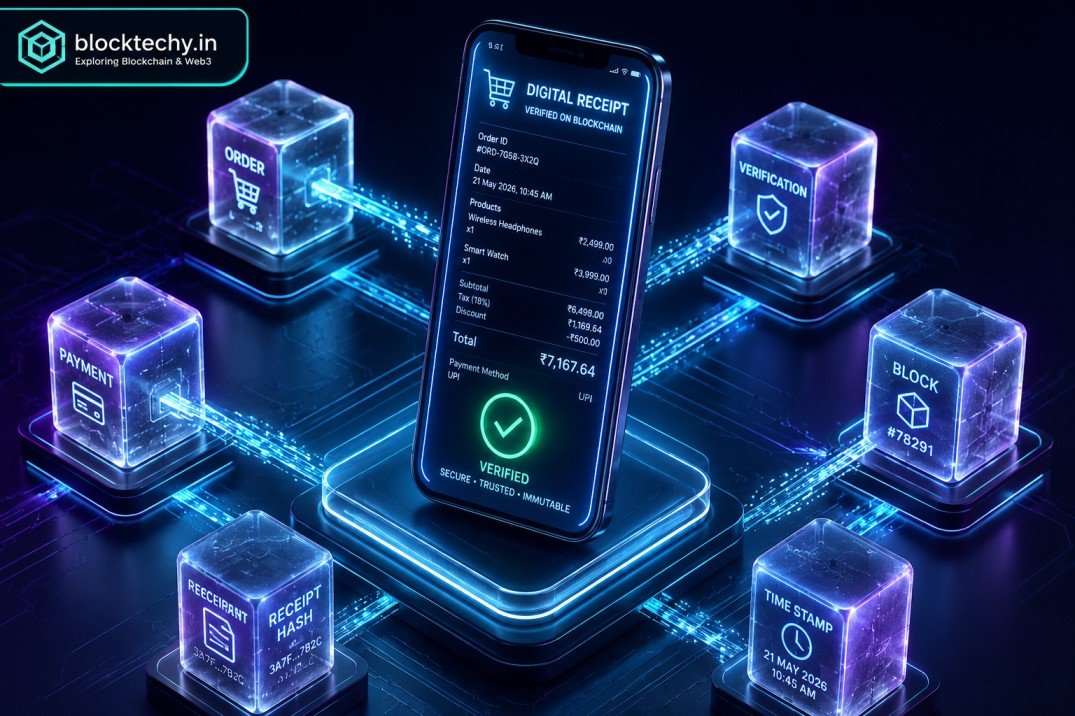
By combining blockchain with digital receipts, businesses could create transaction records that are more difficult to alter, easier to verify, and potentially portable across different platforms. Instead of treating a receipt as simply an email, PDF, or database entry, blockchain could transform it into a verifiable digital record connected to the underlying transaction.
Blockchain-based digital receipts could eventually change how consumers prove purchases, claim warranties, request refunds, track product ownership, and manage transaction histories.
But what exactly would blockchain add to digital receipts? How would the system work? What are the advantages and challenges? And could blockchain actually become an important part of the future of online transactions?
Let’s explore.
What Is a Digital Receipt?
A digital receipt is an electronic record that confirms a purchase or transaction.
Instead of receiving a paper receipt, customers may receive a receipt through:
- SMS
- A mobile application
- An online customer account
- A retailer’s website
- A downloadable PDF
- A payment application
A typical digital receipt may contain information such as the order number, product name, quantity, price, taxes, discounts, payment method, purchase date, and seller information.
For example, when someone purchases a smartphone online, the seller may send a digital receipt containing the product details, transaction amount, order ID, and purchase date.
Although this is useful, the receipt itself is usually controlled by the company that generated it.
If the company changes its database, closes its service, loses historical data, or changes its systems, customers may have difficulty accessing old transaction records.
This creates an important question:
Can digital receipts become more trustworthy, portable, and independently verifiable?
Blockchain could provide one possible answer.
What Is Blockchain?
Blockchain is a distributed ledger technology that allows transaction records to be stored across a network rather than relying on a single centralized database.
Transactions are grouped into blocks and linked using cryptographic techniques. Once information is recorded and confirmed according to the rules of a particular blockchain network, changing historical records can be extremely difficult.
Blockchain is best known for cryptocurrencies, but its underlying technology can be applied to many other types of digital records.
For digital receipts, blockchain does not necessarily mean that the entire receipt needs to be stored publicly on a blockchain.
Instead, a blockchain could store a cryptographic proof or hash of the receipt while the detailed receipt remains stored elsewhere.
This approach could provide verification without exposing unnecessary personal information.
How Blockchain-Based Digital Receipts Could Work
Imagine that a customer purchases a laptop from an online retailer.
The transaction could follow a process like this:
Step 1: Customer Makes a Purchase
The customer completes the purchase through an e-commerce platform.
The retailer generates the transaction information, including:
- Product details
- Price
- Tax
- Order ID
- Timestamp
- Seller identity
- Customer reference
- Warranty information
Step 2: Digital Receipt Is Created
The retailer generates a digital receipt containing the relevant transaction information.
The receipt could be represented as a structured digital document rather than only a PDF.
Step 3: Receipt Data Is Hashed
A cryptographic hash function can convert the receipt data into a unique-looking string of characters.
Even a small change in the original receipt would produce a different hash.
Step 4: Proof Is Recorded on Blockchain
The hash or another cryptographic proof could be recorded on a blockchain.
The blockchain would therefore act as an independent verification layer.
Step 5: Customer Receives the Receipt
The customer could receive the digital receipt through an app, email, wallet, or online account.
The customer could potentially retain the receipt independently of the retailer.
Step 6: Receipt Can Be Verified Later
Suppose the customer needs to prove that they purchased the laptop.
The receipt data can be processed again to generate its hash. The hash can then be compared with the blockchain record.
If the values match, the receipt has not been changed since the original record was created.
This creates an important distinction:
The blockchain does not necessarily store the receipt itself. It can store proof that the receipt existed in a particular form at a particular time.
Why Blockchain Could Improve Digital Receipts
Traditional digital receipts have several weaknesses that blockchain could potentially address.
1. Improved Tamper Evidence
One of the biggest benefits of blockchain-based receipts is tamper evidence.
A conventional digital receipt may exist as a PDF or database record. Although businesses can have strong security controls, centralized records can theoretically be modified.
Blockchain-based verification makes unauthorized modification easier to detect.
If the receipt is changed after its blockchain proof was created, the newly generated hash would no longer match the original record.
This could make fraudulent receipt modification more difficult.
2. Easier Purchase Verification
Customers frequently need proof of purchase.
This can happen when:
- Returning a product
- Claiming a warranty
- Requesting insurance reimbursement
- Selling a used product
- Resolving a payment dispute
- Proving ownership
- Requesting a replacement
A blockchain-backed receipt could provide a verifiable record without requiring the original retailer’s database to be the only source of truth.
3. Better Warranty Management
Warranty management is another area where blockchain-based receipts could become useful.
Today, customers may need to search through emails or contact retailers to prove when a product was purchased.
A blockchain-backed receipt could connect the purchase date and product information to a verifiable digital record.
For example, a customer purchasing a laptop could receive a digital receipt containing its warranty information. When requesting warranty service, the authorized service provider could verify the receipt instead of asking the customer to search for an old email.
4. Easier Returns and Refunds
Returns often require proof of purchase.
A blockchain-based receipt could provide a standardized transaction reference that retailers and customers can verify.
Smart contracts could potentially automate parts of refund processes.
For example, if a transaction meets predefined return conditions, software could verify the relevant receipt and trigger the next stage of the refund workflow.
However, human review would still be necessary for many real-world return situations.
5. Greater Customer Ownership of Transaction History
Traditional transaction histories are usually fragmented.
A customer may have purchases spread across:
- Amazon-like marketplaces
- Independent websites
- Food delivery platforms
- Travel services
- Subscription providers
- Physical stores
- Digital marketplaces
Each company maintains its own database.
Blockchain-based receipts could help create a more portable model where customers maintain access to verifiable transaction records across different services.
This could contribute to a broader concept of user-owned digital identity and data.
Blockchain Receipts and Digital Ownership
Digital receipts could eventually become more than proof of payment.
They could potentially represent proof of purchase and ownership.
Consider a customer purchasing a limited-edition digital product.
Instead of receiving only an email confirmation, the customer could receive a cryptographically verifiable ownership record.
This could be particularly interesting for:
- Digital collectibles
- Event tickets
- Software licenses
- Online courses
- Gaming assets
- Luxury goods
- Limited-edition products
- Certificates
- Memberships
The receipt could become a bridge between the transaction and the asset itself.
This concept is especially relevant to Web3, where digital ownership is often represented through blockchain-based assets and wallets.
Smart Contracts and Digital Receipts
Smart contracts could add another layer of functionality.
A smart contract is a program deployed on a blockchain that executes predefined rules.
For example, imagine an online retailer offering a one-year warranty.
The receipt could contain information about the product and warranty period. A smart-contract-based system could help verify whether a warranty claim falls within the applicable period.
Similarly, a digital receipt could potentially interact with loyalty programs.
A customer purchases a product, the transaction is verified, and the system automatically updates loyalty points or membership benefits.
This could reduce manual processing and improve automation.
However, smart contracts should not be treated as magical replacements for business logic. Real-world situations often involve exceptions, disputes, damaged products, fraud investigations, and human judgment.
Privacy: The Most Important Challenge
Blockchain-based receipts sound attractive, but privacy is one of the biggest issues.
Blockchains can provide strong transparency and verification, but transaction information may be difficult to remove once recorded.
This creates a problem if sensitive customer information is placed directly on-chain.
Receipts can contain:
- Names
- Addresses
- Phone numbers
- Email addresses
- Payment information
- Product information
- Purchase histories
Publishing such information directly to a public blockchain would create significant privacy concerns.
A better architecture could keep sensitive receipt information off-chain while storing only a cryptographic proof on the blockchain.
For example:
Private receipt data → Secure storage
Receipt hash → Blockchain
This approach can reduce the amount of personal information exposed while still providing verification.
Privacy-enhancing technologies could also become increasingly important as blockchain-based receipt systems develop.
Could Blockchain Reduce Receipt Fraud?
Receipt fraud is a real concern for retailers.
Fraudsters may attempt to manipulate receipts, create fake proof of purchase, or exploit return systems.
Blockchain does not eliminate fraud completely, but it could make certain forms of receipt manipulation easier to detect.
For example, a fake receipt could claim that a product was purchased on a particular date.
If the retailer or authorized verifier checks the receipt against a blockchain-backed record and no matching proof exists, the claim could be flagged.
This could be particularly useful for high-value products.
However, blockchain only protects the integrity of information that was correctly recorded in the first place.
If false information is entered into the system initially, blockchain cannot automatically determine whether that information is truthful.
This is sometimes described as the “garbage in, garbage out” problem.
Blockchain Receipts for E-Commerce
E-commerce could be one of the largest use cases for blockchain-backed receipts.
An online purchase generates multiple records:
- Customer places order.
- Payment is processed.
- Seller confirms the order.
- Product is shipped.
- Delivery is completed.
- Receipt is generated.
- Warranty period begins.
- Customer may request a return.
- Refund may be processed.
A blockchain-based system could potentially connect these events through verifiable transaction records.
This could create a more transparent lifecycle for a purchase.
For example, a customer could have a digital receipt that evolves into a complete transaction history containing purchase, shipment, delivery, warranty, return, and refund events.
Cross-Platform Verification
Another major possibility is interoperability.
Imagine purchasing a camera from one online store.
Two years later, you want to sell it on a second-hand marketplace.
Instead of simply telling the buyer that the camera is genuine, you could provide a verifiable digital purchase record.
The buyer could verify:
- Original purchase date
- Product information
- Authenticity information
- Warranty status
- Seller information
This could improve trust in second-hand markets.
Luxury goods and high-value electronics could particularly benefit from this model.
Digital Receipts and Sustainability
Digital receipts already reduce the need for paper receipts, but blockchain could potentially add another layer of traceability.
For example, retailers could connect receipts with product lifecycle information.
A digital receipt might eventually include information related to:
- Product origin
- Manufacturing
- Supply chain events
- Warranty
- Repairs
- Resale
- Recycling
This could help create a more complete digital product passport.
The European Union and other markets are increasingly interested in digital product information and traceability, making this area particularly relevant for future commerce systems.
Challenges of Blockchain-Based Receipts
Despite its potential, blockchain is not automatically the best solution for every receipt.
Scalability
Large retailers can generate millions of transactions.
Recording every receipt directly on a blockchain could create scalability and cost problems.
Layer-2 networks, batching, rollups, or off-chain systems could potentially help.
Transaction Costs
Public blockchains can involve network fees.
If a retailer generates millions of receipts, paying a transaction fee for every receipt may not be economically practical.
Systems may therefore need batching or alternative architectures.
Privacy Regulations
Data protection regulations create additional challenges.
Companies must carefully design blockchain receipt systems so that personal information is not permanently exposed on an immutable ledger.
User Experience
Most customers do not want to understand blockchain.
They simply want to buy something and receive a receipt.
Therefore, successful blockchain-based receipt systems would need to hide technical complexity behind familiar interfaces.
Customers should ideally be able to use the system without knowing how hashing, wallets, or smart contracts work.
Adoption
Blockchain receipts become much more useful when many businesses support compatible standards.
If every retailer creates a completely different system, customers may still face fragmented transaction histories.
Interoperability will therefore be critical.
What Could the Future Look Like?
The future of digital receipts may involve a combination of traditional databases, blockchain networks, digital identity, smart contracts, and decentralized storage.
A possible future transaction could look like this:
A customer buys a product online.
The retailer generates a structured digital receipt.
Sensitive information is encrypted and stored securely.
A cryptographic proof is recorded on a blockchain.
The customer receives the receipt in a digital wallet.
The product’s warranty is automatically associated with the receipt.
If the customer returns the product, the retailer verifies the transaction digitally.
If the customer sells the product later, ownership information can be transferred to the new owner.
When the product reaches the end of its lifecycle, recycling or disposal information could also be linked to the digital record.
In this model, a receipt becomes more than a confirmation email.
It becomes a verifiable digital record of an asset’s transaction history.
Will Every Receipt Use Blockchain?
Probably not.
Blockchain is useful when multiple parties need to trust or verify shared information without relying entirely on one central authority.
For simple purchases, a traditional database may remain cheaper, faster, and easier.
A grocery store selling a low-cost item may have little reason to create a blockchain-backed receipt.
Blockchain could be more valuable when the transaction involves:
- High-value goods
- Multiple organizations
- Long-term warranties
- Ownership transfers
- Digital assets
- Authentication
- Complex supply chains
- Regulatory requirements
- Resale markets
The technology should therefore be applied where its benefits justify its additional complexity.
The Role of Web3
Blockchain-based receipts also fit into the larger Web3 vision of user-controlled digital assets and data.
In the traditional internet model, companies generally control the platforms where transaction information is stored.
In a more decentralized model, customers could have portable digital records that they can use across multiple services.
This does not necessarily mean customers must personally operate blockchain infrastructure.
Instead, wallets and applications could provide simple interfaces for managing verifiable credentials and transaction records.
The goal would be to give users greater control without forcing them to become blockchain experts.
Final Thoughts
Blockchain for digital receipts could represent an important evolution in how online transactions are recorded and verified.
Traditional digital receipts already provide significant convenience, but they generally depend on centralized systems controlled by individual businesses.
Blockchain could add another layer of trust by creating tamper-evident, independently verifiable proofs of transactions.
The potential benefits include better receipt verification, improved warranty management, easier returns, stronger fraud detection, portable purchase histories, digital ownership, and greater interoperability between platforms.
At the same time, blockchain is not a perfect solution.
Privacy, scalability, transaction costs, regulatory requirements, interoperability, user experience, and adoption remain significant challenges.
The most practical approach may not be putting complete receipts on public blockchains. Instead, future systems could combine secure off-chain storage with blockchain-based verification.
As e-commerce continues to evolve, the humble receipt could become much more powerful. Instead of being a disposable email or PDF that customers search for only when something goes wrong, a digital receipt could become a trusted, portable, and verifiable part of a customer’s digital transaction history.
Blockchain may ultimately help turn the receipt from a simple proof of purchase into a broader proof of transaction, authenticity, and ownership.
That could make digital commerce more transparent, interoperable, and trustworthy—and it may be one of the quieter ways blockchain technology influences the future of everyday online transactions.