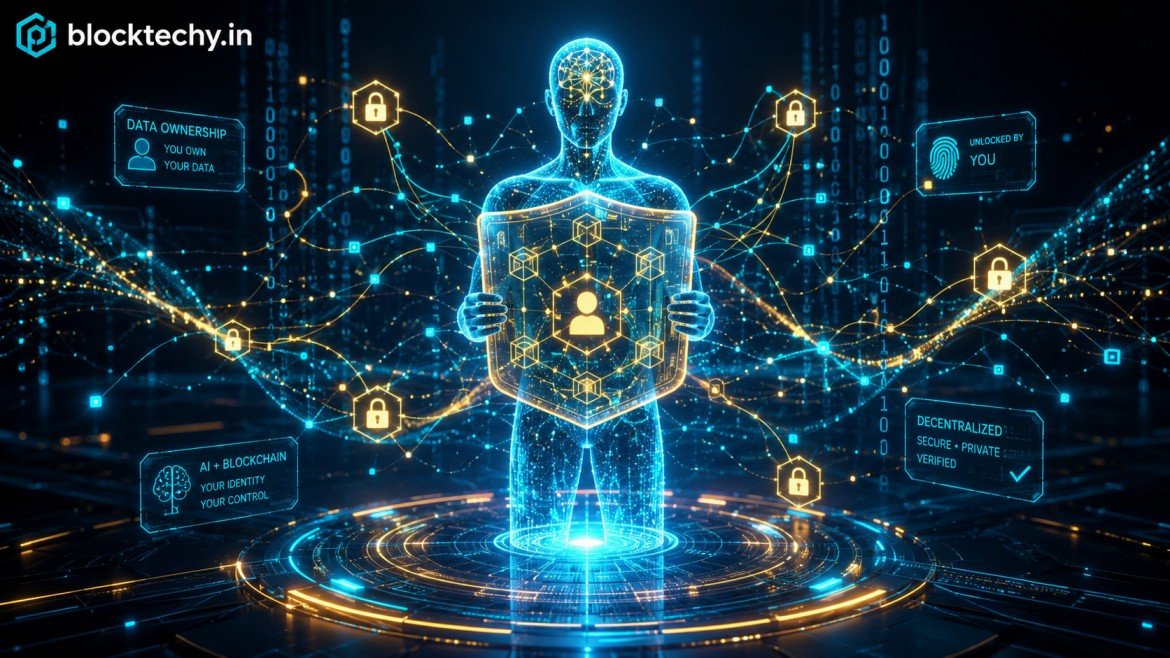
Introduction
Data has become one of the most valuable resources in the digital economy. Every search, purchase, social media interaction, location signal, online transaction, and digital service generates information. Businesses use this data to improve products, personalize experiences, train artificial intelligence models, and make important decisions.
But there is a fundamental problem: who actually owns all this data?
In many digital environments, users generate data but have limited control over how it is stored, shared, analyzed, or monetized. A platform may collect information from millions of people while users have little visibility into where that information goes or how long it remains available.
This is where Artificial Intelligence (AI) and blockchain could create a major shift.
AI is becoming increasingly capable of understanding, analyzing, and generating information. Blockchain, meanwhile, provides decentralized record-keeping, cryptographic verification, and programmable ownership mechanisms. Individually, both technologies are powerful. Together, they could create new approaches to digital identity, personal data management, data marketplaces, privacy, and ownership.
The combination does not automatically solve every data problem. Blockchain cannot magically make inaccurate information trustworthy, and AI cannot guarantee privacy. However, when designed carefully, the two technologies could help move the internet toward a model where individuals have significantly more control over their digital information.
Let’s explore how AI and blockchain could transform data ownership and what this could mean for the future of Web3 and the digital economy.
What Is Data Ownership?
Data ownership refers to the ability to control important aspects of information, including:
- Who can access the data
- How the data can be used
- Where the data is stored
- Who can share it
- Whether access can be revoked
- Whether the data can generate economic value
- How the data is verified
- How long the data should remain available
Today, data ownership is often complicated because generating data and legally owning or controlling it are not necessarily the same thing.
For example, imagine that a person uses a fitness application. The user generates information about workouts, sleep patterns, heart rate, and daily activity. The application may process this information to provide recommendations or improve its services.
The user created the underlying information, but the platform may control how the data is stored and accessed according to its terms and technical architecture.
This creates a gap between data generation and data control.
AI and blockchain could potentially help reduce this gap.
Why Current Data Ownership Models Have Problems
The traditional internet has largely developed around centralized platforms.
A company typically operates servers, databases, authentication systems, analytics tools, and applications. Users interact with these systems through accounts.
This model is convenient, but it creates several challenges.
1. Centralized Control
When a company controls the infrastructure, it may also control access to user information.
Users generally depend on the platform’s policies and security practices.
2. Data Silos
Information can become trapped inside individual applications.
Your professional information may exist on one platform, financial information on another, health-related information on another, and social information somewhere else.
These systems often do not communicate easily.
3. Limited Transparency
Users may not know exactly how their information is being processed or shared.
Privacy policies can explain general practices, but they do not necessarily provide real-time visibility into every data operation.
4. Security Risks
Centralized databases can become attractive targets for attackers.
A successful breach can potentially expose large amounts of information from millions of users.
5. Limited Economic Participation
Companies can generate significant value from data-driven products and AI systems, while individual users may receive little direct economic benefit from the information they contribute.
These challenges create an opportunity for alternative architectures.
How Blockchain Could Change Data Ownership
Blockchain is a decentralized ledger that allows information and transactions to be recorded across a distributed network.
One of its most important characteristics is that blockchain can establish verifiable digital ownership and permissions without requiring a single centralized database to control everything.
However, blockchain should not be viewed as a place to store every piece of personal information.
Storing large amounts of sensitive data directly on a public blockchain can create privacy, scalability, and regulatory problems.
A more practical architecture could combine blockchain with off-chain or decentralized storage.
For example:
User Data → Secure Storage → Blockchain Verification → Smart Contract Permissions
The actual data could remain encrypted and stored elsewhere, while blockchain records ownership claims, permissions, hashes, or access rules.
This could provide a verifiable layer for data management without putting sensitive information directly onto a public ledger.
Blockchain-Based Data Permissions
Smart contracts could potentially make data access programmable.
Imagine that you own a digital dataset containing information about your professional skills.
Instead of simply uploading this information to a centralized platform, you could maintain control over access permissions.
A smart contract could define rules such as:
- Company A can view selected information.
- Company B can access the data for 30 days.
- An AI application can analyze the dataset but cannot redistribute it.
- A research organization can access anonymized information.
- Access expires automatically after a defined period.
This creates the concept of programmable data ownership.
Instead of ownership being represented only through a database account, permissions could become machine-readable and potentially enforceable through blockchain-based systems.
The Role of AI in Data Ownership
Blockchain can provide infrastructure for ownership, verification, and permissions, but AI brings another important capability: intelligent data management.
Modern AI systems can analyze huge amounts of information and identify patterns that humans might miss.
This could help users understand and control their own data.
For example, an AI-powered personal data assistant could analyze the information associated with a user’s digital identity and answer questions such as:
- What information is being shared?
- Which applications have access to my data?
- Which permissions are about to expire?
- What information is potentially sensitive?
- Which services are requesting unnecessary access?
- What data could be monetized?
- Which datasets contain duplicate or outdated information?
Instead of users manually navigating complicated privacy settings, AI could act as an intelligent interface between people and their data.
AI + Blockchain: A New Data Ownership Architecture
The most interesting possibilities emerge when AI and blockchain work together.
Consider a hypothetical system called a Personal Data Vault.
A user could have an encrypted digital data vault containing information such as:
- Professional credentials
- Education records
- Digital identity information
- Purchase history
- Creative work
- Personal preferences
- IoT data
- Application-generated information
Blockchain could manage identity, ownership proofs, and permissions.
AI could analyze the data locally or through privacy-preserving infrastructure and help the user understand how it is being used.
The architecture could look something like this:
User → AI Data Assistant → Encrypted Data Vault → Blockchain Identity & Permissions → Authorized Applications
In this model, the user becomes the central participant rather than merely a source of data for centralized platforms.
AI Could Help Users Monetize Their Data
One of the most interesting ideas surrounding data ownership is the possibility of data monetization.
Today, companies build valuable products using enormous datasets. In a future decentralized data economy, individuals could potentially participate more directly.
Imagine an AI company looking for high-quality datasets for training or evaluation.
Instead of obtaining data exclusively through a centralized intermediary, it could request access from a decentralized data marketplace.
Users could choose whether to participate.
A smart contract might define:
Dataset Access → Usage Conditions → Duration → Compensation
AI could also help users determine whether an offer is reasonable.
For example, an AI assistant could explain:
“This organization wants access to anonymized purchase data for six months. The proposed compensation is X. Your data would be used for market research.”
The user could then approve or reject the request.
This model could transform data from something people passively give away into something they actively manage.
Data Provenance and AI Training
Another major issue is the origin of data used by AI systems.
AI models require enormous amounts of training data. But questions around data provenance, copyright, attribution, and consent have become increasingly important.
Blockchain could potentially provide a transparent record of where certain datasets originated.
For example, a digital artwork, article, dataset, or research document could have a blockchain-based record showing:
- Creator
- Timestamp
- Ownership claim
- Licensing terms
- Authorized usage
- Version history
AI systems could potentially use this information to determine whether data is licensed for a particular purpose.
This could create stronger connections between AI training and data provenance.
Blockchain would not automatically prove that every piece of information is truthful or legally owned, but it could provide a tamper-resistant record of claims and transactions.
Decentralized Identity and Data Ownership
Digital identity is another area where AI and blockchain could have a significant impact.
Today, users often create separate accounts across dozens or hundreds of platforms.
A decentralized identity model could allow individuals to control a portable digital identity.
Instead of repeatedly providing complete documents or personal information, users could potentially prove specific attributes.
For example:
“I am over 18.”
A service might only need confirmation of age rather than a complete identity document.
Similarly:
“I have a university degree.”
A verification system could confirm the credential without requiring the user to upload an entire academic record every time.
Blockchain could provide verification infrastructure, while AI could make the identity experience easier and more intelligent.
AI Could Improve Data Quality
Ownership is valuable only if data is accurate and useful.
AI could help clean, classify, summarize, and organize personal datasets.
For example, an AI system could identify:
- Duplicate records
- Outdated information
- Suspicious activity
- Incorrect entries
- Missing fields
- Conflicting information
Blockchain could then provide a verifiable history of changes.
This combination could be especially valuable for businesses, researchers, supply chains, and digital identity systems where data integrity is important.
Privacy-Preserving AI and Blockchain
There is an important misconception that blockchain requires all information to be publicly visible.
That is not necessarily true.
Modern blockchain systems can use cryptographic techniques and privacy-focused architectures to reduce exposure of sensitive information.
Potential technologies include:
- Zero-knowledge proofs
- Encryption
- Decentralized identifiers
- Secure computation
- Federated learning
- Trusted execution environments
- Privacy-preserving machine learning
For example, zero-knowledge proofs can allow someone to prove that a statement is true without revealing the underlying information.
This could be useful for data ownership.
A person might prove that they meet a specific requirement without exposing their complete personal dataset.
AI could process information while privacy technologies help minimize unnecessary disclosure.
The Future of Personal AI Agents
One of the most exciting possibilities is the development of personal AI agents that act as digital representatives of users.
Instead of simply answering questions, these agents could manage data permissions.
For example, your AI agent could receive a request:
“A financial research company wants access to your anonymized transaction history for three months.”
The AI could evaluate:
- Who is requesting the data?
- Why do they need it?
- What information is requested?
- How long will they retain it?
- Can they resell it?
- What compensation is offered?
- Can access be revoked?
The blockchain layer could record the resulting permission or agreement.
This could make data management much more practical for everyday users.
Use Cases Across Industries
The combination of AI and blockchain could affect many sectors.
Healthcare
Patients could potentially gain greater control over medical records while AI analyzes information to provide insights.
Blockchain could help establish verifiable access permissions and audit trails.
The challenge would be ensuring strong privacy and compliance because health data is highly sensitive.
Education
Students could maintain portable digital credentials.
Degrees, certificates, skill records, and achievements could be verified using blockchain-based credentials.
AI could recommend learning opportunities based on the user’s verified skills.
Finance
Users could control access to financial information while AI analyzes spending patterns and financial behavior.
Blockchain-based identity and permission systems could help reduce unnecessary data sharing.
Supply Chain
Businesses could combine AI analytics with blockchain-based provenance records.
AI could identify supply chain risks while blockchain provides an auditable history of product-related information.
Digital Content
Artists, writers, developers, and creators could potentially establish verifiable records for their work.
Blockchain could track licensing transactions, while AI could help identify unauthorized use or analyze licensing opportunities.
Challenges and Limitations
Although the concept is promising, AI and blockchain are not magic solutions.
Several challenges must be addressed.
Scalability
Blockchain networks can face limitations in transaction throughput and storage.
Storing large datasets directly on-chain is usually impractical.
Privacy
Blockchain records can be difficult to modify or remove.
This creates challenges when personal information needs to be deleted or corrected.
Regulation
Data ownership involves complex legal questions.
Different countries have different rules regarding privacy, consent, data portability, copyright, and personal information.
Technology alone cannot determine legal ownership.
User Experience
Cryptographic wallets, private keys, smart contracts, and decentralized identity systems can be complicated.
For mainstream adoption, users should not need to understand blockchain technology to control their data.
AI Reliability
AI systems can make mistakes.
An AI agent managing data permissions could make a harmful decision if its instructions or underlying model are incorrect.
Human oversight will remain important.
Interoperability
Different blockchains, applications, identity systems, and data formats need to communicate with one another.
Without interoperability, decentralized data ownership could simply create new data silos.
Is Blockchain Enough to Give Users Data Ownership?
Not by itself.
This is one of the most important points to understand.
Blockchain can provide mechanisms for verification, ownership claims, permissions, and transactions. But it does not automatically give someone legal ownership of information.
For example, putting a claim on a blockchain does not automatically prove that the claimant legally owns a dataset.
Similarly, blockchain cannot guarantee that an organization will behave honestly after receiving authorized access.
Real data ownership will require a combination of:
Technology + Law + Governance + Privacy + User Consent
AI and blockchain can provide important technical components, but broader institutions and regulations will still matter.
Will AI and Blockchain Replace Big Tech?
Probably not in the simple sense of “replace.”
A more realistic future may be a hybrid model.
Large technology companies could continue providing infrastructure, applications, AI models, cloud services, and user experiences.
At the same time, decentralized systems could provide additional layers for identity, verification, permissions, provenance, and user-controlled data.
The future may therefore be less about completely replacing centralized platforms and more about changing the balance of control.
Users could have stronger ownership and portability while companies continue providing services.
What Could Data Ownership Look Like in 2030?
Imagine opening a new application in 2030.
Instead of creating another username and password, you connect your digital identity.
An AI assistant explains what information the application wants.
It might say:
“This application wants access to your professional credentials and verified age. It does not require your address or financial information.”
You approve the request.
A blockchain-based system records the permission.
The application receives only the necessary information.
Later, you revoke access.
Your AI assistant confirms that the permission has expired.
If the company wants additional data, it must ask again.
This could represent a major change from today’s model of broad data collection.
The internet could move toward a permission-based data economy where people have greater visibility and control.
The Bigger Web3 Vision
Web3 has often been described as a more decentralized version of the internet.
One of its central ideas is that users should have greater control over their digital identities and assets.
AI could make that vision easier to use.
Blockchain can be technically complex. Most people do not want to manage private keys, inspect smart contracts, or understand cryptographic signatures.
AI agents could become the interface that hides this complexity.
Instead of interacting directly with blockchain infrastructure, users could simply tell an AI:
“Don’t allow this application to access my financial data.”
The AI could translate that instruction into the appropriate permission settings.
This could make decentralized technology more accessible to mainstream users.
The Economic Impact of User-Owned Data
If data ownership becomes more practical, it could create a new digital economy.
Individuals might become participants in data markets rather than passive data providers.
Creators could license information.
Researchers could request datasets.
AI developers could obtain permissioned training data.
Users could receive compensation for specific forms of data access.
Companies could compete on how responsibly they handle user information.
This could create a shift from:
“Give us your data so we can provide the service.”
toward:
“Here is what we need, why we need it, and what you receive in return.”
That difference could fundamentally change digital business models.
Conclusion
AI and blockchain could transform the way society thinks about data ownership.
Blockchain provides tools for decentralized verification, digital identity, programmable permissions, provenance, and transparent transactions. AI provides intelligence that can analyze information, manage permissions, detect risks, and simplify complex systems.
Together, they could create a future in which users have greater control over their digital information.
However, the transformation will not happen simply by putting data on a blockchain or adding AI to existing applications. The real opportunity lies in designing systems where privacy, consent, ownership, transparency, and usability are built into the architecture from the beginning.
The most important change may not be technological at all.
It could be a change in mindset.
For years, the internet has treated user data as something collected by platforms. The next generation of digital infrastructure could treat data as something that individuals actively control.
If blockchain provides the ownership and trust layer, and AI provides the intelligence layer, the result could be a more user-centric digital economy.
The future of data ownership may therefore not be about choosing between AI and blockchain.
It could be about combining both technologies to give people more meaningful control over the digital information they create.