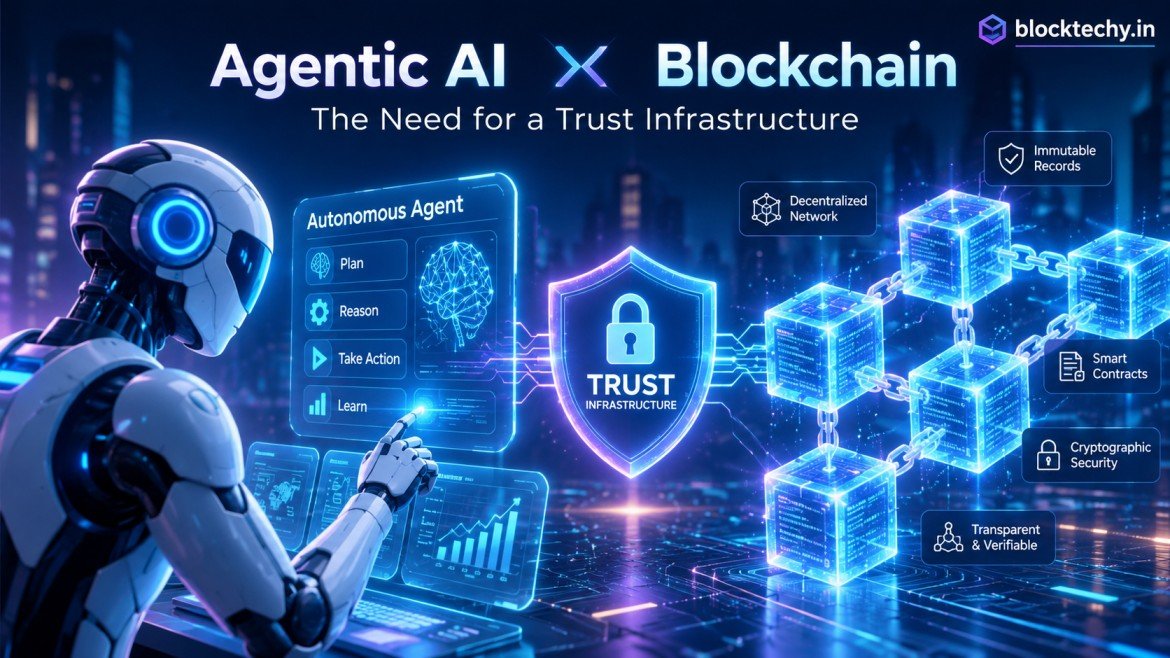
Introduction
Artificial Intelligence has already transformed the way we search for information, write code, analyze data, and automate business processes. However, the next major evolution of AI is already here: Agentic AI.
Unlike traditional AI models that simply respond to prompts, agentic AI systems can independently make decisions, execute tasks, collaborate with other AI agents, interact with APIs, manage digital assets, and continuously learn from their environment. These autonomous capabilities promise unprecedented productivity—but they also introduce entirely new security challenges.
As AI agents become capable of making financial transactions, signing contracts, managing digital identities, and interacting with critical infrastructure, one question becomes increasingly important:
How do we trust autonomous AI?
The answer may lie in blockchain technology.
Blockchain is no longer just about cryptocurrencies. It has evolved into a powerful trust infrastructure capable of securing digital identities, recording immutable actions, verifying data authenticity, and enabling decentralized governance. As autonomous AI becomes more widespread, blockchain security will play a central role in ensuring transparency, accountability, and trust.
In this article, we’ll explore why blockchain security matters more than ever in the age of agentic AI and how these two transformative technologies complement each other.
Understanding Agentic AI
Agentic AI refers to AI systems capable of independently pursuing goals with minimal human intervention.
Instead of waiting for commands, these systems can:
- Plan complex workflows
- Make autonomous decisions
- Interact with software applications
- Communicate with other AI agents
- Execute transactions
- Learn from outcomes
- Adapt strategies over time
Imagine a digital employee that can:
- Book business meetings
- Purchase cloud resources
- Negotiate service contracts
- Analyze financial markets
- Hire freelancers
- Manage supply chains
—all without constant human supervision.
This level of autonomy dramatically increases efficiency, but it also raises serious security concerns.
The Biggest Security Challenges of Agentic AI
As AI gains more authority, the consequences of mistakes—or malicious manipulation—become far greater.
Some major challenges include:
1. Identity Verification
How do you know an AI agent is authentic?
Could someone impersonate your AI assistant?
Without secure digital identity systems, fake AI agents could perform unauthorized actions.
2. Data Manipulation
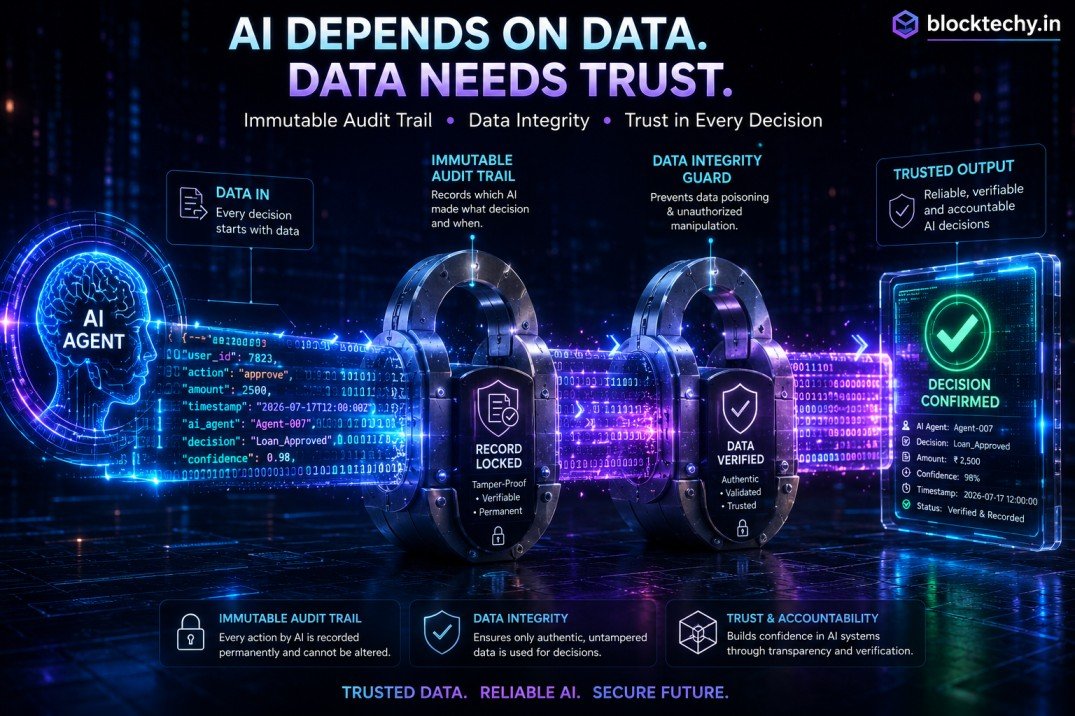
AI depends entirely on data.
If attackers manipulate training datasets or live inputs, autonomous systems may produce dangerous decisions.
This is known as:
- Data poisoning
- Prompt injection
- Context manipulation
3. Unauthorized Transactions
Future AI agents may control:
- Crypto wallets
- Bank accounts
- Enterprise software
- Supply chains
- Smart factories
Without secure verification, attackers could hijack these systems.
4. Lack of Accountability
Suppose an AI agent purchases the wrong asset or approves a fraudulent payment.
Questions immediately arise:
- Who approved it?
- When?
- Which AI model made the decision?
- What data influenced the action?
Traditional systems often lack immutable audit trails.
5. Centralized Vulnerabilities
Most AI platforms today rely on centralized cloud infrastructure.
This creates single points of failure.
A server outage, insider attack, or database compromise could affect millions of AI-powered systems simultaneously.
Why Blockchain Solves Many of These Problems
Blockchain introduces something AI lacks by default:
Trust without centralized control.
Its core security features naturally complement autonomous AI systems.
These include:
- Immutable records
- Cryptographic verification
- Decentralized consensus
- Transparent execution
- Tamper-resistant history
- Distributed storage
- Digital identity management
Together, they create a foundation for trustworthy AI.
Immutable Audit Trails
Every autonomous decision made by an AI agent can be securely recorded on blockchain.
For example:
AI receives task

↓

AI analyzes data

↓

AI chooses action

↓

Decision hash stored on blockchain

↓

Execution verified

↓

Permanent audit record created
No one can secretly alter this history later.
This becomes invaluable for:
- Enterprises
- Governments
- Healthcare
- Finance
- Defense
- Legal compliance
Verifiable AI Decisions
One criticism of AI is the “black box” problem.
Users often don’t know:
- Why AI made a decision
- Which model was used
- Whether the output was modified
Blockchain can securely timestamp:
- AI model version
- Training dataset hash
- Input hash
- Output hash
- Decision metadata
This enables organizations to verify that AI outputs haven’t been altered after generation.
Decentralized Identity for AI Agents
Every autonomous AI agent needs a secure identity.
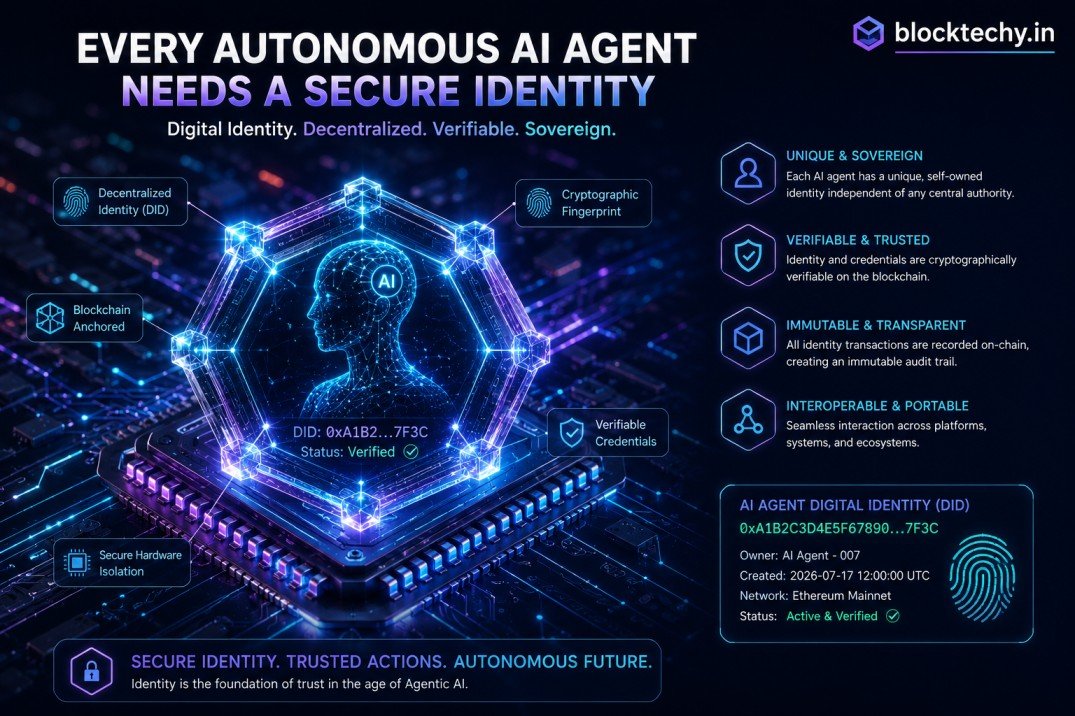
Blockchain-based decentralized identities (DIDs) allow AI agents to prove:
- Who they are
- Which organization owns them
- Their permissions
- Their reputation
- Their transaction history
Instead of relying on usernames and passwords, AI agents authenticate using cryptographic keys.
This dramatically reduces impersonation attacks.
Smart Contracts Enable Secure Automation
Agentic AI often needs to execute agreements.
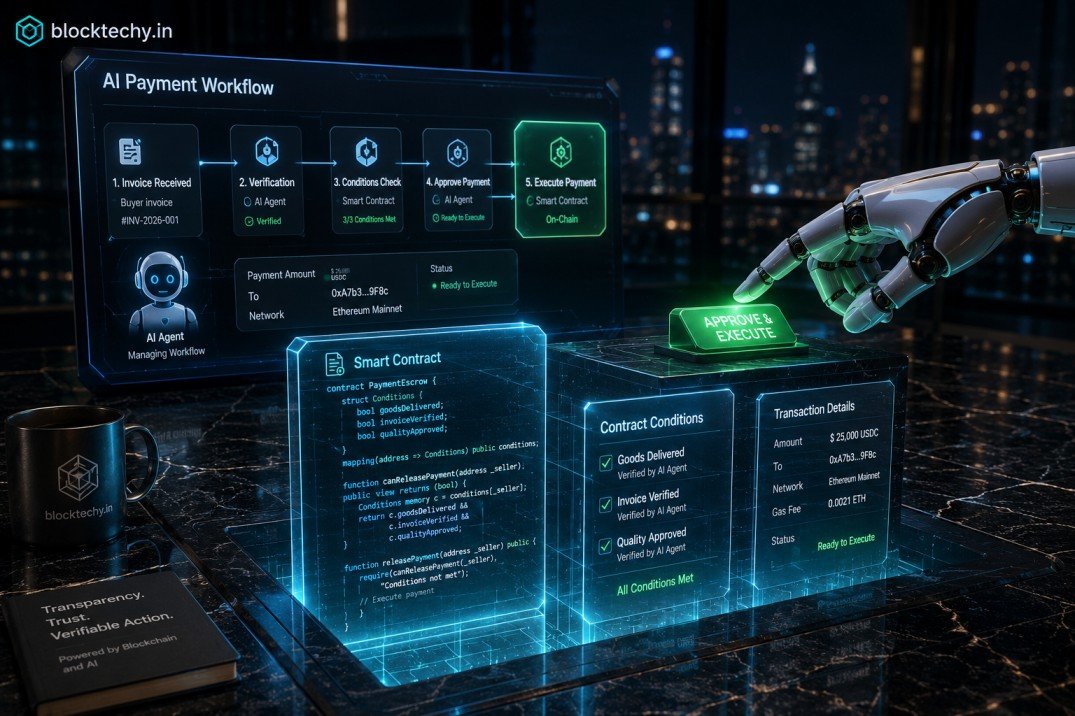
Blockchain smart contracts allow AI agents to interact using predefined rules.
For example:
An AI purchasing assistant can automatically:
- Compare suppliers
- Select the best price
- Verify inventory
- Submit payment
- Release funds only after delivery confirmation
Because the payment rules are encoded in smart contracts, neither party can manipulate the agreement afterward.
Protecting AI Models
AI models themselves are becoming valuable intellectual property.
Organizations invest millions of dollars developing proprietary models.
Blockchain can help protect these assets by:
- Recording ownership
- Timestamping model releases
- Tracking updates
- Verifying authenticity
- Preventing unauthorized modifications
Developers can always prove the origin of their AI models.
Data Integrity Becomes Critical
AI is only as reliable as its data.
Blockchain ensures datasets remain verifiable.
Instead of storing large datasets directly on-chain, organizations typically store:
- Cryptographic hashes
- Version history
- Access permissions
- Update logs
Whenever data changes, its hash changes too.
This immediately reveals tampering attempts.
Multi-Agent Collaboration Requires Trust
Future ecosystems may involve thousands of AI agents working together.
For example:
A logistics network could involve:
- Warehouse AI
- Shipping AI
- Customs AI
- Payment AI
- Insurance AI
These agents may belong to different companies.
Blockchain provides a shared source of truth where all participants can verify transactions without relying on a single organization.
Preventing AI Fraud
Autonomous AI increases fraud risks.
Examples include:
- Fake purchase orders
- Synthetic identities
- Unauthorized fund transfers
- Deepfake approvals
- Fake customer requests
Blockchain reduces these threats by requiring cryptographic verification before actions are executed.
Blockchain Enables AI Accountability
One of the biggest regulatory concerns surrounding AI is accountability.
Governments increasingly require organizations to explain AI decisions.
Blockchain provides:
- Immutable logs
- Timestamped decisions
- Verifiable evidence
- Transparent execution history
This simplifies audits and compliance.
Real-World Industries That Will Benefit
Financial Services
Banks increasingly use AI for:
- Loan approvals
- Fraud detection
- Trading
- Risk analysis
Blockchain ensures every automated financial decision is securely verifiable.
Healthcare
AI assists doctors with:
- Diagnostics
- Medical imaging
- Drug discovery
Blockchain protects patient records while maintaining complete audit trails.
Supply Chain
Autonomous procurement agents can:
- Order inventory
- Track shipments
- Verify suppliers
Blockchain prevents fraud while improving transparency.
Manufacturing
Smart factories increasingly rely on AI agents controlling machines.
Blockchain records machine decisions and maintenance history, reducing operational risks.
Government Services
Governments using AI for:
- Tax processing
- Identity verification
- Public benefits
need transparent, tamper-proof systems.
Blockchain provides exactly that.
AI Wallets Need Blockchain Security
Future AI assistants may own digital wallets.
Imagine asking your AI:
Purchase cloud storage.
The AI compares providers, negotiates pricing, signs a smart contract, and transfers cryptocurrency.
Without blockchain security:
- Wallet theft becomes easier
- Transactions become difficult to audit
- Fraud detection becomes weaker
Blockchain ensures secure ownership through private keys and cryptographic signatures.
Privacy Will Become Even More Important
Agentic AI handles enormous amounts of personal data.
Blockchain can support privacy-preserving techniques such as:
- Zero-Knowledge Proofs (ZKPs)
- Selective disclosure
- Decentralized identity
- Verifiable credentials
These technologies allow AI to verify information without exposing unnecessary personal details.
For example, an AI agent could confirm that a user is over 18 without revealing their exact date of birth.
Challenges of Combining Blockchain and Agentic AI
While blockchain strengthens AI security, integration is not without obstacles.
Some challenges include:
Scalability
Public blockchains may struggle to handle millions of AI-generated transactions per second.
Layer-2 networks and rollups will be essential.
Transaction Costs
Frequent blockchain interactions can become expensive.
Efficient architectures will combine on-chain verification with off-chain computation.
Latency
AI often requires instant responses.
Blockchain confirmations may introduce delays.
Hybrid solutions will likely dominate.
Regulation
Governments worldwide are still defining legal frameworks for both AI and blockchain.
Future compliance standards will shape adoption across industries.
The Future: Autonomous Economies
Experts predict the emergence of autonomous digital economies where AI agents transact with one another on behalf of humans and organizations.
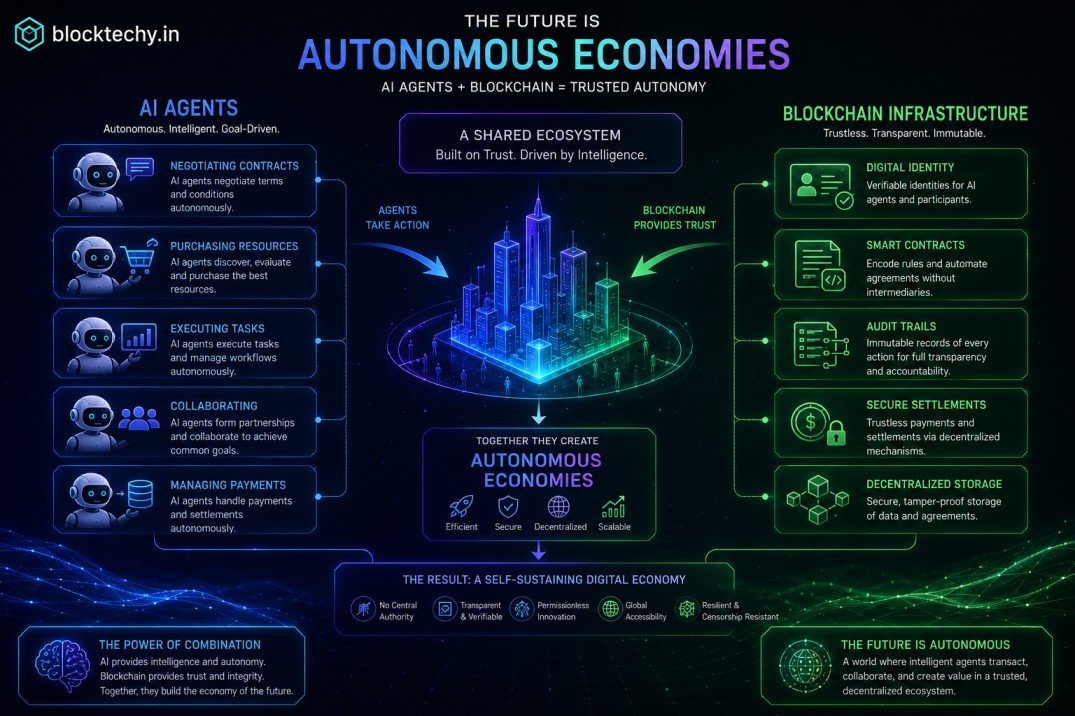
Examples include:
- AI freelancers completing digital work
- Autonomous vehicles paying tolls
- Smart factories ordering raw materials
- Personal AI assistants managing investments
- AI-powered supply chains negotiating contracts
Blockchain provides the secure financial and trust layer that makes these interactions possible.
Without blockchain, autonomous economies would struggle with identity verification, accountability, and secure value exchange.
Why Businesses Should Prepare Now
Organizations that plan to adopt agentic AI should begin investing in blockchain-enabled security strategies today.
Practical steps include:
- Implement decentralized identity solutions.
- Use blockchain to create immutable audit logs for AI decisions.
- Secure sensitive datasets with cryptographic verification.
- Automate business workflows through audited smart contracts.
- Explore zero-knowledge proofs and privacy-preserving technologies.
- Train teams on blockchain fundamentals alongside AI governance.
- Evaluate hybrid architectures that balance on-chain trust with off-chain performance.
Preparing early helps businesses build AI systems that are not only powerful but also trustworthy, compliant, and resilient against emerging threats.
Final Thoughts
The rise of agentic AI marks a significant shift in how software interacts with the world. Instead of acting as passive assistants, AI agents are becoming autonomous decision-makers capable of managing assets, executing contracts, coordinating with other systems, and performing tasks that once required human judgment.
With this increased autonomy comes increased responsibility. Trust, transparency, and security are no longer optional—they are foundational requirements. Blockchain technology addresses many of these challenges by providing immutable records, decentralized identities, cryptographic verification, and programmable trust through smart contracts.
Rather than competing, blockchain and agentic AI are complementary technologies. AI brings intelligence and automation, while blockchain delivers integrity, accountability, and secure coordination. Together, they form the backbone of the next generation of digital infrastructure, enabling autonomous systems that organizations and users can rely on with confidence.
As businesses embrace AI-driven automation over the coming years, those that combine intelligent agents with robust blockchain security will be better positioned to innovate safely, comply with evolving regulations, and earn long-term trust in an increasingly autonomous digital world.
Frequently Asked Questions (FAQs)
1. What is agentic AI?
Agentic AI refers to AI systems that can independently plan, make decisions, execute tasks, and pursue goals with minimal human intervention.
2. Why is blockchain important for AI security?
Blockchain provides immutable records, decentralized identity, cryptographic verification, and transparent audit trails that improve the trustworthiness and accountability of AI systems.
3. Can blockchain prevent AI attacks?
While blockchain cannot stop every AI attack, it significantly reduces risks related to data tampering, identity spoofing, unauthorized transactions, and audit manipulation.
4. Which industries will benefit most from blockchain-secured AI?
Finance, healthcare, supply chain, manufacturing, government, cybersecurity, and decentralized finance (DeFi) are among the sectors expected to benefit the most.
5. Will blockchain and agentic AI work together in the future?
Yes. Many experts view blockchain as the trust layer for autonomous AI, enabling secure identities, verifiable decisions, and reliable transactions between AI agents.