
Hashing in Blockchain: The Digital Fingerprint Securing the Future
Blockchain technology has transformed the way we think about data, security, and trust. At the heart of this revolutionary system lies a powerful concept called hashing. While it may sound technical, hashing is actually quite simple to understand when broken down properly.
In this blog, we’ll explore what hashing is, how it works in blockchain, and why it is so important—all in a clear and easy-to-understand way.
What is Hashing?
Hashing is a process that converts any type of data into a unique string of characters. This output is called a hash value or simply a hash.
Think of it as creating a digital fingerprint for your data.
- Input can be anything: text, numbers, files, images
- Output is always a fixed-length string
No two different inputs are expected to produce the same hash.
How Hashing Works (Simple Visualization)
Imagine a machine:
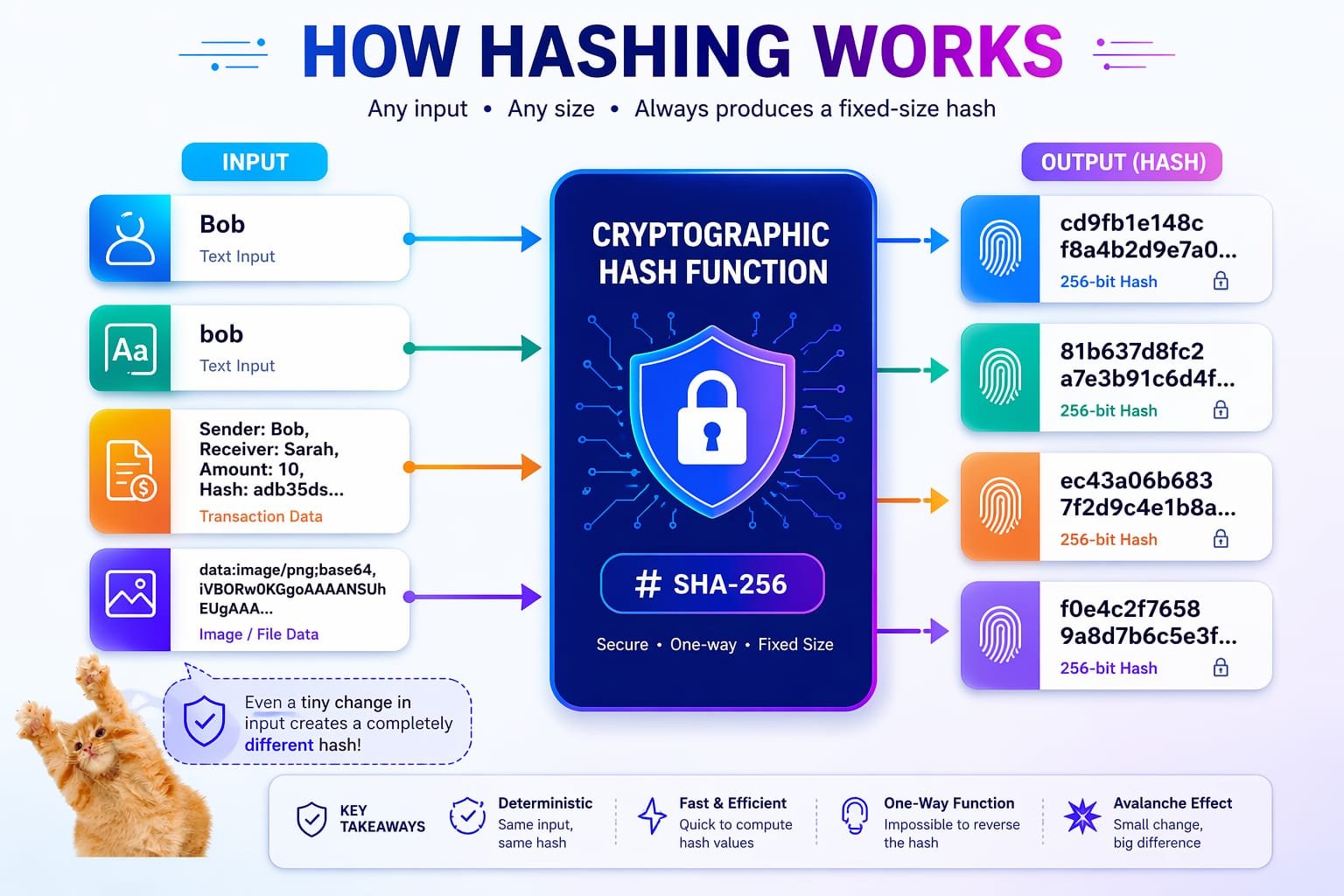
- You enter some data (like your name)
- The machine processes it
- It outputs a coded string (hash)
No matter what you input, the output is always the same length—but completely unique.
Hashing in Blockchain
Blockchain systems like Bitcoin rely heavily on hashing. The most commonly used hashing algorithm is SHA-256.
This algorithm generates a 64-character hash value, ensuring strong security.
Key Properties of Hashing
1. Deterministic Nature
The same input always gives the same output.
Example:
- “Hello” →
185f8db32271fe25f561a6fc938b2e264306ec304eda518007d1764826381969
2. Avalanche Effect
A tiny change in input leads to a completely different hash.
Example:
- “Hello” ≠ “hello”
Even changing one letter drastically changes the result.
3. Fixed-Length Output
No matter the input size:
- A word or a whole book
- The hash output length remains constant
4. One-Way Function
You can generate a hash from data, but you cannot reverse it to get the original input.
5. Collision Resistance
It’s extremely unlikely for two different inputs to produce the same hash.
How Hashing Builds Blockchain
Each block in a blockchain contains:
- Its own hash
- The previous block’s hash
- Transaction data
This creates a secure chain of blocks.
Blockchain Structure (Visual)

If someone tries to change data in one block:
- Its hash changes
- All following blocks break
- The system detects tampering immediately
Why Hashing is Important in Blockchain
1. Immutability
Once data is recorded:
- It cannot be changed without detection
- This ensures trust and transparency
2. Data Security
Hashing protects sensitive information by:
- Converting it into unreadable form
- Preventing unauthorized access
3. Block Linking
Each block is connected using hashes, forming a secure chain.
4. Mining and Proof of Work
In blockchain systems like Bitcoin:
- Miners solve complex hash puzzles
- This process secures the network
5. Transaction Verification
Hashing ensures:
- Data integrity
- Authentic transactions
Real-Life Analogy: The Envelope Seal
Think of hashing like sealing an envelope:
- You send a sealed letter
- If someone opens it, the seal breaks
- You instantly know it was tampered with
In blockchain:
- Hash = Seal
- Change data = Broken seal
Try It Yourself (Fun Activity)
Want to see hashing in action?
- Use any online SHA-256 generator
- Enter your name
- Copy the hash
- Change one letter
- Watch the entire hash change
This demonstrates how sensitive hashing is.
Real-World Example: Bitcoin

In Bitcoin:
- Each block contains transaction data and hashes
- Changing one transaction affects the entire chain
- The network rejects invalid changes
This makes Bitcoin:
- Secure
- Transparent
- Tamper-proof
Types of Hash Functions Used in Blockchain
While SHA-256 is the most popular, blockchain systems may use other hash functions too:
- SHA-1 – Older and less secure now
- SHA-3 – More advanced and secure version
- MD5 (Message Digest 5) – Fast but not secure for blockchain
- RIPEMD-160 – Used along with SHA-256 in Bitcoin addresses
These algorithms differ in speed, security, and resistance to attacks.
How Hashing Works Step-by-Step in Blockchain
Let’s break it down simply:
- A transaction is created
- Transaction data is grouped into a block
- The block is passed through a hash function
- A unique hash is generated
- The hash of the previous block is added
- The block is added to the chain
This step-by-step process ensures security and continuity.
Role of Hashing in Mining
In Bitcoin mining:
- Miners compete to solve a complex mathematical puzzle
- They repeatedly hash block data with different values (nonce)
- The goal is to find a hash that meets specific conditions (e.g., starts with zeros)
This process is called Proof of Work (PoW).
Mining Visualization

This ensures:
- Network security
- Fair validation
- Prevention of fraud
Hashing vs Encryption (Important Difference)
Many students confuse hashing with encryption.
| Feature | Hashing | Encryption |
|---|---|---|
| Purpose | Data integrity | Data confidentiality |
| Reversible | No | Yes (with key) |
| Output | Fixed length | Variable |
| Use in Blockchain | Yes | Limited |
Hashing = One-way
Encryption = Two-way
Hashing in Digital Signatures
Hashing is used along with cryptography to create digital signatures:
- First, data is hashed
- Then the hash is encrypted using a private key
- This ensures:
- Authenticity
- Integrity
- Non-repudiation
This is how blockchain verifies transactions securely.
Hashing Beyond Blockchain
Hashing is not limited to blockchain. It is widely used in:
- Password storage (websites don’t store real passwords)
- Data integrity checks (file downloads)
- Cybersecurity systems
- Digital certificates
Example: When you log into a website, your password is hashed before being stored.
Common Attacks on Hashing
Although hashing is secure, there are some theoretical attacks:
- Brute Force Attack – Trying all possible inputs
- Rainbow Table Attack – Using precomputed hashes
- Collision Attack – Finding two inputs with same hash
Modern algorithms like SHA-256 are designed to resist these attacks.
How Blockchain Prevents These Attacks
Blockchain adds extra layers of security:
- Uses strong hash functions like SHA-256
- Combines hashing with decentralization
- Requires consensus from multiple nodes
- Makes attacks extremely expensive and impractical
Future of Hashing in Blockchain
Hashing continues to evolve with technology:
- Development of quantum-resistant algorithms
- More energy-efficient hashing techniques
- Integration with advanced cryptographic systems
As blockchain grows, hashing will remain a core component.
Advantages of Hashing
- Ensures data integrity
- Enhances security
- Detects tampering instantly
- Supports decentralized systems
- Builds trust without middlemen
Limitations of Hashing
- Cannot recover original data
- Requires high computational power (in mining)
- Rare possibility of hash collisions
Final Thoughts
Hashing is the backbone of blockchain technology. It ensures that data remains secure, unchanged, and trustworthy across a decentralized network.
Without hashing, systems like Bitcoin would not be possible.
Understanding hashing helps you understand why blockchain is so powerful—and why it’s shaping the future of digital security.
Pro Tips for Students
- Always mention SHA-256 in exams
- Explain avalanche effect with example (“Hello” vs “hello”)
- Draw a simple blockchain diagram showing hash linking
- Use real-life analogy (envelope seal) for better marks
Quick Recap
- Hashing converts data into a fixed-length unique value
- It is irreversible and secure
- It links blocks in blockchain
- Even a small input change creates a huge output difference
- It ensures immutability and trust