
Introduction
The blockchain industry has evolved dramatically since the launch of Bitcoin in 2009. Today, thousands of blockchain networks exist, each designed with unique features, consensus mechanisms, and use cases. Bitcoin excels as a decentralized store of value, Ethereum dominates smart contracts and decentralized applications (dApps), Solana offers high-speed transactions, while networks like Avalanche, Polygon, BNB Chain, and Polkadot continue to innovate in scalability and functionality.
Despite these advancements, one major challenge continues to limit blockchain adoption: blockchains cannot naturally communicate with one another.

Imagine if Gmail users could only send emails to other Gmail users, or if iPhone users couldn’t call Android phones. The internet would never have become the global communication platform it is today. Similarly, isolated blockchain ecosystems restrict innovation, reduce liquidity, and create fragmented user experiences.
This is where Cross-Chain Interoperability becomes one of the most transformative technologies in Web3. It enables different blockchain networks to exchange assets, data, and information securely without relying on centralized intermediaries.
In this article, we’ll explore what cross-chain interoperability is, why it matters, how it works, the technologies behind it, real-world applications, challenges, and what the future holds for interconnected blockchain ecosystems.
What Is Cross-Chain Interoperability?
Cross-chain interoperability refers to the ability of different blockchain networks to communicate, share information, and transfer digital assets with one another seamlessly.
Instead of operating as isolated ecosystems, interoperable blockchains function like connected countries with open trade routes, allowing users and applications to move freely across multiple networks.

For example:
- Transfer Bitcoin into Ethereum-based DeFi applications.
- Use NFTs created on one blockchain inside games built on another.
- Execute smart contracts that interact with multiple blockchains simultaneously.
- Share identity credentials across different blockchain ecosystems.
In simple terms, interoperability transforms separate blockchains into one interconnected digital economy.
Why Blockchain Interoperability Is Important
Without interoperability, every blockchain operates independently.
This creates several problems:
1. Fragmented Liquidity
Digital assets remain locked within individual ecosystems.
For example:
- Bitcoin liquidity stays on Bitcoin.
- Ethereum DeFi uses only Ethereum assets.
- Solana assets remain inside Solana.
Cross-chain technology combines liquidity across networks.
2. Poor User Experience
Users often need to:
- Create multiple wallets
- Manage different tokens
- Switch networks
- Use centralized exchanges
Interoperability simplifies this process by enabling seamless movement between chains.
3. Limited dApp Functionality
Applications built on one blockchain cannot easily access data or assets from another.
Interoperability enables developers to build multi-chain applications that leverage the strengths of several networks simultaneously.
4. Better Scalability
Different blockchains specialize in different tasks.
For example:
- Ethereum offers strong security.
- Solana provides fast transaction speeds.
- Polygon reduces transaction costs.
Cross-chain systems allow applications to use each blockchain where it performs best.
How Cross-Chain Interoperability Works
Several technologies make blockchain communication possible.

1. Blockchain Bridges
Blockchain bridges lock assets on one blockchain while creating equivalent wrapped assets on another.
Example:
A user locks 1 BTC.
The bridge issues 1 Wrapped Bitcoin (WBTC) on Ethereum.
Users can now access Ethereum DeFi while maintaining Bitcoin exposure.
When they return, WBTC is burned, and the original BTC is unlocked.
This mechanism allows assets to travel across ecosystems.
2. Cross-Chain Messaging
Sometimes applications need data instead of assets.
Cross-chain messaging protocols enable:
- Smart contract communication
- Data sharing
- Governance voting
- Oracle updates
- Identity verification
Instead of moving tokens, they move verified information.
3. Atomic Swaps
Atomic swaps allow users to exchange cryptocurrencies directly between different blockchains without intermediaries.
For example:
Alice swaps Bitcoin.
Bob swaps Litecoin.
Either both transactions succeed or both fail.
No party can cheat the other.
4. Relay Networks
Relay chains monitor multiple blockchains and verify transactions between them.
These systems ensure trustless communication while maintaining decentralization.
Types of Cross-Chain Interoperability
Asset Interoperability
Transfers cryptocurrencies across different networks.
Examples include:
- Wrapped tokens
- Stablecoin transfers
- Token bridges
Data Interoperability
Shares blockchain information.
Examples:
- NFT ownership
- Identity credentials
- Smart contract data
- Oracle feeds
Smart Contract Interoperability
Allows contracts deployed on different blockchains to interact.
This creates more sophisticated decentralized applications.
Application Interoperability
Entire decentralized applications can operate across multiple chains simultaneously.
Users enjoy a unified experience regardless of the blockchain being used.
Major Cross-Chain Technologies
1. Blockchain Bridges
Bridges remain the most common interoperability solution.
Examples include:
- Asset transfers
- NFT migration
- Stablecoin movement
Advantages:
- Easy to use
- Widely supported
Disadvantages:
- Frequently targeted by hackers
- Often require trust assumptions
2. Sidechains
Sidechains connect to a primary blockchain while operating independently.
Benefits include:
- Faster transactions
- Lower fees
- Additional scalability
3. Layer-2 Networks
Layer-2 solutions inherit security from the main blockchain while processing transactions off-chain.
Examples:
- Rollups
- State channels
Many Layer-2 ecosystems are becoming increasingly interoperable.
4. Interoperability Protocols
Purpose-built interoperability networks connect many independent blockchains.
These protocols focus on secure messaging rather than simply transferring assets.
Popular Cross-Chain Projects
Several blockchain projects are dedicated to solving interoperability challenges.
Polkadot
Polkadot connects independent blockchains called parachains through a central Relay Chain.
Advantages include:
- Shared security
- Fast communication
- Cross-chain messaging
- High scalability
Cosmos
Cosmos describes itself as the “Internet of Blockchains.”
Its Inter-Blockchain Communication (IBC) protocol enables sovereign blockchains to exchange assets and information securely.
Chainlink CCIP
The Cross-Chain Interoperability Protocol (CCIP) allows developers to build applications that securely communicate across multiple blockchains using decentralized oracle infrastructure.
LayerZero
LayerZero introduces omnichain communication, enabling applications to interact seamlessly across supported blockchain networks while minimizing trust assumptions.
Wormhole
Wormhole connects numerous blockchain ecosystems and facilitates cross-chain transfers of tokens, NFTs, and arbitrary messages. It is widely integrated into decentralized finance and gaming applications.
Real-World Applications
Cross-chain interoperability unlocks use cases that single blockchain ecosystems cannot easily achieve.
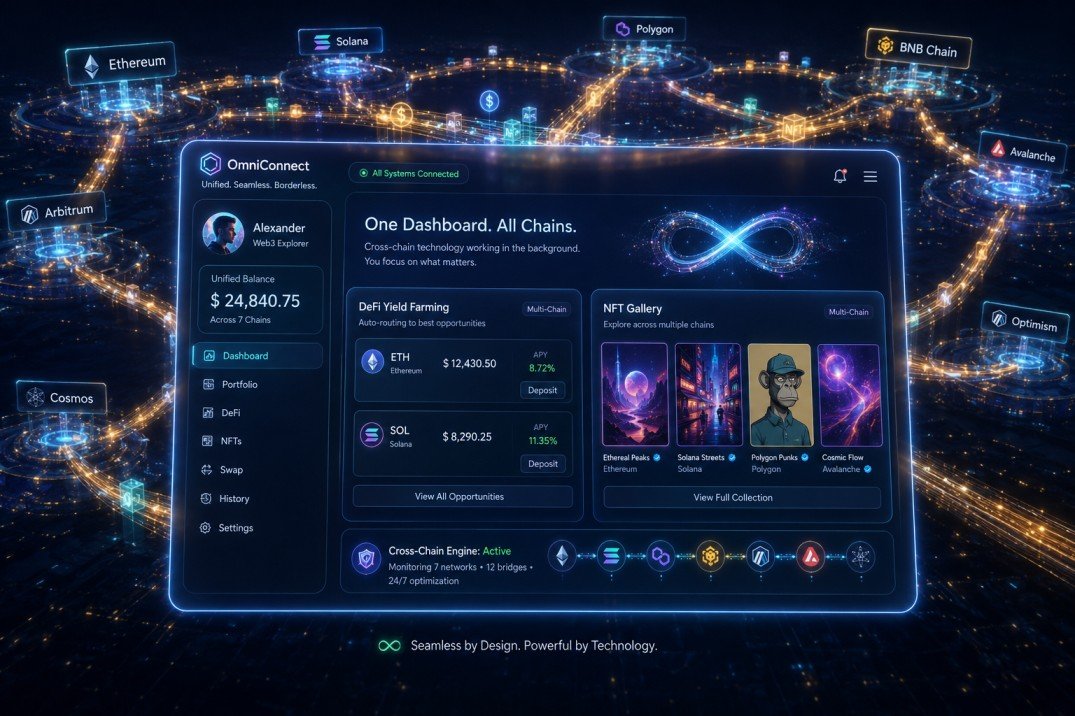
1. Decentralized Finance (DeFi)
Users can:
- Borrow on Ethereum
- Provide liquidity on Solana
- Trade on Avalanche
- Earn yield across multiple ecosystems
without remaining confined to one blockchain.
2. NFT Ecosystems
Future NFTs will not remain limited to one network.
A single NFT could:
- Be purchased on Ethereum
- Used in a Polygon-based game
- Displayed in a Solana marketplace
- Traded on multiple chains
3. Blockchain Gaming
Games increasingly span multiple blockchains.
Players may:
- Earn tokens on one network
- Use items on another
- Transfer achievements between ecosystems
Cross-chain technology enables truly portable digital assets.
4. Enterprise Blockchain
Businesses often use private blockchains for confidentiality while interacting with public networks for transparency and settlement.
Interoperability bridges this gap, enabling secure data exchange and automated workflows across diverse blockchain infrastructures.
5. Supply Chain Management
Products move across manufacturers, logistics providers, retailers, and regulators.
Each participant may use a different blockchain.
Cross-chain communication creates one transparent and verifiable record throughout the product lifecycle.
6. Digital Identity
Instead of creating separate identities for every blockchain, users could maintain a single decentralized identity recognized across multiple networks.
This improves convenience while preserving user control over personal data.
Benefits of Cross-Chain Interoperability
The advantages are substantial.
Increased Liquidity
Assets move freely across ecosystems.
Better User Experience
Users no longer remain locked into one blockchain.
Stronger Developer Ecosystem
Developers build once while accessing multiple blockchain networks.
Greater Innovation
Applications combine the strengths of several blockchains.
Improved Scalability
Network congestion decreases by distributing workloads.
Reduced Vendor Lock-In
Projects avoid dependence on a single blockchain platform.
Challenges of Cross-Chain Technology
Despite rapid progress, interoperability introduces technical and security challenges.
Security Risks
Cross-chain bridges have historically been among the largest targets for cyberattacks.
Smart contract vulnerabilities, validator compromises, and implementation bugs have resulted in billions of dollars in losses across the industry.
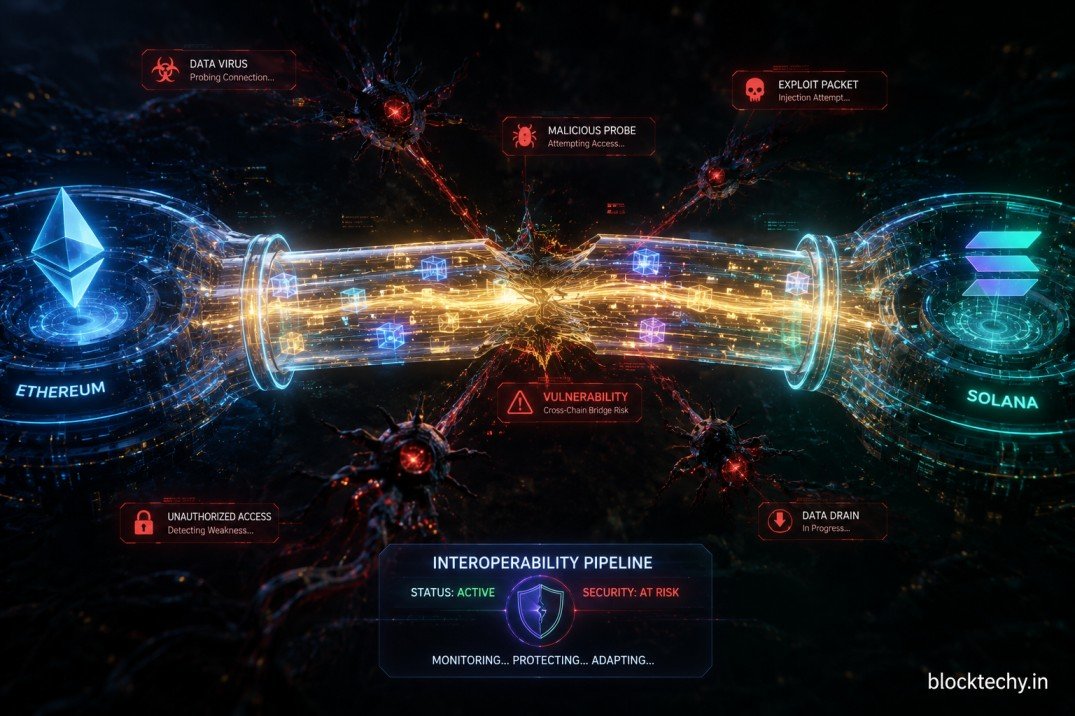
Improving bridge security remains a top priority.
Complexity
Each blockchain has:
- Different consensus mechanisms
- Different virtual machines
- Different cryptography
- Different transaction formats
Connecting all of them securely is extremely challenging.
Standardization
The blockchain ecosystem lacks universal communication standards.
Without common protocols, interoperability remains difficult to scale globally.
Scalability
As more chains connect, interoperability networks must process increasing amounts of cross-chain messages without sacrificing speed or decentralization.
Trust Assumptions
Some interoperability solutions rely on trusted validators, custodians, or multisignature systems.
The long-term goal is trust-minimized or fully trustless communication.
The Future of Cross-Chain Blockchain Networks
The future of blockchain is unlikely to revolve around a single dominant chain. Instead, experts increasingly envision a multi-chain ecosystem where specialized networks collaborate rather than compete.

Emerging trends include:
- Universal cross-chain wallets
- AI-powered blockchain routing
- Cross-chain decentralized identity
- Omnichain decentralized applications (dApps)
- Cross-chain DAO governance
- Shared liquidity protocols
- Interoperable real-world asset (RWA) tokenization
- Institutional cross-chain settlement
- Seamless enterprise blockchain integration
Users may not even realize which blockchain powers a transaction. Applications will automatically choose the fastest, cheapest, or most secure network in the background, much like the internet routes data packets today.
Best Practices for Developers Building Cross-Chain Applications
Developers aiming to build secure and scalable cross-chain applications should follow several best practices:
- Choose interoperability protocols with proven security records.
- Conduct regular smart contract audits.
- Minimize trust assumptions whenever possible.
- Implement strong monitoring and fail-safe mechanisms.
- Design applications to handle network delays and failed cross-chain messages gracefully.
- Educate users about bridge risks and transaction verification.
- Stay updated with evolving interoperability standards and security improvements.
By prioritizing security and user experience, developers can build resilient applications that inspire confidence in the growing multi-chain ecosystem.
Conclusion
Cross-chain interoperability is becoming one of the most important building blocks of the next generation of blockchain technology. Rather than existing as isolated islands, blockchain networks are evolving into an interconnected ecosystem where assets, data, identities, and applications move securely across chains.
This connectivity promises to unlock greater liquidity, improve user experiences, accelerate innovation, and enable decentralized applications that are far more powerful than those confined to a single network. While challenges such as security, standardization, and scalability remain, continuous advancements in interoperability protocols, bridge technologies, and cross-chain messaging are driving the industry forward.
As blockchain adoption expands across finance, gaming, healthcare, supply chains, and enterprise systems, seamless communication between networks will become essential. The future of Web3 is not about choosing one blockchain over another—it’s about creating a world where every blockchain can collaborate, allowing users and developers to benefit from the strengths of each network.
Cross-chain interoperability is, therefore, not just a technical enhancement; it is the foundation for a truly connected, efficient, and decentralized digital economy.
Follow this link to join my WhatsApp group:
https://chat.whatsapp.com/JvmrMTxkdgt9u6kGMT73XY