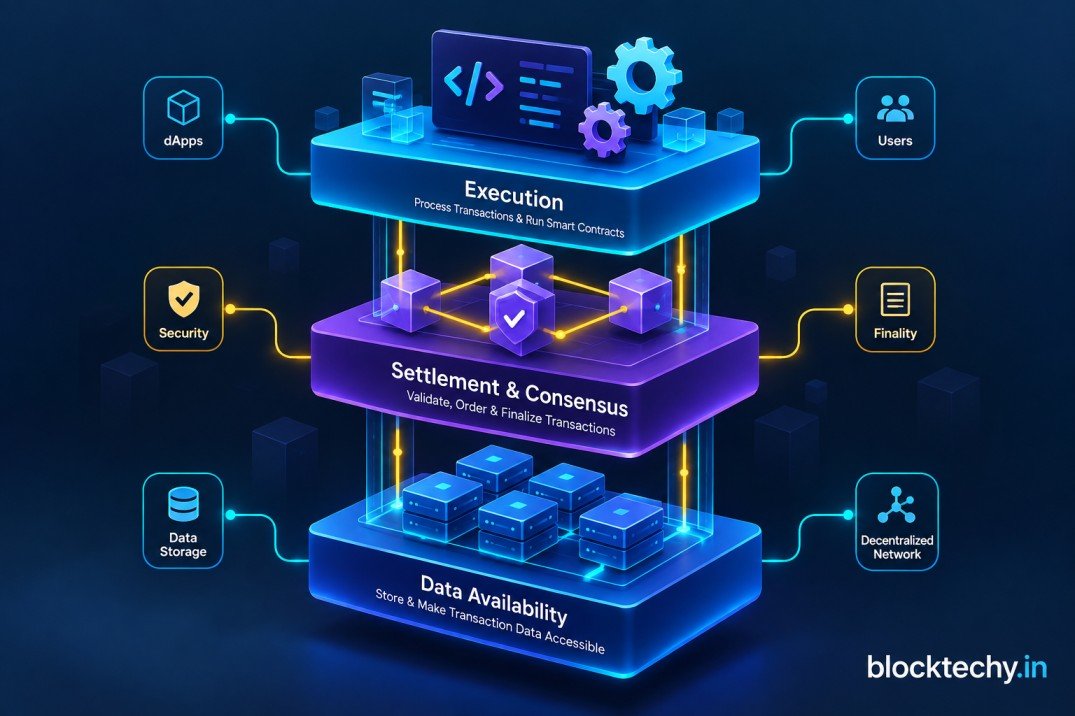
Modular Blockchains Explained: Why Blockchain Architecture Is Changing
Blockchain technology is entering a new phase of development. The first generation of blockchains focused mainly on creating decentralized networks that could process transactions securely. Later, smart contract platforms expanded what blockchains could do, enabling decentralized finance (DeFi), NFTs, DAOs, gaming, and Web3 applications.
However, as blockchain adoption has grown, traditional blockchain architecture has revealed important limitations. A single blockchain often has to handle transaction execution, data availability, consensus, and settlement at the same time. This approach can work at smaller scales, but it becomes increasingly difficult to optimize every part of the system as demand grows.
This is where modular blockchains come into the picture.
Instead of requiring one blockchain to perform every task, modular architecture separates blockchain responsibilities into specialized layers. Each layer can focus on what it does best while interacting with other components of the network.
The result is a fundamentally different way of designing blockchain systems.
In this article, we will explore what modular blockchains are, how they differ from monolithic blockchains, the major components of modular architecture, their advantages and challenges, and why modularity could play an important role in the future of blockchain infrastructure.
What Is a Modular Blockchain?
A modular blockchain is a blockchain architecture in which different core blockchain functions are separated into specialized components or layers.
A traditional blockchain generally tries to perform several important functions within the same network:
- Transaction execution
- Consensus
- Data availability
- Settlement
- Transaction ordering
In a modular architecture, these responsibilities can be distributed across different layers.
For example, one network may specialize in data availability, while another layer handles transaction execution and another provides settlement.
The basic idea can be represented as:
Execution → Settlement → Consensus → Data Availability
These components can work together without necessarily being implemented inside one single blockchain.
This approach is similar to how modern software systems are built. Instead of creating one enormous application responsible for everything, developers often divide systems into specialized services that communicate with each other.
Blockchain developers are increasingly applying a similar philosophy to decentralized networks.
Monolithic vs. Modular Blockchains
To understand modular blockchains, it helps to first understand the traditional model.
What Is a Monolithic Blockchain?
A monolithic blockchain attempts to perform most or all blockchain functions within the same network.
Examples historically associated with this architectural approach include networks such as Bitcoin and early generations of smart-contract platforms.
A simplified monolithic blockchain looks like this:
Users
  ↓
Transactions
  ↓
Execution
  ↓
Consensus
  ↓
Data Availability
  ↓
Settlement
Everything happens within one blockchain environment.
This architecture has an important advantage: simplicity.
Users and developers interact with one primary network, and the blockchain itself manages the major parts of the transaction lifecycle.
However, this design can create scalability challenges.
Suppose thousands or millions of users want to interact with the blockchain simultaneously. The same network has to execute transactions, reach consensus, store data, and make that information available to network participants.
Optimizing one function can sometimes negatively affect another.
Why Are Blockchain Architectures Changing?
Blockchain networks face a fundamental challenge.
They need to provide:
- Decentralization
- Security
- Scalability
These goals are often described through the blockchain trilemma.
Increasing transaction throughput while maintaining strong decentralization and security is technically difficult.
A monolithic blockchain may try to improve performance by increasing block sizes, improving hardware requirements, or optimizing execution. But some approaches can increase the resources required to operate a full node.
That creates a difficult trade-off.
Modular architecture approaches the problem differently.
Instead of forcing one blockchain to do everything, developers can divide responsibilities.
For example:
Layer A: handles transaction execution.
Layer B: provides data availability.
Layer C: handles settlement.
Layer D: provides consensus and transaction ordering.
This specialization allows each component to be optimized independently.
The Four Major Functions of Blockchain Architecture
A useful way to understand modular blockchains is to examine the major functions involved in processing transactions.
1. Execution
Execution refers to actually processing transactions and changing the state of the blockchain.
For example, when someone swaps tokens through a decentralized exchange, the blockchain needs to execute the smart contract responsible for that transaction.
Execution answers:
“What happens when these transactions are processed?”
Execution environments can include:
- Ethereum Virtual Machine (EVM)
- WebAssembly-based environments
- Custom virtual machines
- Application-specific execution environments
In modular systems, execution does not necessarily need to happen on the same blockchain that provides data availability or settlement.
2. Consensus
Consensus allows network participants to agree on the state of the blockchain.
A decentralized network needs a mechanism that allows participants to agree on:
- Which transactions are valid
- The order of transactions
- Which blocks belong to the canonical chain
Different blockchain networks use different consensus mechanisms.
Examples include:
- Proof of Work
- Proof of Stake
- Proof of Authority
- Byzantine Fault Tolerant consensus mechanisms
In modular architectures, consensus can be separated from execution.
The consensus layer can focus on determining the canonical ordering of data without necessarily executing every transaction itself.
3. Data Availability
Data availability is one of the most important concepts in modern blockchain scaling.
A blockchain can publish transaction information, but other participants need to be able to access that data.
Why does this matter?
Imagine an application processes thousands of transactions through a specialized execution layer. Other participants need enough information to verify that the resulting state is legitimate.
If transaction data is unavailable, independent verification becomes difficult.
Therefore, a modular blockchain system may use a specialized data availability layer.
The purpose of such a layer is to make required transaction data available to network participants while allowing other layers to focus on execution or settlement.
4. Settlement
Settlement is the process through which blockchain state and transaction outcomes become finalized or recognized by another trusted layer.
A settlement layer can provide functionality such as:
- Finality
- Dispute resolution
- Verification
- Asset settlement
For example, a Layer 2 network can execute transactions separately while using a Layer 1 blockchain for settlement.
This allows the Layer 2 network to process activity more efficiently while relying on the underlying blockchain for security or finality mechanisms.
How Modular Blockchains Work
A simplified modular architecture might look like this:
                Users
                  ↓
           Applications
                  ↓
            Execution Layer
                  ↓
          Settlement Layer
                  ↓
        Consensus / Ordering
                  ↓
        Data Availability Layer
However, real-world implementations can have different arrangements.
Some layers may perform multiple functions, while other systems may separate responsibilities even further.
The key idea is not a fixed four-layer structure.
The key idea is specialization.
Rollups and the Rise of Modular Architecture
One of the biggest drivers of modular blockchain development has been the growth of Layer 2 rollups.
Rollups execute transactions outside the main Layer 1 execution environment and then submit relevant information back to the underlying blockchain.
Two major types are:
Optimistic Rollups
Optimistic rollups generally assume submitted transactions are valid unless someone challenges them.
They use fraud-proof mechanisms to handle disputes.
Zero-Knowledge Rollups
Zero-knowledge rollups use cryptographic proofs to demonstrate that transactions were executed correctly.
These systems can reduce the amount of computation that the main blockchain needs to perform directly.
Rollups therefore demonstrate an important modular principle:
Transaction execution can be separated from the underlying blockchain’s settlement and security infrastructure.
Modular Blockchains vs. Layer 2 Scaling
These concepts are closely connected but not identical.
A Layer 2 is generally a system built on top of an existing blockchain to improve scalability or functionality.
A modular blockchain architecture is a broader design philosophy in which blockchain functions are divided among specialized components.
A Layer 2 can therefore become part of a modular blockchain ecosystem.
For example:
Application
     ↓
Rollup / Execution Layer
     ↓
Settlement Layer
     ↓
Data Availability Layer
Each component contributes a specific capability.
Advantages of Modular Blockchains
1. Better Scalability
The biggest potential advantage is scalability.
Instead of requiring one blockchain to process everything, specialized layers can handle different workloads.
Execution layers can process transactions while another layer focuses on making transaction data available.
This separation can make it easier to increase throughput.
2. Specialized Optimization
Different applications have different requirements.
A gaming blockchain may need extremely fast transaction processing.
A financial application may prioritize security and finality.
A social application may require high transaction throughput and low fees.
Modular architecture allows developers to choose infrastructure according to their specific requirements.
Instead of designing one blockchain that tries to satisfy everyone, developers can build specialized systems.
3. Easier Blockchain Development
Modular infrastructure can reduce the amount of work required to launch a blockchain or application-specific network.
Developers may not need to build every blockchain component from scratch.
They can potentially select:
- An execution environment
- A consensus mechanism
- A settlement network
- A data availability provider
This resembles modern software development, where developers rely on existing infrastructure instead of building databases, authentication systems, and servers from scratch.
4. Application-Specific Blockchains
Modular architecture can make application-specific blockchains more practical.
For example, a decentralized gaming ecosystem could have its own execution environment while relying on external infrastructure for data availability and settlement.
This provides more control over:
- Transaction fees
- Execution rules
- Performance
- Application-specific logic
5. More Flexibility
A modular blockchain does not necessarily need to follow a single architectural design forever.
Components can evolve independently.
If a better data availability technology becomes available, a project could potentially integrate it without redesigning its entire execution environment.
This flexibility is one of the strongest arguments for modular infrastructure.
Examples of Modular Blockchain Infrastructure
Several blockchain projects and ecosystems have contributed to the development of modular architecture.
Ethereum
Ethereum has increasingly moved toward a rollup-centric scaling approach.
Rather than requiring the Ethereum mainnet to execute every transaction directly, Layer 2 networks can handle execution while Ethereum provides important settlement and security infrastructure.
This represents a significant architectural shift from a purely monolithic scaling model.
Celestia
Celestia is designed around modular blockchain infrastructure, particularly data availability.
Its architecture separates data availability and consensus from transaction execution.
This allows developers to build execution environments that use specialized infrastructure for publishing and verifying data availability.
Cosmos
Cosmos has long emphasized application-specific blockchains.
The Cosmos ecosystem allows developers to create customized blockchain environments rather than forcing every application to operate under identical execution rules.
Its broader ecosystem demonstrates the idea that different blockchains can specialize while remaining interconnected.
Data Availability Sampling
One of the important technologies associated with modular blockchain design is Data Availability Sampling (DAS).
The basic problem is straightforward.
If blockchain blocks become extremely large, requiring every node to download and store all data can become expensive.
Data availability sampling provides a different approach.
Instead of requiring every participant to download the entire dataset, nodes can sample portions of the data and use cryptographic techniques to gain confidence that the complete data is available.
This can potentially allow blockchains to support larger amounts of data without imposing the same storage and bandwidth requirements on every participant.
What Are Data Availability Layers?
A data availability layer is infrastructure designed specifically to make blockchain transaction data accessible to the participants who need it.
The separation creates an architecture such as:
Rollup
  ↓
Transaction Data
  ↓
Data Availability Layer
  ↓
Underlying Network
The rollup can focus primarily on execution while relying on another network for data availability.
This is a major component of the modular blockchain vision.
The Economic Impact of Modular Blockchains
Modular architecture can also change blockchain economics.
In a traditional blockchain, users pay fees for transactions processed by one network.
In a modular ecosystem, costs can be distributed across multiple layers.
For example, a user transaction might involve costs associated with:
- Execution
- Data availability
- Settlement
- Proof generation
This can make blockchain economics more flexible but also more complex.
Different layers may compete on:
- Transaction fees
- Security
- Performance
- Data availability
- Developer experience
This could create a more specialized blockchain infrastructure market.
Challenges of Modular Blockchains
Modularity is not a solution to every blockchain problem.
It introduces new challenges.
1. Increased Complexity
A monolithic blockchain can be easier to understand conceptually because most functionality exists within one system.
A modular ecosystem may involve multiple networks.
For example:
Execution Layer
      ↓
Bridge
      ↓
Settlement Layer
      ↓
Data Availability Layer
More components mean more technical dependencies.
2. Security Assumptions
A modular system depends on the security properties of its underlying components.
If an execution layer relies on another network for data availability, the security of the application may depend partly on that data availability system.
Therefore, developers need to carefully evaluate the trust assumptions of each component.
3. Interoperability
Different layers need reliable communication mechanisms.
Moving assets or information between systems can introduce additional complexity.
Bridges have historically been an important security concern in the blockchain industry.
Therefore, modular ecosystems need robust interoperability infrastructure.
4. Fragmented Liquidity
If applications operate across many different chains and layers, liquidity can become fragmented.
Instead of all users and assets existing in one environment, they may be distributed across multiple networks.
This can create challenges for:
- Decentralized exchanges
- Lending protocols
- Payments
- Cross-chain applications
5. User Experience
Users generally do not want to understand which blockchain layer is processing their transaction.
They simply want:
Connect wallet → perform transaction → receive result.
A modular backend can be technically sophisticated while still requiring a simple user experience.
Making this complexity invisible to users will be an important challenge for Web3 developers.
Modular Blockchains and Web3 Applications
Modular architecture could have a significant impact on Web3 application development.
Consider a decentralized social media platform.
Instead of putting every operation on one blockchain, developers could use:
- A specialized execution layer for social interactions
- A data availability layer for transaction data
- A settlement layer for finality
- Decentralized storage for large media files
This could make the application more scalable while allowing each infrastructure component to specialize.
The same concept could apply to:
- Blockchain gaming
- DeFi
- NFT platforms
- Decentralized identity
- Payments
- Social networks
- Enterprise blockchain applications
Modular Architecture and Blockchain Interoperability
As blockchain systems become more modular, interoperability becomes increasingly important.
Users may interact with multiple layers without realizing it.
For example:
User Wallet
     ↓
Application
     ↓
Rollup
     ↓
Settlement Network
     ↓
Data Availability Network
For this architecture to work smoothly, these components need reliable communication.
Interoperability protocols, messaging systems, bridges, and cross-chain standards can therefore become increasingly important infrastructure.
Will Modular Blockchains Replace Monolithic Blockchains?
Not necessarily.
Blockchain architecture is likely to become more diverse rather than converging on one universal model.
Monolithic blockchains still have important advantages.
They can provide:
- Simpler architecture
- Integrated security
- Straightforward developer experience
- Unified liquidity
- Easier user interaction
Modular architectures provide different benefits, particularly specialization and scalability.
Therefore, the future could contain both models.
Some applications may prefer highly integrated blockchains, while others may choose modular infrastructure.
The Future of Modular Blockchain Architecture
The blockchain industry is gradually moving from the question:
“How can one blockchain do everything?”
toward:
“How can multiple specialized components work together securely?”
That change is significant.
Future blockchain infrastructure may increasingly resemble a stack of specialized services.
For example:
        Applications
             ↓
       Execution Layer
             ↓
       Interoperability
             ↓
      Settlement Layer
             ↓
   Consensus / Ordering
             ↓
     Data Availability
Developers could select different components depending on the requirements of their applications.
This could create a more competitive blockchain infrastructure ecosystem.
Instead of one network controlling every function, specialized networks may compete to provide individual services.
Why Modular Blockchains Matter for Developers
For blockchain developers, modular architecture introduces an important change in how projects can be designed.
A developer no longer necessarily needs to think only about:
“Which blockchain should I deploy my smart contract on?”
Instead, developers may increasingly ask:
- Where should transactions execute?
- Where should data be stored?
- Which network provides settlement?
- What consensus mechanism is appropriate?
- What security assumptions exist?
- How should users move between layers?
- How can transaction costs be minimized?
This creates more architectural freedom.
For developers learning Solidity, Ethereum, Layer 2 technologies, or Web3 infrastructure, understanding modular blockchain architecture can therefore be valuable.
Modular Blockchains and the Blockchain Trilemma
Modularity is closely related to the ongoing effort to address the blockchain trilemma.
Instead of attempting to maximize decentralization, security, and scalability inside a single layer, modular systems can distribute responsibilities.
For example:
Layer 1: focuses on security and settlement.
Layer 2: focuses on execution and scalability.
Data Availability Layer: focuses on making transaction data accessible.
This separation does not magically eliminate trade-offs.
Instead, it provides more flexibility in managing them.
Conclusion
Modular blockchains represent a major evolution in blockchain architecture.
Traditional monolithic blockchains attempt to handle execution, consensus, data availability, and settlement within one integrated system. While this approach provides simplicity and strong integration, it can make scaling difficult.
Modular blockchain architecture takes a different approach by separating blockchain functions into specialized components.
Execution can happen in one environment.
Data availability can be handled by another layer.
Settlement can occur on an underlying blockchain.
Consensus and transaction ordering can be managed by specialized infrastructure.
This separation can improve scalability, flexibility, and customization while opening new possibilities for application-specific blockchains and Layer 2 networks.
At the same time, modularity introduces new challenges, including greater system complexity, interoperability requirements, fragmented liquidity, and additional security assumptions.
The future of blockchain architecture may therefore not be about choosing between one “perfect” blockchain and another. Instead, it may involve building interconnected systems where specialized layers work together.
As Web3 applications become more sophisticated, understanding this architectural shift will become increasingly important for developers, investors, entrepreneurs, and anyone interested in the future of decentralized technology.
Modular blockchains are not simply another blockchain trend. They represent a change in how blockchain infrastructure itself can be designed—moving from one network trying to do everything toward a coordinated ecosystem of specialized layers.