Introduction
Artificial intelligence is rapidly becoming part of everyday decision-making. AI systems are now used in finance, healthcare, education, recruitment, cybersecurity, customer service, autonomous systems, and many other industries. These systems can analyze enormous amounts of data and make decisions within seconds. However, as AI becomes more powerful, an important question is becoming increasingly difficult to ignore:
Can people trust decisions made by AI when they cannot understand where those decisions came from?
This is where blockchain for AI decision transparency is gaining attention.
Blockchain is best known as the technology behind cryptocurrencies, but its underlying characteristics—such as tamper-resistant records, cryptographic verification, distributed data storage, and traceability—can potentially help create more transparent AI systems.
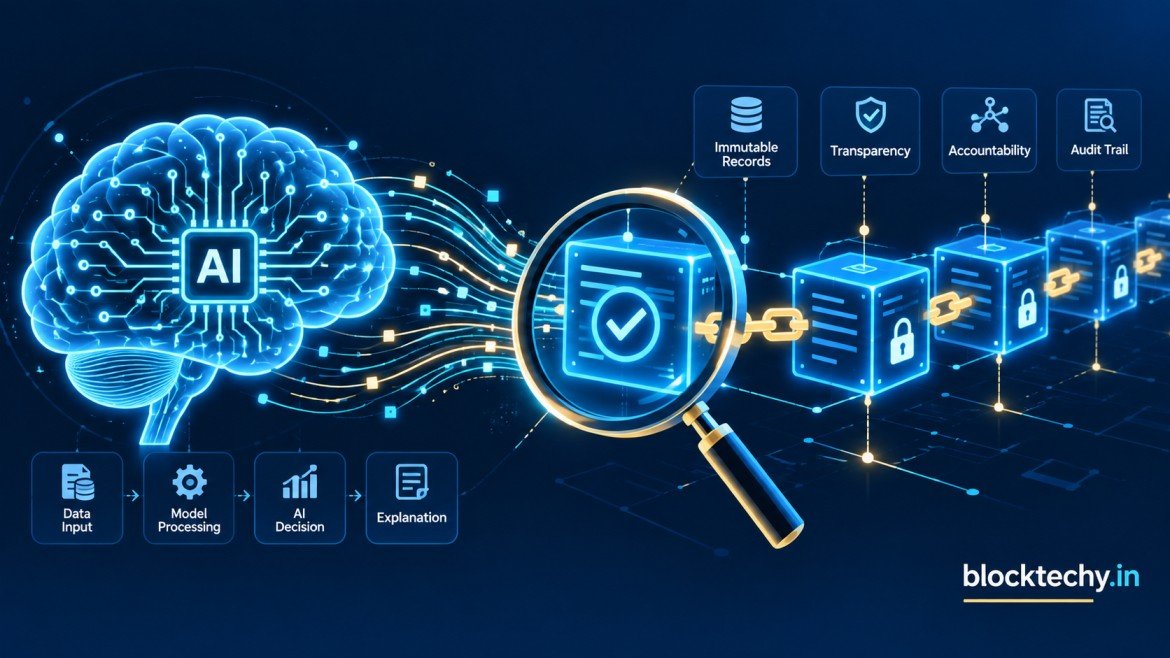
The idea is not necessarily to put an entire AI model or all of its data on a blockchain. Instead, blockchain can act as a verifiable record layer around AI systems. It can record information about datasets, model versions, training events, approvals, decision logs, and other important events.
But does that automatically make AI trustworthy?
Not necessarily.
Blockchain can improve traceability and integrity, but it cannot guarantee that an AI model is fair, accurate, unbiased, or ethically designed. Understanding this distinction is essential when discussing the future of blockchain and AI.
What Is AI Decision Transparency?
AI decision transparency refers to the ability to understand and verify important aspects of how an AI system reaches or produces a decision.
For example, imagine an AI system used by a bank to evaluate loan applications.
A customer might receive a message saying:
“Your loan application was rejected.”
The customer may naturally ask:
- Why was my application rejected?
- Which data was used?
- Which AI model made the decision?
- What version of the model was running?
- When was the model trained?
- Was the model changed recently?
- Was human approval involved?
- Can the decision be audited?
Traditional AI systems may store some of this information in centralized databases and application logs. However, those records may be changed, deleted, or difficult for multiple organizations to independently verify.
Blockchain introduces another approach.
Instead of simply maintaining conventional logs, important events can be recorded in a cryptographically linked and tamper-evident ledger.
For example:
Dataset → Training → Model Version → Deployment → AI Decision → Human Review
Each stage could generate a verifiable record.
This creates a traceability layer around the AI lifecycle.
Why Trust in AI Is Becoming Important
AI systems are increasingly involved in decisions that can affect people’s lives.
Consider several examples:
Financial Services
AI can help detect fraud, evaluate credit risk, and automate financial processes.
Healthcare
AI can assist with medical image analysis, risk prediction, and clinical decision support.
Recruitment
AI tools can help organizations screen resumes and identify potential candidates.
Education
AI systems can support personalized learning and student assessment.
Cybersecurity
Machine-learning models can identify suspicious behavior and potential attacks.
In each case, users may want more than an answer.
They may want to know how that answer was produced.
This creates a major challenge because modern AI models, particularly complex machine-learning and deep-learning systems, can be difficult to interpret.
Blockchain does not solve the mathematical explainability problem inside an AI model. Instead, it can help establish a trustworthy history of the system surrounding that model.
How Blockchain Can Support AI Transparency
Blockchain provides several properties that may be useful for AI governance and auditing.
1. Immutable or Tamper-Evident Records
One of blockchain’s most important characteristics is its ability to maintain records that are difficult to alter without detection.
Suppose an organization deploys an AI model called:
Model Version 1.4
The organization could create a cryptographic hash of the model and record that hash on a blockchain.
Later, if someone claims that the model was changed, the current model can be hashed again.
If the hashes do not match, investigators can identify that the artifact is different.
The blockchain does not necessarily store the entire model.
Instead, it can store a digital fingerprint of the model.
This can help with model version verification.
2. AI Model Version Tracking
AI models evolve continuously.
Developers may:
- change training data,
- modify algorithms,
- adjust parameters,
- retrain models,
- fix bugs,
- change deployment configurations,
- update safety rules.
This can make auditing complicated.
Blockchain can provide a chronological record of important model versions.
For example:
| Event | Model | Date | Verification |
|---|---|---|---|
| Initial training | V1.0 | Jan 2026 | Hash |
| Bias testing | V1.0 | Jan 2026 | Hash |
| Deployment | V1.0 | Feb 2026 | Hash |
| Retraining | V1.1 | Apr 2026 | Hash |
| Deployment | V1.1 | Apr 2026 | Hash |
An auditor could potentially verify which model version was active at a particular point in time.
This could become especially valuable in regulated environments.
3. Dataset Provenance
AI systems are heavily dependent on data.
A model trained on poor-quality or inappropriate data can produce poor results regardless of how advanced the algorithm is.
Therefore, understanding where training data came from is important.
Blockchain can potentially record information such as:
- dataset identifier,
- source organization,
- timestamp,
- dataset version,
- permission information,
- transformation history,
- validation events,
- ownership or licensing metadata.
For privacy reasons, sensitive datasets should generally not simply be placed directly on a public blockchain.
Instead, blockchain can store hashes or references to securely stored off-chain datasets.
For example:
Dataset → Secure Storage → Hash → Blockchain
If the dataset changes, its cryptographic fingerprint can change as well.
This creates a mechanism for verifying data integrity.
4. Recording AI Decision Events
Blockchain could also be used to create auditable records of important AI decisions.
Imagine an AI system approving insurance claims.
A blockchain-based audit record might contain:
- decision ID,
- model version,
- timestamp,
- policy version,
- input-data hash,
- decision result,
- confidence information,
- human review status.
Sensitive personal information does not necessarily need to be stored on-chain.
Instead, the blockchain can contain a reference or cryptographic proof connected to secure off-chain records.
This can help auditors reconstruct the history of a decision without exposing confidential information publicly.
Blockchain and Explainable AI Are Different
One of the most important points to understand is that blockchain and explainable AI solve different problems.
Explainable AI attempts to answer:
“Why did the AI make this prediction?”
Blockchain primarily helps answer:
“Can we verify what happened and whether the recorded history was changed?”
For example, suppose an AI model rejects a loan.
An explainability technique might indicate that:
- income contributed significantly,
- debt-to-income ratio contributed significantly,
- credit history contributed significantly.
Blockchain could separately verify:
- which model version was used,
- which policy version was active,
- when the decision occurred,
- whether the recorded decision history was modified.
Therefore, blockchain and explainable AI can potentially complement each other.
Explainable AI
Explains the decision.
Blockchain
Helps verify the history and integrity of relevant records.
Together, they could create a more auditable AI ecosystem.
Smart Contracts and AI Governance
Another potential application involves smart contracts.
Smart contracts are programs deployed on blockchain networks that automatically execute predefined rules.
Organizations could potentially use smart contracts to enforce certain AI governance processes.
For example:
- AI model is submitted.
- Model metadata is recorded.
- Required testing is completed.
- Authorized reviewer approves deployment.
- Smart contract records approval.
- Model becomes eligible for deployment.
This could create a structured workflow where important AI lifecycle events require predefined approvals.
For highly regulated applications, this type of automated governance could potentially reduce reliance on informal processes.
However, smart contracts themselves must be designed carefully because incorrect rules can produce incorrect outcomes.
Decentralized AI Governance
Traditional AI development is often centralized.
A single organization may control:
- the data,
- the model,
- the infrastructure,
- the deployment process,
- the logs.
This creates a trust problem when several parties need to collaborate.
Blockchain can potentially introduce a shared verification layer.
For example, imagine an AI ecosystem involving:
Data Provider → AI Developer → Model Auditor → Business → Regulator
Instead of each organization maintaining completely separate records, blockchain could provide a shared ledger containing agreed-upon verification events.
Each participant could independently verify relevant records.
This concept is particularly interesting for industries where multiple organizations must cooperate but cannot fully trust one another.
Example: Transparent AI in Healthcare
Consider an AI system that assists doctors in analyzing medical images.
The complete medical image should not necessarily be stored on a public blockchain because healthcare information is sensitive.
Instead, the architecture could look like this:
Medical Image
↓
Secure Healthcare Database
↓
AI Model Analysis
↓
Decision + Explanation
↓
Hash of Relevant Records
↓
Blockchain Audit Layer
The blockchain could record:
- AI model version,
- analysis timestamp,
- dataset version,
- verification hash,
- authorization event.
A hospital auditor could later verify that the analysis record corresponds to the model and data version originally recorded.
The blockchain would not prove that the AI diagnosis was medically correct.
It would provide evidence about what system was used and what happened during the process.
That distinction is extremely important.
Example: AI in Financial Services
Imagine a financial institution using AI to detect fraudulent transactions.
A transaction triggers an AI fraud-detection system.
The system produces:
Risk Score → 92/100
The bank then takes action.
A blockchain-based audit system could potentially record:
- model version,
- rules version,
- transaction reference hash,
- timestamp,
- risk-score record,
- reviewer information if human review occurs.
If an investigation happens later, auditors could verify the historical record.
This could help organizations demonstrate that their processes were followed consistently.
Can Blockchain Make AI More Trustworthy?
The answer depends on what we mean by trustworthy.
Blockchain can potentially improve:
Traceability
Organizations can track important events throughout the AI lifecycle.
Data Integrity
Cryptographic hashes can help detect changes to recorded data or model artifacts.
Accountability
Organizations can create stronger audit trails.
Verification
Independent parties can verify certain records without relying entirely on one organization’s internal database.
Governance
Smart contracts and shared ledgers can support structured approval workflows.
But blockchain does not automatically guarantee:
- unbiased AI,
- accurate predictions,
- high-quality training data,
- ethical decisions,
- privacy,
- explainability,
- responsible deployment.
Therefore, blockchain can contribute to AI trustworthiness, but it is only one component of a larger system.
The “Garbage In, Garbage Out” Problem
A blockchain can preserve incorrect information perfectly.
Suppose an organization records false or poor-quality training data.
Blockchain may make the record difficult to modify, but that does not make the data correct.
This creates an important principle:
An immutable record is not automatically a truthful record.
Blockchain can answer:
“Was this record changed?”
It cannot necessarily answer:
“Was this record originally correct?”
External validation, data-quality systems, independent audits, and trustworthy data sources are still necessary.
Privacy Challenges
Blockchain transparency can conflict with privacy.
AI systems frequently process sensitive information such as:
- financial information,
- medical information,
- personal identifiers,
- behavioral data,
- business data.
Putting sensitive information permanently onto a blockchain could create serious privacy concerns.
Therefore, many practical architectures may use a combination of:
On-chain data
for:
- hashes,
- timestamps,
- proofs,
- identifiers,
- governance records.
and
Off-chain storage
for:
- large datasets,
- personal information,
- confidential documents,
- AI models,
- detailed decision records.
This hybrid architecture can provide verification without unnecessarily exposing sensitive information.
Scalability and Cost
AI systems can generate enormous amounts of information.
A large AI platform could produce millions of events every day.
Recording every event directly on a blockchain could become expensive and inefficient.
Blockchain networks also have throughput limitations depending on their architecture.
A more practical design may involve batching and hashing.
For example:
- AI system produces 1 million logs.
- Logs are stored securely off-chain.
- A cryptographic summary is created.
- Only the summary or root hash is recorded on-chain.
This reduces blockchain storage requirements while maintaining a mechanism for later verification.
Blockchain Does Not Automatically Solve AI Bias
AI bias is another major issue.
Suppose an AI recruitment system produces discriminatory outcomes.
Recording its decisions on blockchain does not automatically remove the bias.
In fact, blockchain could potentially make a flawed system easier to audit without making the system itself better.
To address bias, organizations still need:
- representative datasets,
- bias testing,
- fairness evaluation,
- model monitoring,
- human oversight,
- independent auditing.
Blockchain can provide evidence about what happened, but the organization still has to determine whether the behavior is acceptable.
The Role of Human Oversight
AI transparency should not mean that humans disappear from the decision-making process.
For high-impact applications, humans may need to review AI-generated recommendations.
Blockchain can potentially record:
AI Recommendation → Human Review → Final Decision
This creates a useful audit trail.
For example, if an AI system recommends rejecting an application but a human reviewer approves it, the system could record that sequence.
This could help organizations distinguish between:
- automated recommendations,
- human decisions,
- system-generated actions.
That distinction may become increasingly important as AI systems become more autonomous.
A Possible Architecture for Blockchain-Based Transparent AI
A future AI transparency platform could contain several layers.
Layer 1: Data
Data is collected and securely stored.
Layer 2: AI Model
The AI system processes the data and generates a prediction or recommendation.
Layer 3: Explainability
An explainability system provides relevant information about the decision.
Layer 4: Audit
Important events are converted into cryptographic records.
Layer 5: Blockchain
Hashes, timestamps, model identifiers, and governance events are recorded.
Layer 6: Verification
Auditors, regulators, organizations, or authorized users can verify the history.
This architecture separates AI computation from blockchain verification.
That is likely to be more practical than trying to run the entire AI system directly on a blockchain.
Real-World Benefits for Organizations
If implemented properly, blockchain-based AI transparency could provide several organizational benefits.
Better Auditing
Auditors can verify important events throughout the AI lifecycle.
Improved Accountability
Organizations can establish clearer records of who approved models and when changes occurred.
Greater Data Provenance
Companies can track the origins and versions of datasets.
Easier Compliance
Tamper-evident records may support documentation and regulatory processes.
Cross-Organization Collaboration
Multiple parties can share verification infrastructure without maintaining one centralized ledger.
Improved User Confidence
When users can verify aspects of an AI system’s history, organizations may be able to provide stronger evidence about how the system operates.
However, these benefits depend heavily on implementation quality.
Challenges That Must Be Solved
Before blockchain becomes a standard part of AI infrastructure, several challenges remain.
1. Technical Complexity
Organizations must integrate blockchain with existing AI systems, databases, APIs, and cloud infrastructure.
2. Privacy
Sensitive AI data must be protected.
3. Scalability
High-volume AI systems require efficient logging mechanisms.
4. Governance
Organizations need clear rules regarding who can create, verify, and access records.
5. Cost
Blockchain infrastructure can introduce additional operational expenses.
6. Interoperability
Different AI platforms and blockchain networks need common standards.
7. Human Accountability
Technology cannot replace ethical and organizational responsibility.
The Future of Blockchain and AI Transparency
The combination of blockchain and AI is likely to become increasingly relevant as AI systems become more autonomous and widespread.
Future AI platforms could potentially maintain verifiable records of:
Data → Training → Testing → Approval → Deployment → Decision → Monitoring → Update
This could create an AI lifecycle in which important actions are traceable.
We may also see greater use of:
- decentralized AI marketplaces,
- verifiable AI models,
- cryptographic proofs,
- decentralized identity,
- smart-contract governance,
- AI model provenance systems,
- privacy-preserving computation,
- zero-knowledge proofs,
- decentralized data marketplaces.
Zero-knowledge technologies are particularly interesting because they can potentially allow a party to prove that a particular condition was satisfied without revealing the underlying sensitive information.
For AI, this could eventually help prove certain properties of a computation while protecting confidential data.
However, these technologies are still developing, and practical implementations will depend on their performance, security, and regulatory acceptance.
Blockchain + AI: A Complementary Relationship
The strongest approach may not be to choose between blockchain and AI.
Instead, the technologies can serve different purposes.
AI provides intelligence.
It analyzes data, recognizes patterns, generates predictions, and supports decisions.
Blockchain provides verification infrastructure.
It can help establish records, provenance, authorization, and auditability.
Together, they could create systems where AI is not only capable of producing decisions but also supported by a verifiable history.
For example:
AI answers the question: “What should happen?”
while
Blockchain can help answer: “What happened, when did it happen, and can we verify the record?”
These are complementary capabilities rather than substitutes.
Final Thoughts
Blockchain for AI decision transparency is an interesting area at the intersection of artificial intelligence, cybersecurity, data governance, and Web3.
Blockchain can potentially improve AI transparency by providing tamper-evident records, model provenance, dataset tracking, decision auditing, and decentralized verification.
But blockchain should not be treated as a magic solution for AI trust.
A blockchain can preserve a record, but it cannot guarantee that the underlying AI model is accurate or fair. It can prove that a particular model version was used, but it cannot independently prove that the model made the correct decision. It can improve auditability, but it cannot replace human responsibility.
The most promising future may therefore involve a combination of technologies:
Explainable AI + Blockchain + Cryptography + Privacy + Human Oversight + Strong Governance
If these components are designed together, AI systems could become easier to audit and verify without sacrificing privacy or scalability.
The central idea is simple:
Trustworthy AI is not just about making intelligent decisions. It is also about being able to understand, verify, and audit the systems behind those decisions.
Blockchain could become an important part of that infrastructure—but its value will ultimately depend on how thoughtfully it is integrated with AI, data governance, cybersecurity, and human oversight.