Introduction
Subscription-based services have become a major part of the digital economy. From streaming platforms and cloud storage to software applications, online education, gaming, memberships, and digital communities, millions of people now pay recurring fees every month or year.
Traditional subscription payments usually depend on banks, credit cards, payment gateways, and centralized financial platforms. While these systems are convenient, they can also involve transaction fees, payment failures, geographical restrictions, currency conversion costs, and dependence on intermediaries.
Blockchain technology introduces another possibility: blockchain-based subscription payments.
By combining smart contracts, digital wallets, stablecoins, and decentralized networks, blockchain can potentially automate recurring payments without requiring the same traditional payment infrastructure. Instead of relying entirely on a centralized payment processor to remember when a subscription should renew, blockchain-based systems can use programmable contracts and transparent transaction records to manage payment conditions.
This concept is attracting attention across Web3, SaaS, fintech, gaming, creator platforms, and decentralized applications.
But how exactly do blockchain subscription payments work? What advantages can they provide, what challenges remain, and could they become an important part of the future of recurring digital payments?
Let’s explore.
What Are Blockchain Subscription Payments?
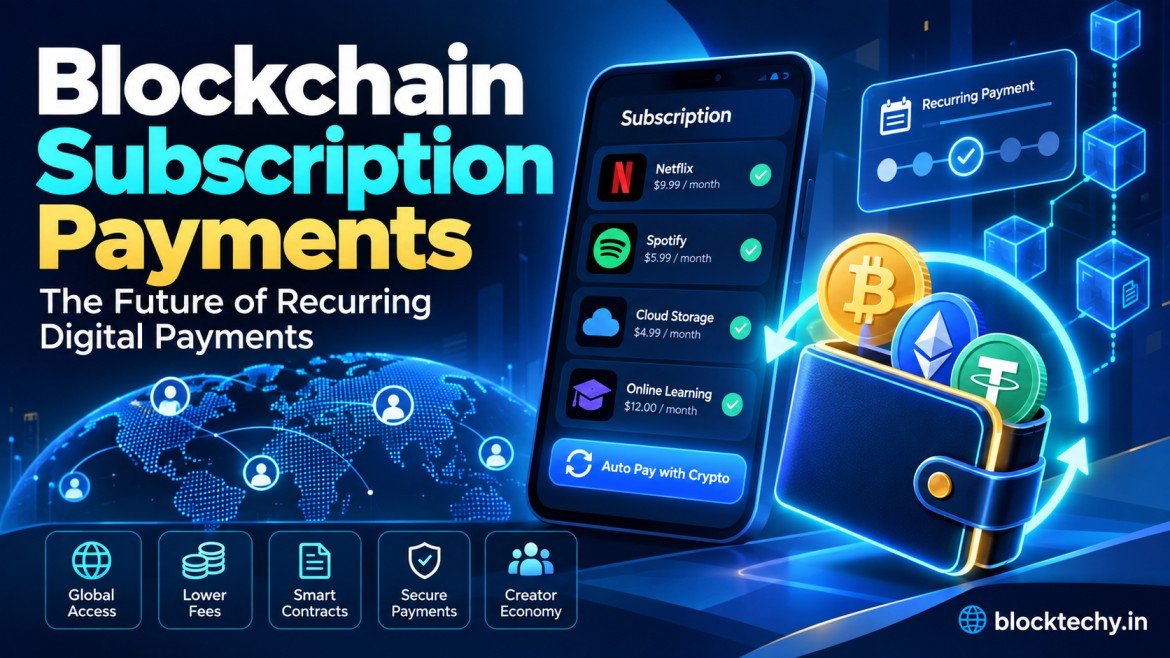
Blockchain subscription payments are recurring digital payments managed using blockchain networks, cryptocurrency wallets, smart contracts, or blockchain-based payment protocols.
The basic concept is similar to a traditional subscription.
A customer signs up for a service and agrees to pay a specific amount periodically. Instead of having the payment processed entirely through a traditional bank or payment gateway, blockchain technology can be used to record transactions and automate payment conditions.
For example, imagine subscribing to a decentralized cloud storage platform for $10 per month.
The system could use a smart contract to define:
- Subscription price
- Payment frequency
- Start date
- Renewal conditions
- Subscription status
- Cancellation conditions
- Access period
When the required conditions are satisfied, the payment mechanism can transfer the required digital assets according to the rules established by the system.
The exact implementation depends on the blockchain, wallet architecture, smart contract design, and payment protocol being used.
How Do Blockchain Subscription Payments Work?
A blockchain subscription system can involve several components.
1. Customer Wallet
The customer generally uses a blockchain-compatible wallet to hold digital assets.
Instead of entering card information, the user connects their wallet to the application.
The wallet may contain assets such as:
- Stablecoins
- Native blockchain tokens
- Other supported digital assets
For recurring payments, however, the system needs a mechanism that allows future payments to occur under clearly defined authorization rules.
2. Smart Contract
Smart contracts are one of the most important components of blockchain subscription payments.
A smart contract is a program deployed on a blockchain that automatically executes predefined rules.
For a subscription service, a smart contract could contain logic such as:
If the subscription is active and the required payment condition is satisfied, process the payment and extend the subscription period.
This reduces the need for manual processing.
However, smart contracts cannot simply access a user’s wallet and arbitrarily take funds. Appropriate authorization, token allowances, signatures, account abstraction mechanisms, or other payment designs are required.
This is an important distinction between blockchain subscriptions and traditional card-based subscriptions.
3. Digital Assets or Stablecoins
Cryptocurrencies can be used for recurring payments, but price volatility creates a significant problem.
For example, if a service costs the equivalent of $20, paying with a volatile cryptocurrency could result in different dollar values from one month to another.
Stablecoins can help address this issue because they are designed to maintain a relatively stable value relative to an underlying asset, commonly the U.S. dollar.
For this reason, stablecoins are particularly relevant to blockchain-based payment systems.
4. Payment Infrastructure
Blockchain subscription platforms may also require additional infrastructure for:
- Payment scheduling
- Wallet authorization
- Transaction monitoring
- Notifications
- Subscription management
- Currency conversion
- Compliance
- Refunds
- Access control
Therefore, blockchain subscription payments are not simply a matter of putting a payment function inside a smart contract.
A complete system requires both blockchain and application-layer infrastructure.
Blockchain Subscription Payments vs Traditional Subscriptions
Traditional subscriptions typically involve several intermediaries.
For example:
Customer → Payment Gateway → Card Network → Bank → Merchant
Blockchain-based systems may use a different architecture:
Customer Wallet → Blockchain Payment System → Merchant
The exact architecture varies, but blockchain can reduce dependence on some intermediaries.
Let’s compare the two approaches.
| Feature | Traditional Payments | Blockchain Payments |
|---|---|---|
| Payment method | Cards, bank accounts | Wallets, digital assets |
| Settlement | Banking/payment networks | Blockchain network |
| Automation | Payment processors | Smart contracts/protocols |
| Geographic access | Depends on provider | Potentially global |
| Transparency | Limited transaction visibility | Publicly verifiable on-chain transactions |
| Intermediaries | Often multiple | Potentially fewer |
| Volatility | Usually low for fiat | Depends on asset |
| Refunds | Established processes | Must be designed into system |
| User experience | Mature | Still developing |
| Regulation | Established frameworks | Developing across jurisdictions |
Blockchain does not automatically make every payment cheaper, faster, or better. Its value depends heavily on the network and system design.
Benefits of Blockchain Subscription Payments
1. Programmable Payments
One of blockchain’s biggest advantages is programmability.
Smart contracts can encode payment rules directly into software.
A subscription platform could define rules around:
- Renewal
- Expiration
- Discounts
- Usage limits
- Membership tiers
- Payment amounts
- Access permissions
This creates possibilities beyond simple recurring charges.
For example, a decentralized software platform could automatically change a user’s access level depending on whether their subscription is active.
2. Global Payments
Traditional financial systems can make international payments complicated.
Users may encounter:
- Currency conversion fees
- Geographic restrictions
- Bank compatibility issues
- Payment processor limitations
- Settlement delays
Blockchain networks operate across borders, potentially allowing businesses to accept digital payments from users in different countries.
Stablecoins can make this particularly useful for international digital services.
For example, a software company could accept stablecoin payments from customers in multiple countries without requiring a separate local payment infrastructure for every market.
3. Potentially Lower Intermediary Costs
Traditional payment systems may involve several participants.
Each participant can introduce fees or operational costs.
Blockchain can reduce the number of intermediaries involved in certain payment flows.
However, blockchain transactions still have costs.
These may include:
- Network fees
- Smart contract execution costs
- Wallet infrastructure costs
- Conversion fees
- Payment processor fees
Therefore, the claim that blockchain payments are always cheaper is not accurate.
Cost advantages depend on the blockchain and implementation.
4. Transparent Transactions
Public blockchains provide transaction records that can be independently verified.
This can help organizations create transparent payment systems.
A business could potentially verify:
- Payment status
- Transaction history
- Subscription activation
- Renewal transactions
- Wallet addresses
This transparency can be valuable for decentralized applications and blockchain-native businesses.
At the same time, public transaction data can create privacy concerns, which must be addressed through appropriate architecture.
5. Reduced Dependence on Card Expiration
Traditional subscription businesses frequently deal with expired cards, replaced cards, insufficient funds, and payment failures.
Blockchain systems can use different mechanisms that are not tied to physical card expiration dates.
For example, a user could authorize recurring stablecoin payments through a programmable payment system.
However, insufficient wallet balance can still cause payment failures.
Blockchain does not eliminate payment failure; it changes the mechanisms behind it.
The Role of Stablecoins
Stablecoins could become one of the most important components of blockchain subscription payments.
Consider a subscription priced at $15 per month.
Using a volatile cryptocurrency could expose both the customer and merchant to price fluctuations.
A stablecoin designed to track the U.S. dollar can make pricing more predictable.
This could be useful for:
- SaaS subscriptions
- Online education
- Digital memberships
- Gaming services
- Creator platforms
- Cloud services
- Developer tools
- Web3 applications
Stablecoins can therefore act as a bridge between blockchain payment infrastructure and familiar fiat-denominated pricing.
However, stablecoins also introduce considerations related to reserves, issuer risk, regulation, liquidity, and network availability.
Smart Contracts and Subscription Automation
Smart contracts make blockchain subscriptions particularly interesting.
Imagine a decentralized online learning platform.
A user purchases a monthly subscription.
The system could use programmable logic to:
- Verify the user’s payment authorization.
- Process the subscription payment.
- Record the subscription status.
- Provide access to premium content.
- Track the expiration date.
- Process the next payment according to the authorized payment mechanism.
- Remove access if the subscription ends.
This creates an automated relationship between payment and digital access.
The same concept could be applied to decentralized applications, memberships, gaming services, and digital communities.
Use Cases for Blockchain Subscription Payments
SaaS Applications
Software companies could potentially use blockchain-based recurring payments to serve international customers.
Instead of relying exclusively on card payments, SaaS platforms could offer stablecoin-based subscription options.
Digital Content
Creators could create blockchain-based memberships where subscribers receive access to:
- Premium articles
- Videos
- Courses
- Communities
- Exclusive content
- Digital collectibles
Payments and membership access could be linked through programmable infrastructure.
Gaming
Blockchain gaming platforms could use recurring payments for:
- Premium memberships
- Game subscriptions
- Virtual services
- Gaming communities
- Digital content
Smart contracts could connect payment status with access rights.
Decentralized Storage
Decentralized storage networks are another potential application.
A user might pay periodically for a certain amount of storage.
The payment system could automatically maintain access while the subscription remains active.
Online Education
Educational platforms could offer monthly or annual subscriptions using blockchain payment infrastructure.
International students could potentially pay using supported digital assets without relying exclusively on traditional payment methods.
Web3 Communities
Decentralized communities can use subscription models for:
- Private discussion groups
- Research platforms
- DAO-related services
- Developer communities
- Professional networks
Membership status can potentially be linked to wallet-based credentials.
Challenges of Blockchain Subscription Payments
Despite the potential advantages, blockchain subscriptions face significant challenges.
1. User Experience
Traditional subscriptions are extremely familiar.
Users enter card details once and payments happen automatically.
Blockchain wallets can be more complicated.
Users may need to understand:
- Wallets
- Private keys
- Network selection
- Gas fees
- Token approvals
- Transaction signatures
For mainstream adoption, the user experience needs to become much simpler.
2. Recurring Payment Authorization
Recurring payments are technically different from ordinary blockchain transactions.
A user normally signs a blockchain transaction.
For a subscription, the system needs a secure way to authorize future payments without forcing the user to manually approve every transaction.
Possible approaches include:
- Token allowances
- Smart contract wallets
- Account abstraction
- Delegated authorization
- Session-based permissions
- Specialized recurring payment protocols
Each approach has different security and usability trade-offs.
3. Security Risks
Smart contracts can contain bugs.
If a subscription contract is poorly designed, attackers may exploit vulnerabilities.
Potential risks include:
- Unauthorized spending
- Incorrect payment logic
- Access-control bugs
- Reentrancy vulnerabilities
- Token approval abuse
- Compromised wallets
Security audits and careful contract design are therefore essential.
4. Regulatory Uncertainty
Payment systems are heavily regulated.
Blockchain-based subscription platforms may need to consider regulations involving:
- Payments
- Consumer protection
- Anti-money-laundering requirements
- Know-your-customer rules
- Taxation
- Stablecoins
- Digital assets
- Data protection
Regulations vary significantly between countries.
Businesses must therefore evaluate the legal requirements applicable to their customers and operations.
5. Blockchain Fees and Scalability
Blockchain networks can experience congestion.
When transaction demand increases, fees may also increase depending on the network.
A subscription system processing millions of small payments needs infrastructure capable of handling high transaction volumes efficiently.
Layer-2 networks and other scaling solutions may help reduce transaction costs and improve throughput.
Privacy Considerations
Blockchain transparency is both an advantage and a challenge.
On a public blockchain, transaction information can potentially be observed by anyone.
If subscription payments are directly connected to identifiable wallet addresses, someone may be able to analyze a user’s payment activity.
Privacy-preserving technologies and careful application architecture may therefore become increasingly important.
Businesses should avoid assuming that blockchain automatically provides financial privacy.
In many cases, blockchain provides transparency rather than anonymity.
Will Blockchain Replace Traditional Subscription Payments?
Blockchain is unlikely to completely replace traditional subscription payment systems in the immediate future.
Instead, the more realistic possibility is a hybrid payment ecosystem.
Customers may eventually have several options:
- Credit cards
- Debit cards
- Bank transfers
- Mobile payments
- Digital wallets
- Stablecoins
- Blockchain-based recurring payments
Businesses could support multiple payment methods and allow customers to choose the method that works best for them.
Blockchain may become particularly useful in areas where its unique characteristics provide value, such as global payments, programmable financial services, Web3 applications, and digital-native businesses.
The Future of Recurring Digital Payments
The future of subscription payments may involve increasingly programmable financial infrastructure.
Imagine a world where a subscription isn’t simply a monthly transaction but a programmable relationship between a user, a service, and a digital wallet.
A smart contract could potentially manage:
- Subscription activation
- Payment authorization
- Renewal
- Discounts
- Usage-based billing
- Loyalty rewards
- Access permissions
- Cancellation
- Refund conditions
This could enable more flexible subscription models.
For example, instead of paying a fixed $20 every month, a decentralized cloud service could charge according to actual usage.
A streaming platform could offer different payment models.
A developer platform could automatically charge based on API usage.
A digital community could automatically renew membership.
Blockchain’s programmable nature could make these models easier to integrate directly into digital applications.
Blockchain Subscription Payments and Web3
Web3 applications are particularly suited to blockchain-based payment models because users already interact with blockchain wallets.
A decentralized application can connect:
Wallet + Identity + Payment + Access + Smart Contract
into a single ecosystem.
This creates possibilities for decentralized memberships and services.
For example, a Web3 research platform could allow users to connect their wallets and purchase monthly access using stablecoins.
The subscription status could be represented by blockchain-based records or credentials, while application infrastructure manages the user’s access.
This creates a more integrated financial layer for decentralized applications.
What Businesses Should Consider
Businesses interested in blockchain subscriptions should not adopt the technology simply because it is popular.
They should first identify the problem they are trying to solve.
Important questions include:
- Who are the customers?
- Which countries are they located in?
- What payment methods do they currently use?
- Are international payments a problem?
- Are transaction fees significant?
- Is blockchain actually necessary?
- Which assets should be accepted?
- How will recurring authorization work?
- How will refunds be handled?
- What happens when a payment fails?
- How will customer support work?
- What regulations apply?
- How will smart contracts be secured?
Blockchain should be treated as infrastructure rather than a marketing feature.
Final Thoughts
Blockchain subscription payments represent an interesting evolution of recurring digital payments.
Traditional subscription systems have already solved many of the challenges associated with recurring billing, but blockchain introduces new possibilities through smart contracts, digital wallets, stablecoins, programmable payments, and decentralized networks.
The technology could be particularly useful for global digital services, Web3 applications, decentralized platforms, creator economies, SaaS products, gaming, online education, and digital memberships.
However, significant challenges remain.
User experience, recurring payment authorization, smart contract security, transaction costs, privacy, regulation, and customer protection all need to be addressed before blockchain subscriptions can achieve widespread mainstream adoption.
The future may therefore not be a simple replacement of traditional payment systems with blockchain.
Instead, we may see a hybrid financial ecosystem where traditional payment methods and blockchain-based payment infrastructure coexist.
As blockchain technology becomes easier to use and programmable payment infrastructure continues to mature, recurring digital payments could become more flexible, automated, and globally accessible.
Blockchain subscription payments are still an emerging technology, but they demonstrate an important idea: payments can become programmable components of digital applications rather than simply transactions processed by external financial systems.
For businesses and developers building the next generation of digital services, that possibility could be one of blockchain’s most practical applications.