Introduction
Digital transformation is changing the way businesses A design, operate, monitor, and maintain physical assets. From smart factories and connected vehicles to buildings, healthcare systems, and energy infrastructure, organizations increasingly rely on real-time digital information to understand what is happening in the physical world.
One technology at the center of this transformation is the digital twin.
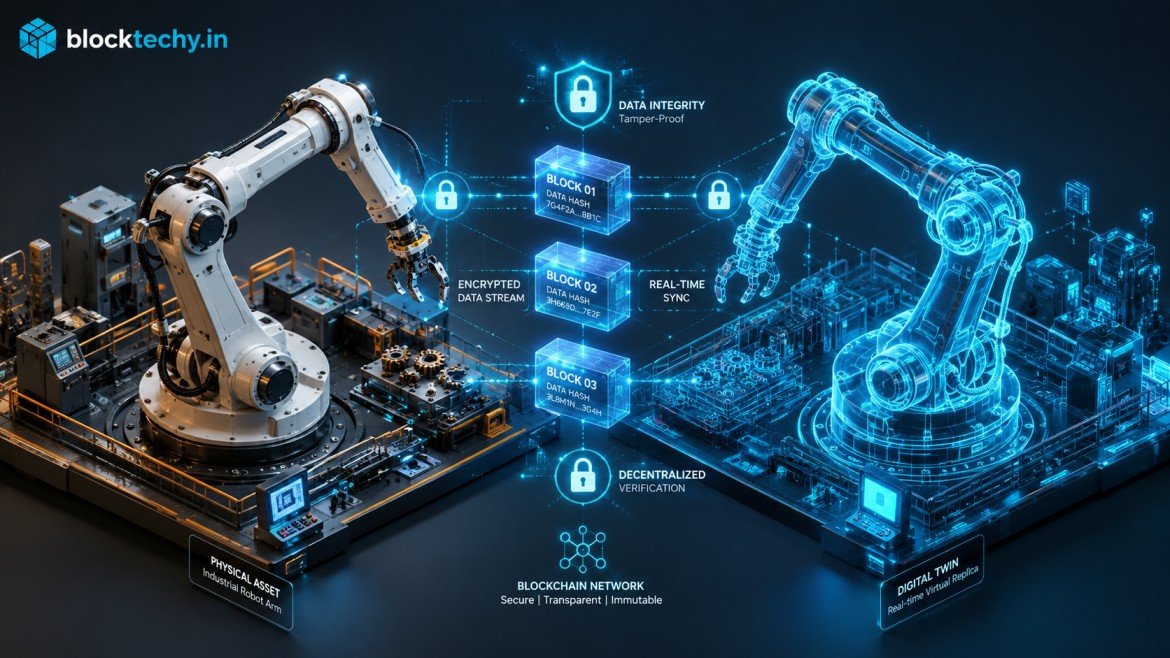
A digital twin is a virtual representation of a real-world object, system, process, or environment. It can continuously receive data from sensors and connected devices, allowing the digital model to reflect the current state and behavior of its physical counterpart. According to the U.S. National Institute of Standards and Technology (NIST), a digital twin is a virtual representation of a physical or perceived real-world entity.
Digital twins can help organizations predict equipment failures, optimize operations, simulate changes, improve product design, and make better decisions. However, they also introduce an important challenge: security and trust.
If the data feeding a digital twin is manipulated, the virtual representation may no longer accurately reflect reality. An attacker who changes sensor data, compromises an IoT device, or alters historical records could potentially influence decisions made using the twin.
This is where blockchain technology could play an important role.
Blockchain can provide tamper-resistant records, traceability, decentralized verification, and programmable access control. When combined carefully with digital twins, blockchain can create a more trustworthy data and coordination layer for complex physical systems.
In this article, we will explore what digital twins are, how they work, their security challenges, and how blockchain can help make digital twin ecosystems more secure.
What Is a Digital Twin?
A digital twin is essentially a digital counterpart of something that exists in the real world.
Imagine a large manufacturing machine operating inside a factory. The machine may contain dozens or hundreds of sensors measuring temperature, vibration, pressure, speed, energy consumption, and other operational parameters.
Those sensors continuously generate data.
A digital twin collects and processes this information to create a digital representation of the machine. Instead of physically inspecting the machine every time engineers want to understand its condition, they can analyze the digital twin.
The twin can show:
- Current operating conditions
- Historical performance
- Sensor readings
- Maintenance information
- Component health
- Predicted failures
- Simulated scenarios
- Operational changes
- Performance trends
NIST describes digital twin technology as enabling electronic representations of real-world entities and the ability to view their states and transitions between states.
This makes digital twins particularly useful for systems where continuous monitoring and decision-making are important.
How Do Digital Twins Work?
A typical digital twin ecosystem contains several interconnected components.
1. Physical Asset
The process starts with a real-world object or system.
For example:
- Factory machine
- Aircraft engine
- Electric vehicle
- Building
- Wind turbine
- Power grid
- Medical device
- Warehouse
- Industrial robot
2. Sensors and IoT Devices
Sensors collect information from the physical asset.
For example, a machine might have sensors measuring:
- Temperature
- Pressure
- Vibration
- Rotation
- Energy consumption
- Humidity
These devices create the data required to understand the physical system.
3. Communication Network
The collected data is transferred through networks to computing infrastructure.
Depending on the application, this could involve:
- Wi-Fi
- 5G
- Industrial networks
- Edge computing
- Cloud platforms
- IoT gateways
4. Digital Twin Model
The data is then used to update the virtual representation.
The digital twin may combine sensor data with:
- Engineering models
- Historical data
- Simulation models
- Machine learning
- Artificial intelligence
- Operational rules
5. Analytics and Decision-Making
The final stage involves analyzing the twin.
Organizations can use the information to answer questions such as:
Is the machine operating normally?
Will a component fail soon?
What happens if production speed increases?
Which maintenance action should be performed?
This makes digital twins much more than simple dashboards. They can become interactive models used for monitoring, simulation, prediction, and optimization.
Why Are Digital Twins Becoming Important?
Digital twins are becoming increasingly relevant because modern physical systems are becoming more connected and complex.
A traditional monitoring system might tell an engineer that a machine’s temperature is 85°C.
A digital twin can potentially put that number into context.
It may compare the current temperature with:
- Previous operating conditions
- Similar machines
- Maintenance history
- Expected operating ranges
- Vibration levels
- Production workload
Artificial intelligence can then analyze the combined information and identify unusual behavior.
Research on digital twins increasingly focuses on their use in cybersecurity as well. A 2025 survey described digital twins as useful for monitoring, simulating, diagnosing, and analyzing cyber-physical system behavior.
However, this increased intelligence also creates a bigger security requirement.
The Security Problem With Digital Twins
A digital twin is only as trustworthy as the data and models behind it.
Consider a simple example.
A factory machine normally operates at 70°C. Its digital twin receives sensor data showing a temperature of 90°C.
The system might conclude that the machine is overheating and automatically reduce production.
But what if the sensor was compromised?
Suppose an attacker modifies the sensor data and makes the system believe that the machine is operating at 60°C when it is actually at 100°C.
The digital twin could make an incorrect decision.
This creates a fundamental problem:
How can organizations trust the data entering a digital twin?
NIST’s research on digital twin security specifically highlights cybersecurity and trust considerations surrounding these systems.
Several security challenges are particularly important.
1. Data Tampering
Digital twins depend heavily on data.
If someone modifies sensor information, maintenance records, configuration information, or operational logs, the digital twin may produce incorrect results.
For example, an attacker could manipulate:
Original reading: 95°C
Modified reading: 65°C
The digital twin might then incorrectly determine that the machine is operating safely.
Blockchain can help by creating a tamper-evident record of important data events.
Instead of trusting a single database, organizations can record cryptographic proofs or hashes of important records on a distributed ledger.
If the data is later changed, the hash comparison can reveal that something has been modified.
2. Lack of Data Provenance
Another major problem is knowing where data came from.
A digital twin may receive information from hundreds of devices.
If something goes wrong, engineers need to know:
- Which device generated the data?
- When was it generated?
- Was it modified?
- Which system processed it?
- Who accessed it?
- Was the device authorized?
Blockchain can create an auditable history of important events.
For example:
Sensor → Gateway → Digital Twin → Blockchain Record
The blockchain can record metadata such as the device identity, timestamp, data hash, and event information.
This creates a stronger chain of provenance.
3. Unauthorized Access
Digital twins can contain highly valuable information.
A manufacturing digital twin might reveal:
- Production capacity
- Machine configuration
- Maintenance schedules
- Operational processes
- Engineering specifications
A building digital twin could contain information about:
- HVAC systems
- Access systems
- Energy usage
- Building infrastructure
Unauthorized access could therefore create serious security and privacy risks.
Blockchain-based identity and access-control mechanisms can help organizations establish verifiable permissions.
Smart contracts can potentially enforce predefined rules about who is allowed to access particular digital twin resources.
4. Multiple Organizations Sharing Data
Many digital twin ecosystems involve multiple stakeholders.
For example, an aircraft may involve:
- Aircraft manufacturers
- Airlines
- Maintenance companies
- Component manufacturers
- Regulators
- Insurance companies
These organizations may need to exchange information without completely trusting one another.
A centralized database controlled by one organization may not always be ideal.
Blockchain can provide a shared verification layer where participating organizations can independently verify important records.
This is one reason recent research has explored blockchain-based and hybrid blockchain architectures for digital twin ecosystems involving multiple stakeholders and security-critical data exchange.
How Blockchain Can Make Digital Twins More Secure
Blockchain and digital twins solve different problems.
A digital twin focuses primarily on representing and understanding a physical system.
Blockchain focuses on trust, verification, records, and coordination between participants.
When combined properly, they can complement each other.
1. Blockchain Can Protect Data Integrity
One of blockchain’s most useful properties is its ability to provide tamper-resistant records.
Instead of storing every piece of sensor data directly on a blockchain, a system can store a cryptographic hash or proof of the data.
For example:
Sensor Data → Hash → Blockchain
The original data can remain in a database, cloud storage, or distributed storage system.
Later, the system can calculate the hash again.
If the new hash matches the blockchain record, the data has not changed relative to the committed record.
If the hashes are different, the system knows that something requires investigation.
This approach can provide integrity verification without putting massive amounts of IoT data directly onto a blockchain.
2. Blockchain Can Improve Traceability
Digital twins constantly change.
A machine’s state at 10:00 AM may be different from its state at 2:00 PM.
Tracking important changes becomes increasingly difficult as the number of devices and stakeholders grows.
Blockchain can create an auditable event history.
For example:
08:00 — Sensor registered
08:15 — Maintenance completed
09:30 — Configuration changed
10:10 — Temperature anomaly detected
10:15 — Maintenance alert generated
This type of traceability can be valuable during audits, investigations, and maintenance operations.
Research into blockchain-based digital twins has specifically identified traceability and data integrity as important benefits.
3. Blockchain Can Strengthen Device Identity
IoT devices are an important part of digital twin systems.
However, identifying and authenticating thousands of devices can be difficult.
Blockchain-based identity systems can provide a decentralized record of device identities and permissions.
For example, every authorized sensor could have a unique cryptographic identity.
The system could verify:
Is this sensor registered?
Is its identity valid?
Is it authorized to submit data?
Has its permission been revoked?
This can reduce the risk of unauthorized devices injecting false information into the digital twin.
4. Smart Contracts Can Automate Access Rules
Smart contracts are programs deployed on blockchain networks.
They can automatically execute predefined rules when certain conditions are satisfied.
For example:
If a maintenance company is authorized for Machine A, allow access to maintenance records for Machine A.
Or:
If a device’s authorization has expired, reject new data submissions.
This can create programmable access-control mechanisms.
Research published in 2024 explored blockchain-enabled access control for digital twin systems, including the use of attribute-based encryption and distributed storage approaches.
5. Blockchain Can Support Multi-Party Trust
Suppose three companies collaborate on a smart manufacturing project.
Company A owns the factory.
Company B supplies machines.
Company C provides maintenance.
All three organizations need to trust operational records.
Rather than allowing one company to control the complete record, blockchain can provide a shared ledger where important events are collectively verifiable.
This doesn’t eliminate the need for trust entirely, but it can reduce dependence on a single organization’s database.
6. Blockchain Can Help Detect Unauthorized Changes
A digital twin can continuously compare expected and observed states.
Blockchain can complement this process by providing trusted references for important configurations.
For example:
Approved configuration → Blockchain
Current configuration → Digital Twin
The system can compare them.
If the digital twin detects that a machine configuration has changed unexpectedly, it can trigger an alert.
This approach has been explored in blockchain-based digital twin security research for cyber-physical systems.
Example: Blockchain + Digital Twin in a Smart Factory
Consider a modern automobile manufacturing plant.
The factory contains hundreds of robots, conveyor systems, sensors, cameras, and industrial machines.
A digital twin represents the factory digitally.
Every machine sends information to the twin.
AI analyzes this information to identify potential problems.
Now introduce blockchain.
Important events can be recorded on the blockchain:
- Device registration
- Equipment configuration
- Maintenance events
- Data hashes
- Access permissions
- Software updates
- Security events
- Critical state changes
Imagine that an attacker attempts to change a robot’s configuration.
The digital twin detects that the current configuration differs from the expected configuration.
The blockchain contains a trusted record of the previously approved configuration.
The system can therefore identify a potential unauthorized modification.
The digital twin provides visibility and simulation.
Blockchain provides verification and traceability.
AI provides analysis and prediction.
IoT provides real-world data.
Together, these technologies can create a powerful cyber-physical security architecture.
Blockchain Does Not Automatically Make Digital Twins Secure
It is important to avoid one common misconception.
Adding blockchain does not automatically make a digital twin secure.
Blockchain protects information according to the way the system is designed.
If incorrect data enters the blockchain, the blockchain may preserve incorrect data very effectively.
This is often described as the “garbage in, garbage out” problem.
For example:
A compromised sensor sends false temperature data.
The blockchain records the hash of that false data.
The blockchain has successfully protected the record’s integrity—but it has not proven that the original sensor measurement was truthful.
Therefore, blockchain should be combined with other security technologies.
These may include:
- Secure IoT devices
- Hardware-based security
- Digital signatures
- Encryption
- Identity management
- Zero-trust architecture
- AI-based anomaly detection
- Secure communication protocols
- Access control
- Regular security audits
The goal should be a layered security architecture, not blockchain alone.
Blockchain Storage Is Another Challenge
Digital twins can generate enormous amounts of data.
A large industrial environment may produce millions of sensor readings.
Storing all of that information directly on a blockchain would usually be inefficient and expensive.
A better architecture is often:
IoT Sensors → Edge/Cloud Storage → Digital Twin
while blockchain stores:
Hashes + Metadata + Permissions + Important Events
Large files and datasets can remain in conventional or distributed storage systems.
Some research has explored combining blockchain with systems such as IPFS to separate large-scale data storage from blockchain-based integrity and access-control functions.
This hybrid architecture can provide a better balance between scalability and security.
Public Blockchain vs Permissioned Blockchain
Another important design decision is choosing the appropriate blockchain model.
Public Blockchain
A public blockchain allows broad participation.
Advantages include:
- Strong decentralization
- Public verification
- Transparency
- Reduced dependence on one organization
However, public networks may introduce concerns about:
- Privacy
- Transaction costs
- Throughput
- Data exposure
- Regulatory requirements
Permissioned Blockchain
A permissioned blockchain restricts participation to authorized organizations.
This can be useful for:
- Manufacturing
- Healthcare
- Government infrastructure
- Supply chains
- Enterprise environments
Organizations can control who operates nodes and who can access specific information.
For many enterprise digital twin applications, permissioned or hybrid blockchain architectures may therefore be more practical than putting sensitive operational information on a fully public network.
Recent research into hybrid blockchain architectures for digital twins highlights the challenge of balancing real-time requirements, multi-stakeholder data sharing, and trust.
Digital Twins, Blockchain, and AI
The future becomes even more interesting when AI is added to the architecture.
Consider the combination:
IoT → Digital Twin → AI → Blockchain
IoT devices collect data.
The digital twin represents the physical system.
AI analyzes the system and identifies patterns.
Blockchain records important events and establishes a verifiable history.
For example, AI could detect unusual vibration patterns in a factory machine.
The digital twin could simulate possible causes.
The system could then record the security or maintenance event on blockchain.
This creates a feedback loop between physical systems and digital intelligence.
AI can provide prediction.
Digital twins can provide simulation.
Blockchain can provide trust and traceability.
IoT can provide real-world information.
Real-World Applications
The combination of blockchain and digital twins could be useful across many industries.
Manufacturing
Factories can use digital twins to monitor machines, optimize production, and predict maintenance requirements.
Blockchain can help protect maintenance records, device identities, and configuration histories.
Supply Chain
A digital twin can represent products as they move through the supply chain.
Blockchain can provide a verifiable history of important events.
This can help organizations investigate issues such as:
- Product origin
- Manufacturing events
- Transportation
- Ownership changes
- Quality inspections
Healthcare
Digital twins are being explored for healthcare infrastructure and other medical applications.
Blockchain could help with access control, audit trails, and data integrity, although healthcare deployments require especially careful privacy and regulatory design.
Smart Cities
A city could create digital twins of:
- Roads
- Buildings
- Energy systems
- Transportation networks
- Water infrastructure
Blockchain could provide trusted records for infrastructure changes and interactions between multiple organizations.
Energy
Digital twins can represent:
- Solar farms
- Wind turbines
- Power plants
- Electrical grids
- Battery systems
Blockchain could help establish trusted records for device interactions, maintenance, and energy-related transactions.
Automotive
Connected and autonomous vehicles generate enormous quantities of data.
A digital twin can represent vehicle behavior and condition.
Blockchain can potentially help protect software-update records, maintenance histories, component identities, and data provenance.
Major Challenges
Despite its potential, blockchain-based digital twins still face significant challenges.
Scalability
Digital twins can generate massive quantities of data, while blockchains are not designed to store unlimited high-frequency sensor information.
Latency
Many digital twin applications require real-time responses.
Blockchain consensus can introduce delays that are unsuitable for safety-critical control loops.
Privacy
Blockchain records can be difficult to remove or modify.
This creates challenges when dealing with confidential or regulated information.
Interoperability
Digital twin systems often use different platforms, data formats, and standards.
Connecting multiple blockchain and digital twin systems remains difficult.
Cost
Blockchain infrastructure can introduce additional operational and development costs.
Governance
Organizations must determine who controls:
- Blockchain nodes
- Access permissions
- Smart contracts
- Data standards
- Digital twin models
These governance questions become especially important when multiple companies participate.
A 2026 review of hybrid blockchain architectures for digital twins identified governance, economic sustainability, interoperability, and future cryptographic resilience among important areas requiring further attention.
The Future of Secure Digital Twins
Digital twins are moving beyond simple visualization tools.
They are increasingly becoming intelligent systems capable of monitoring, simulating, predicting, and supporting decisions about real-world environments.
As digital twins become more connected, their security requirements will also become more important.
Blockchain could become one component of the security architecture by helping organizations establish:
- Data integrity
- Data provenance
- Device identity
- Access control
- Auditability
- Multi-party trust
- Configuration verification
However, the most effective solutions will likely combine several technologies rather than depending on blockchain alone.
Future digital twin platforms may combine AI, IoT, edge computing, blockchain, cloud infrastructure, cryptography, and zero-trust security.
Research is already exploring blockchain-based digital twin frameworks that combine threat intelligence, behavioral monitoring, and cyber-physical system security.
The result could be a new generation of trusted cyber-physical infrastructure where organizations can understand not only what is happening in the physical world, but also whether the digital information describing that world can be trusted.
Conclusion
Digital twins are becoming an important technology for connecting the physical and digital worlds.
They allow organizations to create virtual representations of machines, buildings, vehicles, factories, infrastructure, and other real-world systems. By combining sensor data, simulation, analytics, and AI, digital twins can improve monitoring, maintenance, efficiency, and decision-making.
But digital twins also create a major security challenge: the digital representation must be trustworthy if organizations are going to make important decisions based on it.
This is where blockchain can add significant value.
Blockchain can provide tamper-resistant records, traceability, decentralized verification, device identity, and programmable access control. Instead of replacing digital twin platforms, blockchain can act as a trust layer supporting the data and interactions around them.
The strongest architecture is therefore not simply “digital twin + blockchain.” It is a combination of IoT for data collection, digital twins for modeling, AI for intelligence, and blockchain for verification and trust.
As industries become increasingly connected, the ability to create secure and trustworthy digital representations of physical systems could become a critical part of the next generation of Web3, Industry 4.0, smart infrastructure, and cyber-physical systems.
Digital twins show us what is happening in the physical world. Blockchain can help us verify whether the digital record behind that view can be trusted.