Introduction
Artificial Intelligence (AI) and blockchain are two of the most transformative technologies of the 21st century. Individually, they have already changed industries ranging from finance and healthcare to logistics and cybersecurity. Together, they have the potential to create a new digital economy built on intelligence, transparency, automation, and trust.
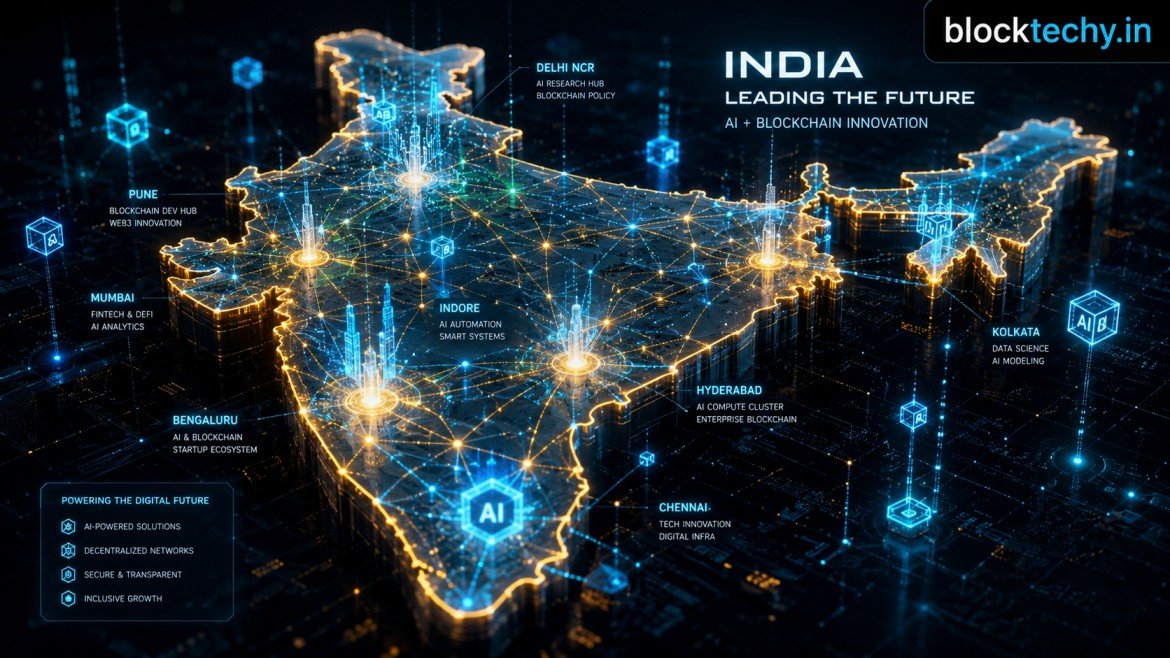
India is uniquely positioned to become a global leader in AI-powered blockchain innovation. With one of the world’s largest developer communities, a rapidly growing startup ecosystem, government-led digital infrastructure, and increasing investments in AI research, the country has all the ingredients needed to dominate this emerging sector.
The next decade will not simply belong to countries with the biggest technology companies. It will belong to nations that successfully integrate AI with decentralized technologies to solve real-world problems.
In this article, we’ll explore why India has a massive opportunity, the challenges ahead, and what must happen for the country to become the world’s innovation hub for AI-powered blockchain.
Why AI and Blockchain Are Stronger Together
AI excels at making intelligent decisions from massive amounts of data.
Blockchain excels at storing information securely, transparently, and without centralized control.
When combined, these technologies create systems that are:
- Intelligent
- Secure
- Transparent
- Autonomous
- Trustworthy
Instead of relying solely on centralized organizations, AI-powered blockchain networks can make decisions, verify transactions, automate contracts, and continuously improve themselves while maintaining complete transparency.
This combination is expected to redefine industries worldwide.
India’s Biggest Advantage: Digital Infrastructure
Few countries have built digital public infrastructure as successfully as India.
The country’s digital ecosystem already includes:
- Aadhaar digital identity
- UPI payment ecosystem
- DigiLocker
- Account Aggregator Framework
- ONDC
- Fast-growing cloud infrastructure
These systems generate enormous amounts of secure digital data.
Blockchain can improve their transparency while AI can analyze this information to improve efficiency and decision-making.
This gives India an enormous competitive advantage over many developed nations that still operate fragmented digital systems.
India’s Massive Developer Community
India has one of the largest software developer populations in the world.
Thousands of engineers are already working in:
- Artificial Intelligence
- Machine Learning
- Blockchain Development
- Cloud Computing
- Cybersecurity
- Data Science
As universities increasingly introduce blockchain, AI, and Web3 courses, the talent pipeline continues to grow.
Young developers are already building:
- DeFi platforms
- NFT marketplaces
- AI agents
- Smart contract systems
- Blockchain analytics tools
- Decentralized applications (dApps)
This growing ecosystem provides the foundation needed for global innovation.
The Rise of Indian AI Startups
India has witnessed explosive growth in AI startups.
These companies are developing:
- Healthcare AI
- Financial AI
- Agricultural AI
- Manufacturing AI
- Legal AI
- Education AI
Now imagine these AI systems running on decentralized blockchain infrastructure.
Instead of centralized servers controlling everything, blockchain can ensure:
- Data integrity
- Ownership
- Transparency
- Security
- Auditability
This opens completely new business opportunities.
Web3 Could Become India’s Next IT Revolution
India became a global IT powerhouse through software outsourcing.
The next opportunity may be Web3.
Blockchain development allows Indian companies to build products for users worldwide instead of working only as service providers.
AI-powered blockchain applications could become India’s next major export.
Potential sectors include:
- Digital identity
- Cross-border finance
- Healthcare
- Supply chains
- Education
- Government technology
- Cybersecurity
- Renewable energy
AI Can Make Smart Contracts Truly Intelligent
Today’s smart contracts follow fixed rules.
For example:
“If payment arrives, transfer ownership.”
But future AI-powered smart contracts could become adaptive.
Imagine:
“If market volatility increases beyond 20%, reduce transaction size automatically.”
Or:
“If suspicious wallet activity is detected, request additional verification.”
This creates self-learning smart contracts capable of making context-aware decisions.
Indian developers have an opportunity to pioneer this field.
Revolutionizing Financial Services
India already leads in digital payments.
The next stage involves combining:
- AI
- Blockchain
- Digital identity
- Tokenized assets
Possible innovations include:
Intelligent Lending
AI analyzes financial behavior.
Blockchain verifies records.
Loan approvals become faster and more transparent.
Fraud Prevention
AI detects suspicious activity.
Blockchain preserves tamper-proof evidence.
Banks can reduce fraud significantly.
Cross-Border Payments
Traditional international transfers remain expensive.
Blockchain reduces transaction costs.
AI optimizes routing, compliance checks, and currency conversion.
This can make international payments faster and cheaper.
Healthcare Transformation
Healthcare generates enormous amounts of sensitive information.
Blockchain ensures patient records remain secure.
AI analyzes this information for:
- Disease prediction
- Personalized treatment
- Medical imaging
- Drug discovery
Patients gain greater control over their medical records while hospitals maintain data integrity.
India’s growing digital health ecosystem makes this particularly promising.
Agricultural Innovation
Agriculture remains one of India’s largest industries.
AI-powered blockchain solutions could help farmers through:
- Crop prediction
- Weather analysis
- Soil monitoring
- Supply chain tracking
- Smart insurance
- Transparent subsidies
Consumers could scan a QR code and view the complete journey of food products from farm to supermarket.
Manufacturing and Supply Chain
Counterfeit goods remain a major global challenge.
Blockchain creates immutable product histories.
AI analyzes manufacturing data to identify:
- Quality issues
- Production delays
- Equipment failures
- Inventory optimization
Together, these technologies improve operational efficiency while increasing consumer trust.
Government Services
India has already demonstrated leadership in digital governance.
Future AI-powered blockchain applications may include:
- Land record management
- Voting systems
- Public procurement
- Tax compliance
- Welfare distribution
- Certificate verification
Blockchain reduces corruption by creating transparent records.
AI improves decision-making using real-time analytics.
AI Agents on Blockchain
One of the most exciting developments is autonomous AI agents.
Instead of humans executing every task, AI agents could:
- Negotiate contracts
- Execute payments
- Purchase services
- Manage investments
- Optimize logistics
- Coordinate decentralized organizations
Blockchain provides secure identity and payment infrastructure for these intelligent agents.
This could create an entirely new digital economy.
Cybersecurity Opportunities
Cyberattacks are becoming increasingly sophisticated.
AI helps identify threats.
Blockchain ensures system integrity.
Future security systems may automatically:
- Detect attacks
- Isolate compromised devices
- Update permissions
- Verify software integrity
- Recover critical systems
India’s cybersecurity sector could become a global leader by combining these technologies.
Education and Skill Development
India’s greatest strength remains its young population.
Universities should increasingly focus on:
- Blockchain development
- AI engineering
- Cryptography
- Distributed systems
- Data science
- Cybersecurity
Industry-academia collaboration will be essential.
Practical innovation labs can help students build real-world decentralized AI applications.
Building Global Standards
Technology leadership isn’t only about creating products.
It also means defining standards.
India can contribute to international frameworks for:
- AI ethics
- Blockchain interoperability
- Digital identity
- Privacy
- Tokenization
- Cross-border regulations
Countries that help create standards often shape global markets.
The Startup Opportunity
Thousands of new startups could emerge by solving practical problems.
Examples include:
- AI-powered logistics
- Blockchain healthcare
- Smart legal contracts
- Decentralized AI marketplaces
- Renewable energy trading
- Supply chain intelligence
- Property verification
- Agricultural finance
Rather than copying existing ideas, Indian entrepreneurs can build solutions tailored for emerging markets.
Challenges India Must Address
Despite enormous potential, several obstacles remain.
Regulatory Clarity
Businesses need predictable regulations regarding:
- Digital assets
- Blockchain infrastructure
- AI governance
- Data privacy
Clear policies encourage innovation while protecting users.
Skilled Workforce
Demand for AI and blockchain engineers exceeds supply.
Continuous education and professional training will remain essential.
Infrastructure
Large AI models require:
- High-performance computing
- GPU clusters
- Reliable cloud infrastructure
- Energy-efficient data centers
Investments in these areas are necessary.
Research Investment
India must increase investments in:
- AI research
- Blockchain scalability
- Quantum-resistant cryptography
- Privacy-preserving computation
Long-term innovation depends on strong research ecosystems.
Cybersecurity
As decentralized systems grow, security becomes even more important.
Developers must prioritize:
- Secure coding
- Smart contract auditing
- AI model protection
- Identity verification
- Continuous monitoring
The Role of Indian Enterprises
Large organizations across banking, manufacturing, telecom, insurance, and healthcare can accelerate adoption by investing in:
- Enterprise blockchain
- AI automation
- Digital identity
- Tokenization
- Intelligent supply chains
Collaboration between enterprises and startups can dramatically speed innovation.
India’s Opportunity on the Global Stage
Many countries are investing heavily in AI.
Others are investing heavily in blockchain.
Few possess India’s unique combination of:
- Large developer ecosystem
- Affordable innovation
- Digital public infrastructure
- Growing startup ecosystem
- Strong engineering talent
- Expanding internet population
If these strengths are effectively combined, India could become one of the world’s most influential technology leaders.
Rather than merely adopting global technologies, Indian innovators have the opportunity to create solutions that millions of people worldwide can use.
Future Trends to Watch
Over the next five years, expect rapid growth in:
- AI-powered decentralized finance (DeFi)
- Autonomous AI agents
- Tokenized real-world assets (RWAs)
- Blockchain-based digital identity
- Decentralized AI marketplaces
- Privacy-preserving AI
- Zero-knowledge proof applications
- Intelligent DAO governance
- Quantum-resistant blockchain security
- Cross-chain AI interoperability
These innovations could reshape the global digital economy.
Conclusion
India stands at a pivotal moment in technological history. The convergence of artificial intelligence and blockchain presents an opportunity that extends far beyond software development—it offers a chance to redefine how trust, automation, and digital collaboration function on a global scale.
By leveraging its vast pool of engineering talent, mature digital public infrastructure, thriving startup ecosystem, and growing focus on research, India can move from being a technology adopter to a technology creator. Success will depend on continued investment in education, supportive regulations, advanced computing infrastructure, and strong public-private collaboration.
The nations that lead the next wave of digital transformation will be those that build secure, intelligent, and decentralized systems. India has the potential to be among them—not only serving its own billion-plus citizens but also delivering AI-powered blockchain solutions that address global challenges in finance, healthcare, governance, agriculture, and beyond.
The future of innovation will not be powered by AI alone or blockchain alone. It will be driven by their convergence, and India has every opportunity to lead that transformation.
Frequently Asked Questions (FAQs)
1. What is AI-powered blockchain innovation?
It is the integration of artificial intelligence with blockchain technology to build systems that are secure, transparent, automated, and capable of making intelligent decisions.
2. Why is India well-positioned to lead in this field?
India combines a large developer base, robust digital public infrastructure, a growing AI startup ecosystem, and increasing investments in emerging technologies.
3. Which industries will benefit the most?
Finance, healthcare, agriculture, supply chain, manufacturing, education, cybersecurity, and government services are expected to see the greatest impact.
4. What are the biggest challenges?
Key challenges include regulatory clarity, skilled talent shortages, computing infrastructure, cybersecurity, and long-term research funding.
5. How can developers prepare for this future?
Developers should strengthen their skills in AI, machine learning, blockchain development, smart contracts, cryptography, cloud computing, and cybersecurity while building real-world decentralized applications.