
Introduction
Blockchain technology has evolved far beyond cryptocurrencies like Bitcoin. Today, organizations across industries are embracing Enterprise Blockchain to improve transparency, security, efficiency, and trust in their business operations. As digital transformation accelerates worldwide, companies are searching for technologies that can streamline workflows, reduce costs, and enhance data integrity. Enterprise blockchain has emerged as one of the most promising solutions.

Unlike public blockchains that allow anyone to participate, enterprise blockchains are designed specifically for businesses. They offer controlled access, better scalability, enhanced privacy, and regulatory compliance, making them ideal for commercial use. From global supply chains and banking to healthcare and manufacturing, enterprise blockchain is transforming the way organizations exchange information and conduct transactions.
In this comprehensive guide, we’ll explore what enterprise blockchain is, how it works, its key benefits, real-world use cases, challenges, future trends, and why it is becoming an essential technology for modern businesses.
What Is Enterprise Blockchain?
Enterprise blockchain is a private or permissioned blockchain network built specifically for organizations. Unlike public blockchain networks, where anyone can join and validate transactions, enterprise blockchain restricts participation to authorized users.
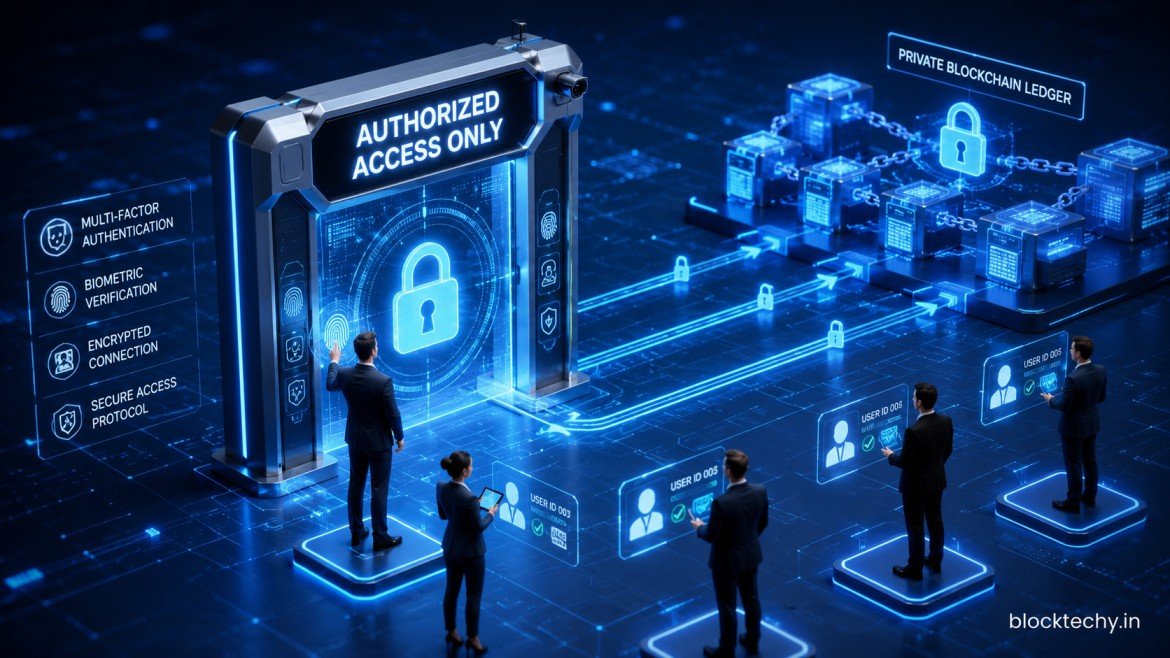
Only approved organizations, employees, or partners can access the network, ensuring better control over sensitive business information.
Enterprise blockchain focuses on:
- Secure business collaboration
- Data privacy
- Faster transaction processing
- Regulatory compliance
- Improved operational efficiency
- Automated workflows through smart contracts
Rather than replacing existing business systems, enterprise blockchain often integrates with ERP software, cloud platforms, databases, and enterprise applications.
Enterprise Blockchain vs Public Blockchain
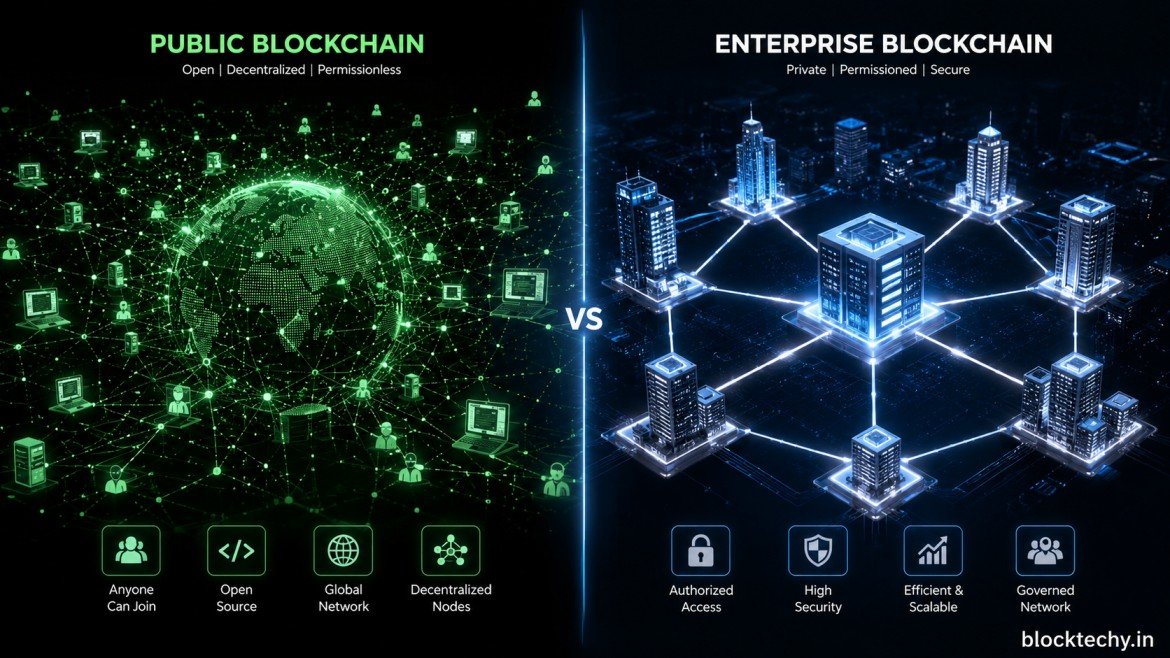
Although both use distributed ledger technology, they serve different purposes.
| Feature | Enterprise Blockchain | Public Blockchain |
|---|---|---|
| Access | Permissioned | Open to everyone |
| Privacy | High | Low |
| Speed | Faster | Relatively slower |
| Governance | Controlled by organizations | Community governed |
| Transaction Cost | Low | Variable |
| Consensus | Efficient algorithms | Mining or staking |
| Scalability | Better for enterprises | Limited in some cases |
Public blockchains prioritize decentralization, while enterprise blockchains prioritize efficiency, privacy, and business collaboration.
How Enterprise Blockchain Works
Enterprise blockchain uses a distributed ledger shared among multiple trusted participants.
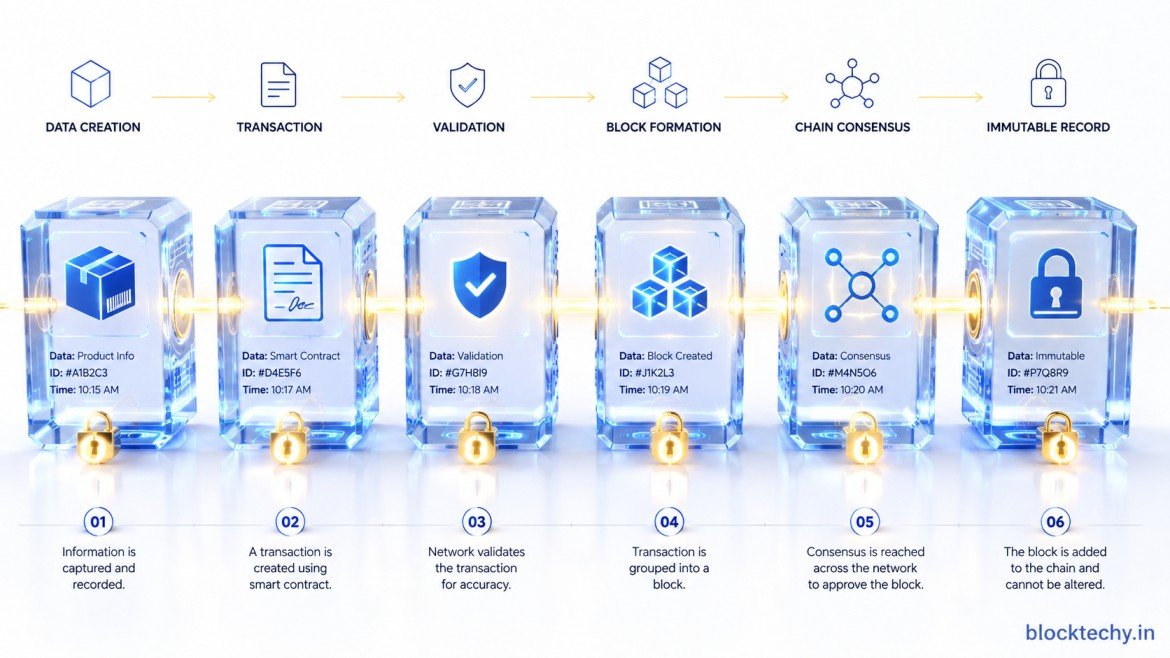
Here’s how the process works:
Step 1: Data Entry
An authorized participant submits a transaction.
For example:
- Shipping update
- Purchase order
- Payment confirmation
- Medical record update
Step 2: Validation
The transaction is verified by approved validator nodes instead of anonymous miners.
Consensus mechanisms commonly include:
- Practical Byzantine Fault Tolerance (PBFT)
- Raft
- Proof of Authority (PoA)
- IBFT
These algorithms process transactions much faster than Proof of Work.
Step 3: Block Creation
Verified transactions are grouped into blocks.
Each block contains:
- Timestamp
- Transaction data
- Previous block hash
- Digital signature
Step 4: Distributed Storage
Every participating organization receives an updated copy of the ledger.
This ensures that everyone sees the same verified information.
Step 5: Smart Contract Execution
If predefined conditions are met, smart contracts automatically execute actions.
Examples include:
- Releasing payments
- Updating inventory
- Approving insurance claims
- Generating invoices
Automation reduces paperwork and human intervention.
Key Features of Enterprise Blockchain

1. Permissioned Access
Only authorized participants can join the network.
This protects confidential business information while maintaining transparency among trusted partners.
2. High Security
Enterprise blockchain uses:
- Cryptography
- Digital signatures
- Immutable records
- Access controls
These security measures significantly reduce the risk of data tampering and cyberattacks.
3. Transparency
All authorized participants share a single source of truth.
This minimizes disputes and increases trust among business partners.
4. Immutability
Once information is recorded and validated, it cannot be altered without network consensus.
This creates reliable audit trails.
5. Smart Contracts
Business rules can be automated using programmable smart contracts.
Benefits include:
- Faster approvals
- Reduced manual work
- Fewer errors
- Lower operational costs
6. Faster Transactions
Since enterprise networks involve trusted participants, transactions are confirmed much more quickly than on many public blockchains.
7. Scalability
Enterprise blockchain platforms are optimized for handling thousands of business transactions efficiently.
Benefits of Enterprise Blockchain for Businesses
Improved Transparency
Every participant works from the same shared ledger.
This eliminates information silos and improves collaboration.
Better Security
Traditional databases can become attractive targets because they rely on centralized storage.
Enterprise blockchain distributes data securely across multiple authorized nodes.
Reduced Fraud
Immutable transaction histories make fraud significantly more difficult.
Any unauthorized changes are easily detected.
Cost Reduction
Businesses can reduce costs by eliminating intermediaries.
Examples include:
- Banks
- Third-party verification services
- Paper documentation
- Manual reconciliation
Faster Business Processes
Automated workflows reduce delays in approvals and settlements.
Tasks that once took days can often be completed in minutes.
Enhanced Compliance
Enterprise blockchain creates permanent audit trails that simplify regulatory reporting.
Auditors can verify records more efficiently.
Improved Supply Chain Visibility
Companies can monitor products from manufacturing to customer delivery.
This improves traceability and product authenticity.
Industries Using Enterprise Blockchain

1. Banking and Financial Services
Banks use enterprise blockchain for:
- Cross-border payments
- Trade finance
- Digital identity
- Loan processing
- Fraud detection
Settlement times can be reduced from several days to just a few minutes.
2. Supply Chain Management
Supply chain organizations use blockchain to:
- Track goods
- Verify product origin
- Monitor shipments
- Prevent counterfeit products
- Improve inventory management
Every stage of a product’s journey is recorded securely.
3. Healthcare
Healthcare organizations use blockchain to secure:
- Electronic medical records
- Prescription management
- Clinical trial data
- Patient consent
- Insurance claims
Patients gain greater control over their health information.
4. Manufacturing
Manufacturers use blockchain for:
- Quality assurance
- Component tracking
- Warranty management
- Supplier verification
This reduces recalls and improves product reliability.
5. Retail and E-commerce
Retail companies use blockchain for:
- Product authentication
- Loyalty programs
- Inventory tracking
- Secure payments
Consumers can verify whether products are genuine.
6. Insurance
Insurance providers benefit from:
- Automated claim processing
- Fraud prevention
- Policy verification
- Smart contract payouts
Claims can be processed much faster than traditional methods.
7. Government Services
Governments are exploring blockchain for:
- Land registries
- Digital identity
- Tax management
- Public records
- Voting systems
Blockchain improves transparency while reducing administrative overhead.
Popular Enterprise Blockchain Platforms
Several enterprise blockchain platforms are widely adopted by businesses.

Hyperledger Fabric
One of the most popular permissioned blockchain frameworks.
Features include:
- Modular architecture
- High privacy
- Smart contracts
- Scalability
- Enterprise-grade security
Ideal for supply chain, finance, and healthcare.
R3 Corda
Designed specifically for financial institutions.
Key strengths include:
- Privacy-focused architecture
- Regulatory compliance
- Secure transactions
- Financial workflows
Quorum
Originally developed by JPMorgan, Quorum is based on Ethereum and supports:
- Private transactions
- Smart contracts
- High performance
- Permissioned networks
Hyperledger Besu
An Ethereum-compatible blockchain supporting both public and private deployments.
Popular for enterprise Ethereum applications.
MultiChain
A permissioned blockchain platform offering:
- Asset management
- Data sharing
- Custom permissions
- Private blockchain deployment
Real-World Examples of Enterprise Blockchain

Walmart
Walmart uses blockchain to improve food traceability.
Instead of taking days to identify contaminated food sources, blockchain enables tracking within seconds, helping improve food safety and reduce waste.
IBM Food Trust
IBM Food Trust connects farmers, manufacturers, distributors, and retailers on a shared blockchain network.
Participants gain real-time visibility into food supply chains, improving transparency and consumer trust.
DHL
DHL has explored blockchain for logistics and shipment tracking.
The technology helps improve supply chain visibility and reduce paperwork.
Visa
Visa investigates blockchain technologies for secure digital payments, tokenization, and cross-border transaction solutions.
De Beers
The diamond company uses blockchain to track diamonds from mines to customers.
This helps verify authenticity and prevent conflict diamonds from entering the market.
Challenges of Enterprise Blockchain
Despite its advantages, enterprise blockchain adoption comes with several challenges.
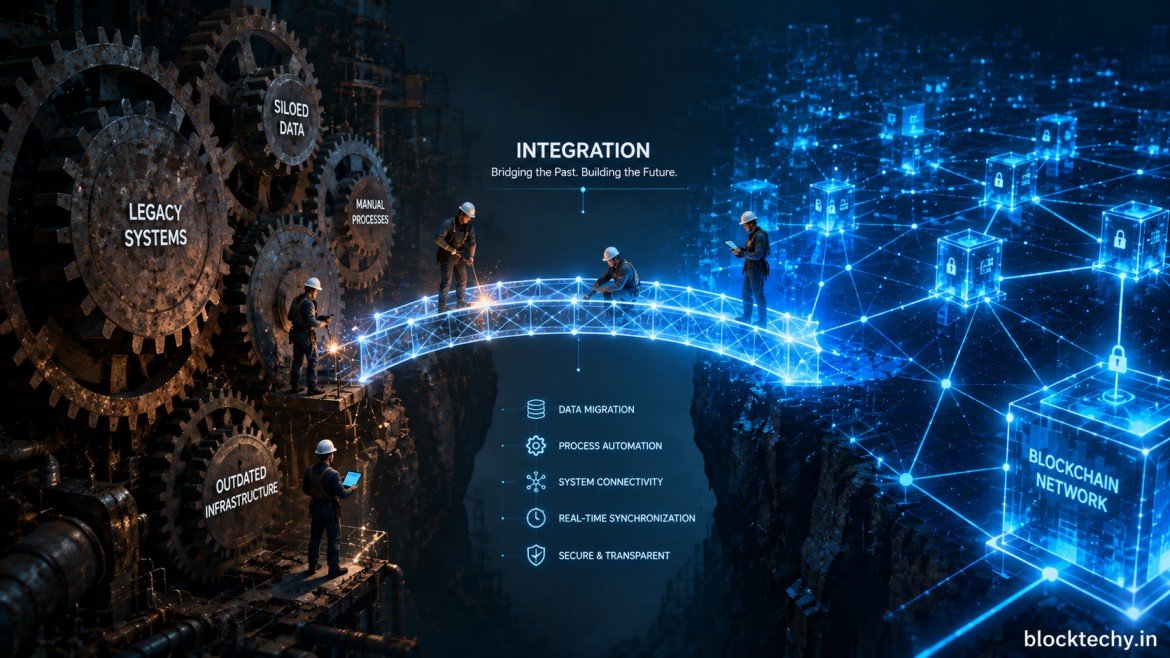
Integration Complexity
Many organizations operate legacy systems that are difficult to integrate with blockchain.
Migration requires careful planning.
Initial Investment
Implementing blockchain infrastructure may involve:
- Software development
- Employee training
- Infrastructure upgrades
- Security implementation
Although costs are high initially, long-term savings often justify the investment.
Scalability
While enterprise blockchains scale better than public ones, handling millions of daily transactions remains technically demanding.
Continuous optimization is necessary.
Regulatory Uncertainty
Blockchain regulations differ across countries.
Organizations must ensure compliance with local data privacy and financial regulations.
Skills Shortage
Blockchain developers remain in high demand.
Many businesses struggle to recruit professionals with expertise in:
- Smart contracts
- Cryptography
- Distributed systems
- Blockchain architecture
Change Management
Employees may resist adopting new workflows.
Successful implementation requires proper training and organizational support.
Enterprise Blockchain and Smart Contracts
Smart contracts are one of the biggest drivers of enterprise blockchain adoption.
These self-executing programs automatically perform actions when predefined conditions are met.

Examples include:
- Automatic invoice payments
- Supplier approval
- Insurance claim settlement
- Loan processing
- Contract renewal
- Asset transfers
Benefits include:
- Faster execution
- Reduced paperwork
- Fewer human errors
- Lower administrative costs
Enterprise Blockchain and Artificial Intelligence
The combination of blockchain and AI is creating powerful business solutions.
AI can:
- Analyze blockchain data
- Predict supply chain disruptions
- Detect fraudulent transactions
- Optimize logistics
- Improve customer experiences
Meanwhile, blockchain ensures that the data used by AI systems remains secure, verifiable, and tamper-resistant.
Together, these technologies enable smarter, more trustworthy business operations.
Future Trends in Enterprise Blockchain
Enterprise blockchain continues to evolve rapidly. Some of the most significant trends include:
Greater Cloud Integration
Cloud providers are offering Blockchain-as-a-Service (BaaS), making deployment faster and more affordable.
Tokenization of Real-World Assets
Businesses are increasingly tokenizing physical assets such as real estate, commodities, and securities to improve liquidity and streamline ownership transfers.
Decentralized Digital Identity
Blockchain-based identity systems allow individuals and organizations to verify credentials securely while reducing identity fraud.
Sustainability Initiatives
Modern enterprise blockchain platforms are moving toward energy-efficient consensus mechanisms, helping organizations meet environmental goals.
Cross-Chain Interoperability
Future enterprise solutions will enable different blockchain networks to communicate seamlessly, improving collaboration between businesses.
Increased Regulatory Clarity
As governments establish clearer frameworks, enterprises are expected to adopt blockchain more confidently for mission-critical operations.
Best Practices for Enterprise Blockchain Adoption
Businesses planning to implement blockchain should consider the following:
- Clearly define business objectives before selecting a platform.
- Choose permissioned networks when privacy and compliance are essential.
- Start with pilot projects before scaling organization-wide.
- Integrate blockchain with existing enterprise systems rather than replacing them entirely.
- Invest in employee training and blockchain education.
- Prioritize cybersecurity and access management.
- Continuously monitor performance and optimize the network as business needs evolve.
A strategic approach ensures that blockchain delivers measurable value rather than becoming a costly experiment.
Conclusion
Enterprise blockchain is no longer an experimental technology—it is becoming a strategic asset for organizations seeking greater efficiency, transparency, and trust. By combining secure distributed ledgers, permissioned access, and smart contracts, businesses can streamline operations, reduce fraud, automate complex workflows, and improve collaboration across multiple stakeholders.

Industries such as finance, healthcare, manufacturing, retail, logistics, and government are already demonstrating the practical benefits of enterprise blockchain. While challenges such as integration, regulatory compliance, and talent shortages remain, ongoing advancements in cloud services, interoperability, artificial intelligence, and tokenization are making enterprise blockchain more accessible and impactful than ever before.
As digital transformation continues, organizations that thoughtfully adopt enterprise blockchain will be better positioned to build resilient, transparent, and future-ready business ecosystems. Rather than simply following a technology trend, enterprises are investing in blockchain to create long-term competitive advantages, foster innovation, and establish greater trust in an increasingly connected global economy.
Follow this link to join my WhatsApp group:
https://chat.whatsapp.com/JvmrMTxkdgt9u6kGMT73XY