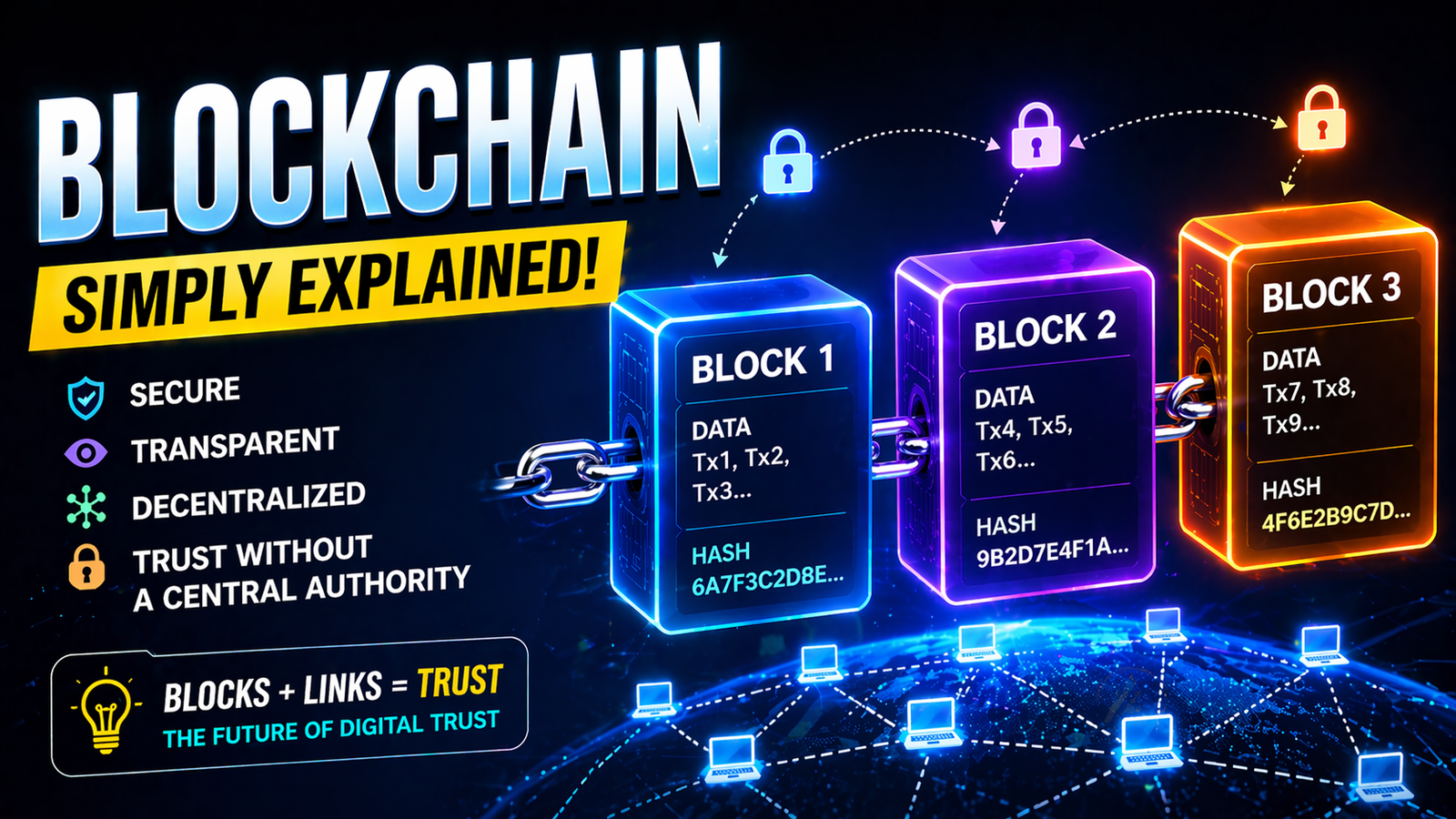
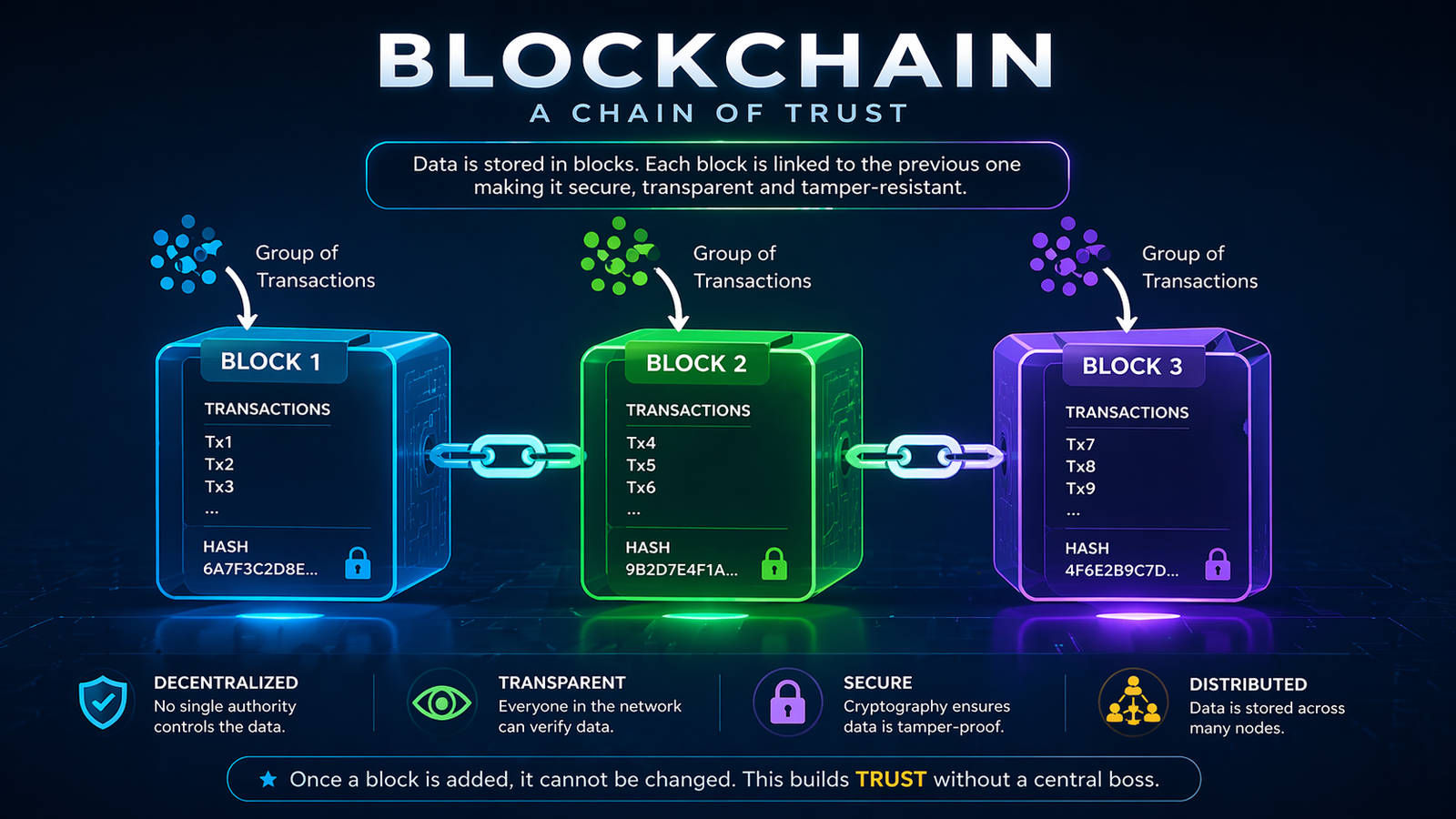
Blockchain is a modern technology used to store information in a safe, transparent, and reliable way. To understand it easily, think of it as a digital record book (ledger) that is shared among many people. Instead of being stored in one place like a traditional database, it is copied and distributed across many computers around the world. These computers are called nodes.
What is a Blockchain?
A blockchain is made up of blocks, and each block contains data. These blocks are connected in a chain, which is why it is called a blockchain. Each block stores a list of transactions. A transaction can be anything involving data, but most commonly it refers to money transfers, such as:
- “Alice paid ₹50 to Bob”
- “Ravi sent ₹200 to Sita”
Once a block is filled with transactions, it is added to the chain in a secure way.
Structure of a Block
Each block in a blockchain has three main parts:
- Transaction Data
This is the actual information stored in the block. It could be payments, agreements, or records. - Hash (Unique Code)
A hash is a special code generated using mathematical algorithms. It acts like a digital fingerprint for the block. No two blocks have the same hash. - Previous Block’s Hash
Each block also stores the hash of the block before it. This is what links all the blocks together.
Because each block is connected to the previous one, changing even a small piece of information in one block will change its hash. This will break the chain, making tampering easy to detect.
Why Blockchain is Secure
Blockchain is considered highly secure because of the following reasons:
1. Immutability (Cannot Be Changed Easily)
Once a block is added to the blockchain, it becomes very difficult to change. If someone tries to edit a transaction, the hash of that block changes. Since all blocks are connected, this change will affect every block after it.
2. Transparency
All participants in the network can see the transactions. This makes the system open and trustworthy.
3. Decentralization
There is no single authority controlling the blockchain. Instead, copies of the ledger are stored across many nodes. Even if one node fails or is attacked, the system continues to work.
4. Consensus Mechanism
Before adding a new block, the network participants must agree that the transaction is valid. This agreement process is called consensus.
Simple Analogy: Shared Notebook
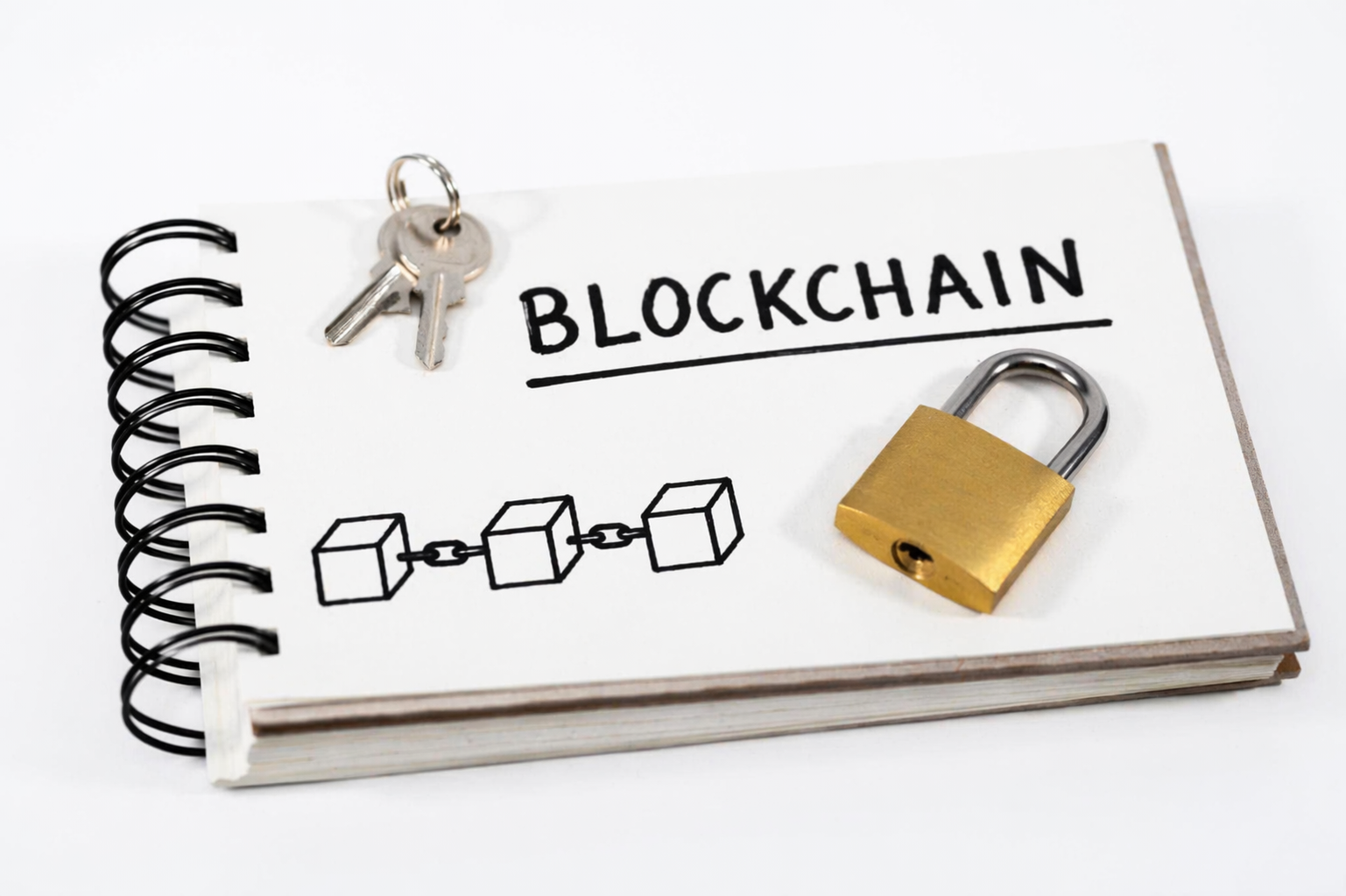
- Everyone has a copy of the same notebook.
- Whenever someone gives money to another person, everyone writes it down.
- After a page is filled with transactions, they close it and add a special code (hash).
- The next page starts with that code, linking both pages together.
Now, suppose someone tries to cheat by erasing a transaction. The hash will change, and it will no longer match the other notebooks. Since everyone else has the correct version, the cheating attempt is easily caught.
Step-by-Step Example
Let’s take a simple example with 5 friends: Aman, Riya, Rahul, Sneha, and Karan.
Step 1: Recording a Transaction
Aman gives ₹100 to Riya.
All five friends write this transaction in their notebooks.
Step 2: Filling a Page (Block)
After recording 10 such transactions, the page is full. This page becomes a block.
Step 3: Adding a Hash
They calculate a special code (hash) for the page and write it at the bottom.
Step 4: Linking the Next Page
The next page starts with the previous page’s hash. This connects the pages.
Step 5: Detecting Tampering
If Riya tries to erase Aman’s payment:
- The hash of that page changes.
- It no longer matches the copies held by others.
- Everyone immediately knows something is wrong.
This is exactly how blockchain ensures trust without needing a central authority.
Key Features of Blockchain
Let’s summarize the important features:
- Distributed Ledger: Data is shared across many computers.
- Secure: Uses cryptography to protect data.
- Transparent: Everyone in the network can verify transactions.
- Tamper-Resistant: Changes are easily detected.
- Decentralized: No single person controls the system.
Real-Life Uses of Blockchain
Blockchain is not just a theory—it is already used in many areas:
- Cryptocurrency
Digital currencies like Bitcoin use blockchain to record transactions securely. - Banking and Finance
Banks use blockchain for faster and safer money transfers. - Supply Chain Management
Companies track products from factory to customer using blockchain. - Healthcare
Patient records can be stored securely and shared safely. - Voting Systems
Blockchain can make voting more transparent and fraud-free.
Why Blockchain Matters
In traditional systems, we rely on a central authority like a bank or a company to manage records. This creates risks such as:
- Data manipulation
- System failure
- Lack of transparency
Blockchain removes the need for trust in a single authority. Instead, trust is built into the system itself using technology.
Conclusion
Blockchain is a powerful technology that changes how we store and share information. It works like a shared notebook where every page is connected and locked with a special code. Because of this structure, it becomes very difficult to cheat or manipulate data.
By using many copies (distributed system) and linking blocks (hashing), blockchain creates a system where people can trust the data without needing a central authority. This makes it secure, transparent, and reliable.
As technology continues to grow, blockchain is expected to play an even bigger role in our daily lives—from digital payments to secure data sharing and beyond.
Blockchain isn’t just a technology—it’s a redefinition of trust in the digital world. The idea that data can be transparent, immutable, and decentralized at the same time is truly revolutionary. This was explained beautifully!